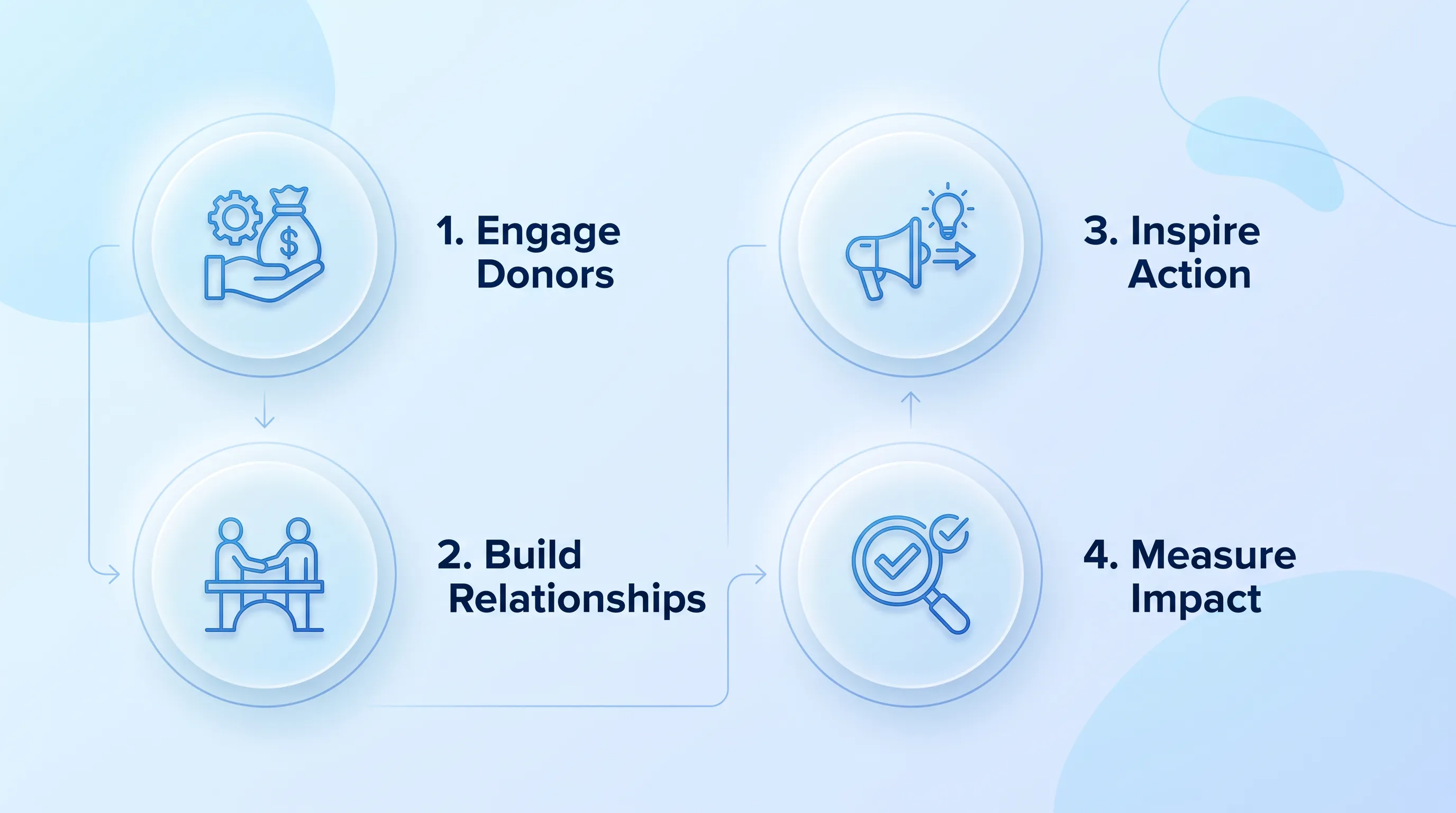
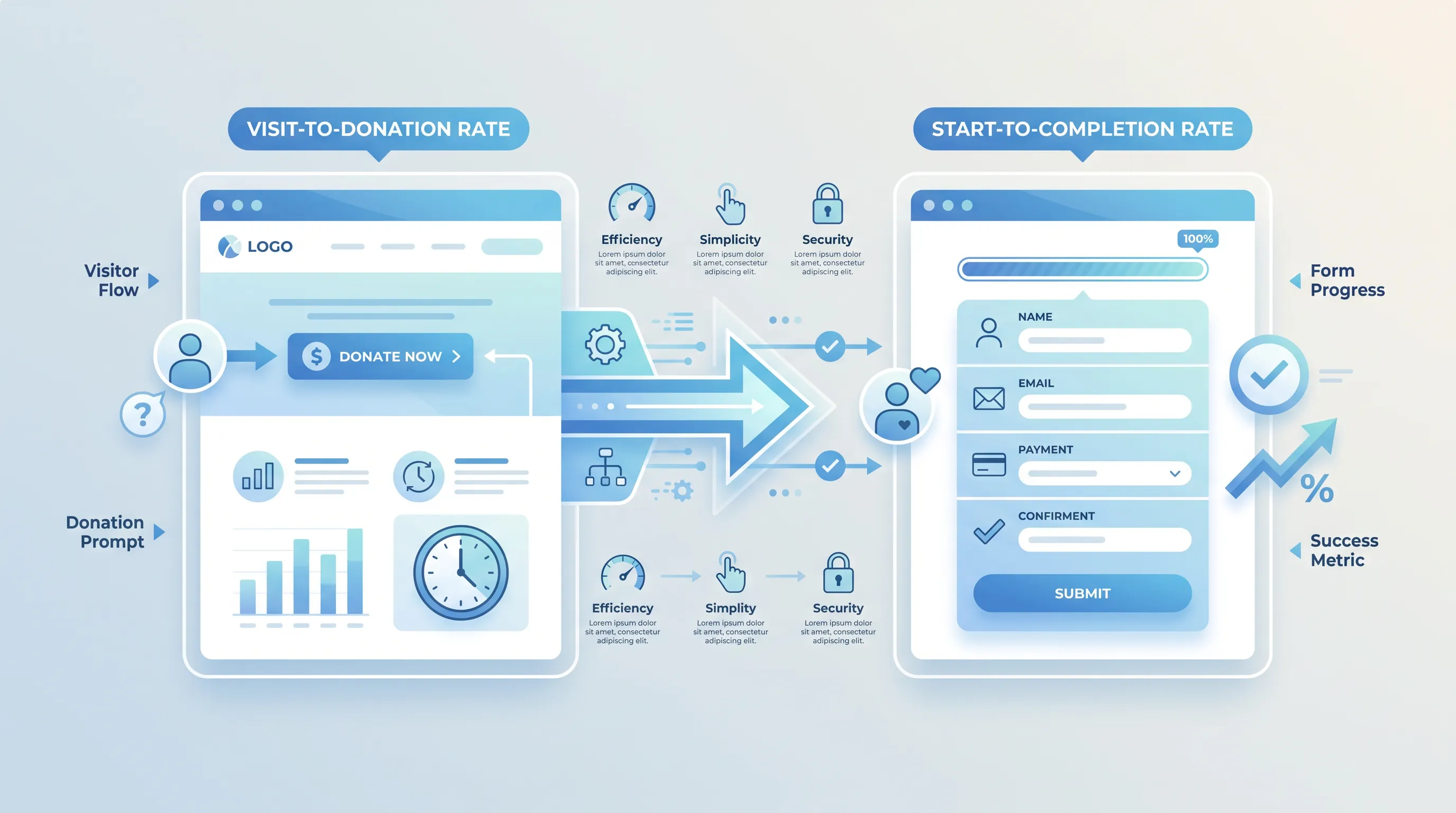
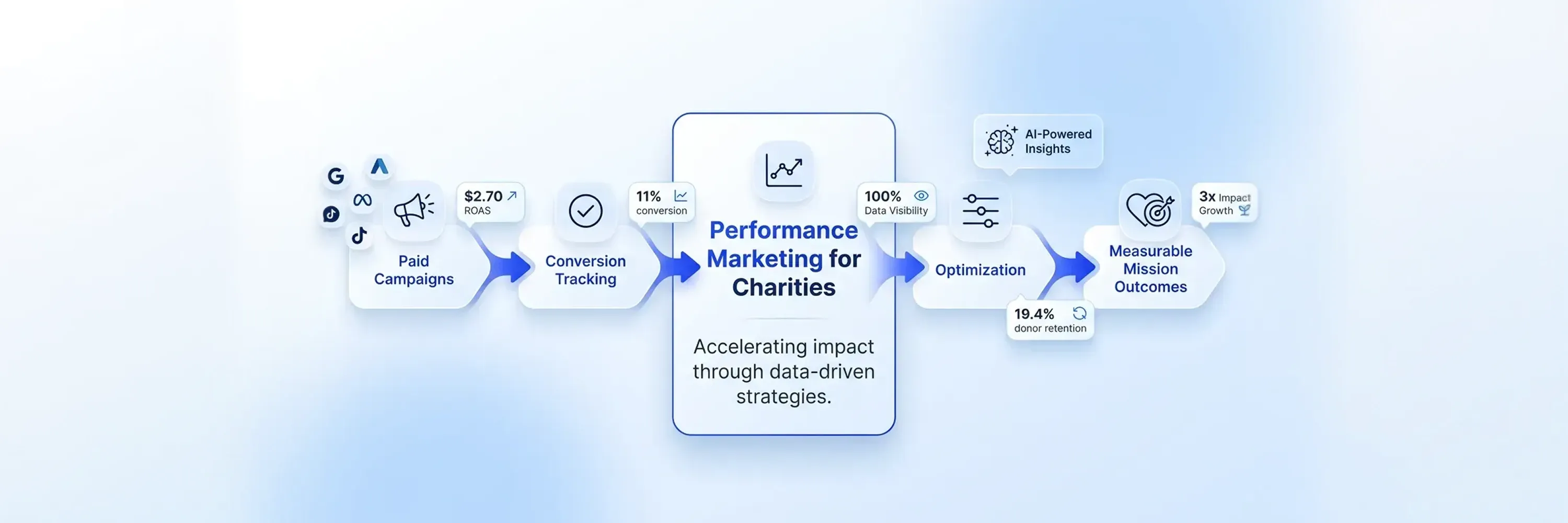
Performance marketing workflow for charities showing paid campaigns, conversion tracking, AI-powered optimization, and measurable mission outcomes connected through a data-driven marketing framework.

Performance Marketing for Charities with Measurable Impact

This article explains how charities can run paid campaigns that produce results tied directly to mission outcomes rather than vanity numbers. It covers the channels worth using, the analytics setup that makes spending defensible, and how AI search is rewriting the way donors find causes online.

Content authorSnoika FoundationPublished onReading time12 min read

Why charities need performance marketing now

Donor attention is splintering across feeds, inboxes, and answer engines, and the old habit of buying brand awareness and hoping it converts no longer pays the bills. Performance marketing for charities has shifted from a nice-to-have to the baseline expectation for any fundraising team that wants to defend its budget. According to the M+R Benchmarks 2024 study, digital ad investment grew 13% year over year while overall return on ad spend dipped, which means more dollars are chasing the same supporters.

The charities pulling ahead are the ones treating every paid impression as accountable to a donation or a volunteer application. Search alone produced a $2.70 return on ad spend for nonprofits in 2024, but only for teams with the tracking to prove it. Early movers in performance marketing for charities are already locking in the donors that late movers will pay double to reach next year.

What performance marketing means for nonprofits

In a charity context, performance marketing is paid activity tied to a specific, trackable outcome. That outcome is a first donation, a recurring gift, a petition signature, a volunteer form, or a major-gift inquiry.

Performance marketing for charities forces a different kind of decision-making. Instead of asking "does this campaign feel on-brand," the team asks what each pound or dollar produced and whether the channel earned the next round of spend. That mindset matters more now because AI-mediated discovery is compressing the funnel. When a donor asks ChatGPT "which charities work on ovarian cancer research," the organisations with clean conversion data and clear positioning are the ones that surface and convert.

A practical contrast helps. An awareness campaign reports 2 million impressions and a lift in brand recall. A performance campaign reports 1,847 new monthly donors at a cost per acquisition of £28, with an expected lifetime value of £312. One pays the programme team. The other pays the agency.

Paid channels that deliver for charities

In performance marketing for charities, channel choice should follow the supporter. The right mix depends on where your audiences spend time and which platforms can actually report a donation back to the campaign that drove it. Most charities under £5m in income do well with two or three channels run properly rather than six channels run badly.

The Google Ad Grant is the obvious starting point, but treating it as the whole strategy is a mistake. It is a search-only programme with strict compliance rules, and it cannot reach people who are not already typing your cause into Google. Real performance marketing for charities means layering paid search and paid social on top of the Grant, with AI-answer visibility treated as part of the same acquisition system.

Google Ads and the Ad Grant

Google Ad Grants gives qualifying nonprofits up to $10,000 per month of in-kind search advertising. Used well, it is a steady stream of high-intent traffic from people searching for help, ways to give, or information about your cause. Used badly, it burns through impressions on broad keywords and gets the account suspended for falling below the 5% click-through rate threshold.

The keyword strategy that works concentrates on high-intent phrases. Think "donate to refugee charity UK" or "how to leave a charity in your will." When demand outstrips the $10,000 cap, supplement with a paid Google Ads account for branded terms and competitor bidding, since the Grant cannot bid aggressively on top positions.

Common pitfalls to avoid:

  • Sending traffic to a homepage instead of a campaign-specific landing page with a single ask

  • Using broad match keywords without negative keyword lists, which wastes the monthly budget on irrelevant clicks

  • Ignoring conversion tracking, which is now a mandatory compliance requirement and the only way to know if any of this is working

Meta and TikTok charity performance ads

Facebook and Instagram remain the workhorses for direct-response fundraising and recurring donor acquisition. Charity performance ads on Meta convert best when the creative leads with a beneficiary story and a clear ask in a short-form video that runs under 30 seconds. TikTok is the newer entrant, and its audience skews younger. Movember's partnership with TikTok, where the platform donated £1 per video up to £10,000, shows how the channel works for awareness and acquisition layered together.

Tracking is the part most charities get wrong. Since January 2025, Meta restricted pixel and Conversions API data on domains flagged under sensitive health categories or social and political categories, which affects a large slice of the sector. The fix is a combined Pixel and Conversions API setup with custom server-side events for donation_complete and fundraising_signup, so the algorithm still learns from your conversions even when browser tracking is blocked.

Charity performance ads on TikTok need their own creative pipeline. Repurposed broadcast spots fail. What works is unpolished founder or beneficiary footage, captions, and a hook in the first two seconds.

Programmatic and connected TV

Programmatic display and connected TV (CTV) become viable once a charity has a working search and social programme producing trackable conversions. The 2024 M+R data showed CTV spend rising 50% year over year among nonprofits, which is why upper-funnel share now sits at 25% of total ad investment. These channels reinforce messaging during major appeal seasons like year-end or disaster response and lift conversion rates on the channels running beneath them.

The warning is straightforward. Without view-through attribution and proper measurement tied to nonprofit growth metrics, CTV becomes an expensive brand exercise that no finance director will renew. Run it only when you can show how it influenced conversions elsewhere.

Search visibility in AI answer engines

Donor discovery is moving into conversation. People ask ChatGPT and Google's AI Overviews for recommendations instead of scanning a results page. Alisa Scharf, vice president of AI and innovation at Seer Interactive, told the 2026 Nonprofit Fundraisers Symposium that "the landscape is getting really messy," and warned that traffic "is not the leading indicator that it once was."

The practical steps are not mysterious. Audit how your charity is described when you query it in each major AI tool, then fix the gaps. Structure content with clear cause positioning, named programmes, geographic focus, and measurable impact statements so the models can extract and cite them. Earn third-party coverage from press, sector reports, and Wikipedia, because those are the sources answer engines pull from. This work is paid-adjacent, but it directly affects whether your performance media has a brand to convert against.

Building an analytics stack for mission outcomes
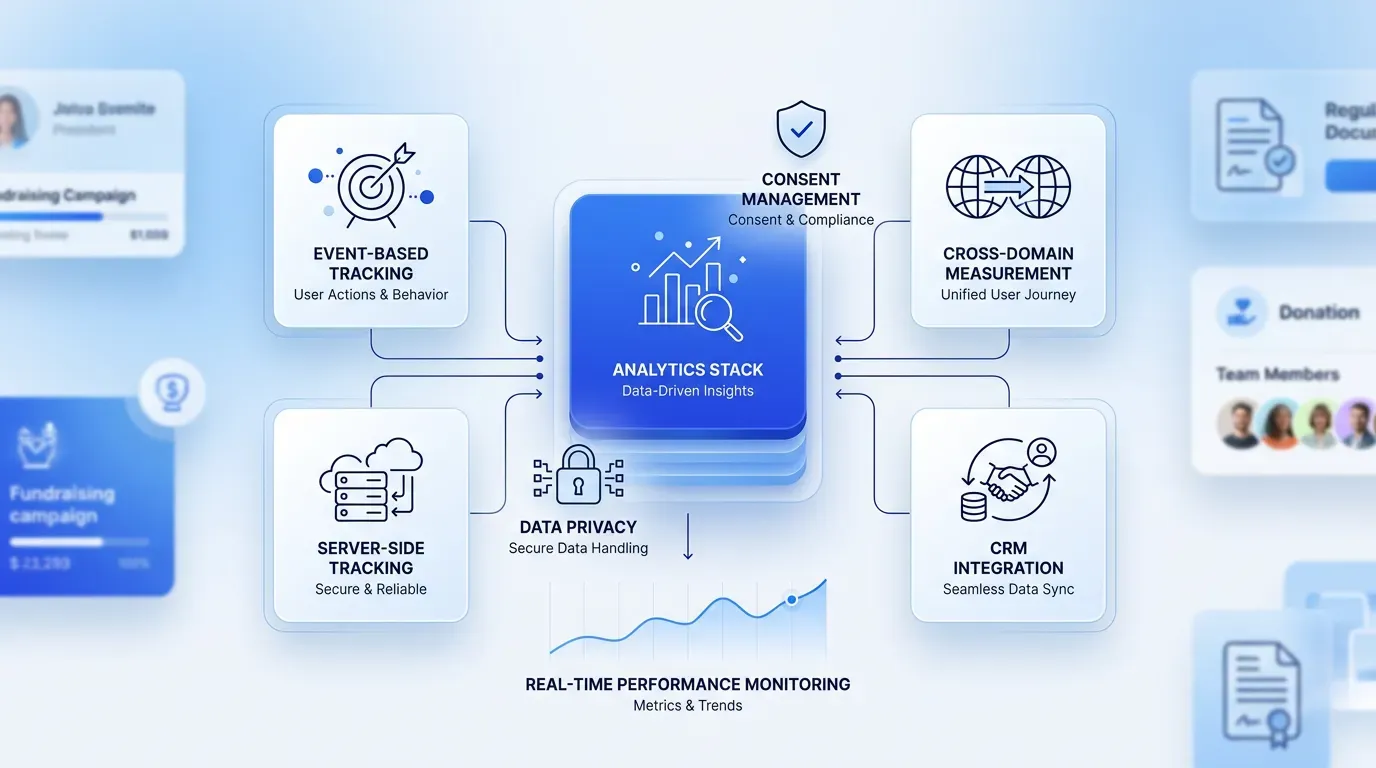
A clean SaaS UI illustration featuring a central blue analytics module surrounded by rounded modules with minimal icons, set against a soft blue gradient.

Without proper measurement, every tactic in this article on performance marketing for charities is guesswork dressed up in a dashboard. The minimum analytics stack for performance marketing for charities has four components: Google Analytics 4 (GA4), server-side tracking, CRM integration, and consent management.

GA4 is the baseline. It uses an event-based data model rather than the old session-based one, so you track actions like donate_click and recurring_gift_started as distinct events. Set up cross-domain measurement if your donation form sits on a separate domain like Donorbox or JustGiving, otherwise GA4 will start a new session at the worst moment and break attribution.

Server-side tracking through Google Tag Manager Server or a similar setup matters because browser-based tracking keeps degrading. Safari blocks third-party cookies by default, and ad blockers cover roughly a third of users. Server-side moves the data collection point to your own infrastructure, which you control and which platforms still accept.

CRM integration is where most charities stall. The donation that GA4 records is the same human that your fundraising team is stewarding in Salesforce or Beacon, and the two systems must talk. Without it, you cannot calculate lifetime value or prove to the board that paid media is producing real supporters rather than one-off transactions. Consent management on top of all this is non-negotiable under the General Data Protection Regulation (GDPR) and similar privacy rules, and first-party data captured with proper consent is now the most valuable asset a charity owns.
Nonprofit growth metrics that actually matter

Most charity dashboards are crowded with numbers that do not change a single decision. The shortlist of nonprofit growth metrics worth reporting weekly is shorter than people think, and it should connect every line to mission outcomes.

The metrics that earn their place on the weekly review:

  • Cost per acquired donor (CPA), split by channel and campaign

  • Return on ad spend (ROAS), with the M+R search benchmark of $2.70 as a useful reference point

  • 12-month lifetime value (LTV) of new donors acquired through paid media, separated for one-time and recurring givers

  • Cost per service delivered, calculated by dividing channel spend by the programmatic outcome the donations funded

  • New donor retention rate at 90 days, which the Fundraising Effectiveness Project pegs at a sector average of 19.4%

Industry benchmarks for performance marketing for charities are thin and unhelpful, because a £5 cost per donor for an emergency appeal is not comparable to £85 for a planned-giving lead. Set internal benchmarks instead. Use the median from your last four quarters of campaign data as the bar to beat. The point of nonprofit growth metrics is to know whether this quarter beat last quarter.

When presenting to boards, drop the acronyms. "We acquired 1,200 new monthly donors at £34 each, and at our current retention rate that funds 4,800 counselling sessions over three years" lands harder than a chart titled CPA by channel. Trustees fund outcomes.

Optimization routines that compound results

Performance gains come from rhythm. The teams that compound results in performance marketing for charities run the same boring routines every week and let the small improvements stack up over a year.

The weekly routine is short and disciplined:

  1. Review CPA and ROAS by campaign, pause anything more than 30% above target for two consecutive weeks

  2. Refresh creative on the top-spending ad set, since fatigue sets in fast on Meta and TikTok

  3. Check landing page conversion rate against the previous four weeks and queue one A/B test for the following week

  4. Reallocate 10–15% of spend from the worst-performing channel to the best-performing one

Monthly work is where the bigger swings happen. Refresh audiences on Meta with new lookalike seeds drawn from your CRM, and run a landing page experiment on the donation form itself. M+R found that donation pages convert at around 11% on desktop and 8% on mobile, so a one-point lift on the page outperforms a month of media tweaks.

The trap to avoid is optimising for clicks divorced from outcomes. Lower CPC looks like progress until you notice the new traffic does not donate. Tie every test back to a mission-linked KPI, and you stay honest.

Performance marketing for charities in an AI-first era

The next 12 to 18 months will reshape both the buying side and the discovery side of paid media. On the buying side, automated bidding is already standard, and Meta's Andromeda update and Google's Performance Max are pushing charities toward AI-driven optimisation that depends on clean conversion signals. The platforms that learn from your data will outperform the teams trying to outsmart them with manual rules.

AI-generated creative is the second shift. Static image production costs are falling, and the bottleneck is moving to strategy, briefing, and which assets to test. Charities that build a creative testing pipeline for charity performance ads now, with five to ten variants per campaign rather than one hero asset, will spend the same budget and learn ten times faster. The ones still commissioning a single annual film will be outpaced.

On the discovery side, the shift from keyword search to conversational discovery is the bigger story. As CauseMatch puts it, "keyword collapse" means donors no longer type "cancer charity" but full sentences describing what they want to support. Performance marketing for charities in this environment depends on clean first-party data the platforms can optimise against and disciplined measurement that connects every dollar to a mission outcome, while clear cause positioning gives AI models something accurate to summarise. Charities that have these in place by the end of 2026 will benefit disproportionately as platforms automate further.

Where to start this quarter

If you read this far and have a planning meeting next week, here is the shortlist that produces the most leverage in the next 90 days for performance marketing for charities of any size.

  1. Audit your current tracking. Open GA4 and confirm donations are firing as conversions, then verify that CRM integration is matching online gifts back to donor records.

  2. Pick one channel to professionalise. Resist the urge to add three. If you have Google Ad Grants but no paid Google Ads account, that is your starting point. If Meta is already strong, look at TikTok or CTV.

  3. Define two or three mission-linked nonprofit growth metrics and put them on a weekly dashboard. Cost per acquired donor and 90-day retention are a defensible starting pair.

  4. Book two hours to review your AI search visibility. Query your charity in ChatGPT and Google AI Overviews. Note what is wrong and what is missing, then assign the fixes.

Wrapping up

Performance marketing for charities increasingly depends on measurable outcomes rather than activity metrics alone. This article examined how paid channels, analytics infrastructure, AI-driven discovery, and mission-focused reporting influence fundraising performance. It also outlined the systems and optimization routines that help charities connect campaign spending directly to donor acquisition and long-term impact. As donor journeys continue shifting toward automated platforms and conversational search, organizations that combine strong measurement with clear positioning will be better equipped to sustain growth and improve fundraising efficiency over time. Get in touch to book a consultation and map out your next quarter.

Start with a budget large enough to generate at least 30 conversions per month on one channel. That gives the platform enough signal to learn and gives your team enough data to judge CPA. If donation volume is low, track a qualified step such as donation form started while you build volume.

Test the landing page and donation flow before you raise spend. Paid traffic exposes friction fast, so check mobile speed and form length, then confirm that the ask matches the ad. A small conversion-rate gain often adds more donations than buying extra clicks.

Yes, small charities can run performance marketing for charities by narrowing the work to one channel and one clear goal. A weekly review of spend and donor quality is enough to start. The key is consistent measurement, because scattered testing drains time and budget.

Measure donor value for at least 12 months after acquisition. A first gift rarely tells the whole story because recurring upgrades and second gifts change the economics. Compare one-time donors and monthly donors separately, since their retention patterns lead to different spending limits.

Use in-house management when your team has time to review campaigns weekly and fix tracking issues quickly. Use an agency when the work needs specialist setup, such as server-side tracking or paid search structure. Snoika Foundation is one example of a partner charities can ask to audit measurement before scaling campaigns.

Book a Demo

Book a time that works best for you

You Might Also Like

Discover more insights and articles

Title:
Paid Search for NGOs: Smarter Campaigns with AI Insights

Meta description:
Stretch your ad budget with paid search for ngos. You will learn how AI insights help you reach active donors and spe

Paid Search for NGOs: Smarter Campaigns with AI Insights

This article is a practical playbook for NGO marketing teams who want to get more from every advertising dollar. It walks through how AI insights and visibility data can sharpen paid search for NGOs working with tight budgets and shifting donor behavior.

Infographic illustrating a nonprofit donor acquisition funnel from search intent and AI-driven discovery through trust evaluation to donation conversion, highlighting visibility, engagement, transparency, and donor growth metrics.

SEO for Fundraising Campaigns: Reaching Donors at the Right Moment

This article walks fundraising leads and nonprofit founders through how SEO for fundraising campaigns can put their cause in front of donors during the short windows when those donors are ready to give. You will learn how building and measurement should adjust as search behavior shifts toward AI-driven discovery.

Infographic showing the progression from storytelling and verifiable facts to technical structure and AI recognition for improved nonprofit visibility and engagement

Content Marketing for Nonprofits That Drives AI Visibility

In this article, we explain how to structure authentic impact stories that build trust and secure verifiable AI search citations. We discuss the transition from traditional search optimization to generative engine frameworks that prioritize evidence-backed narratives.

Illustration comparing a traditional NGO website with an AI-optimized structured content website showing improved discoverability, engagement, and search visibility

SEO Optimization for NGO Websites That AI Can Trust

In this article, we explain how generative AI engines are changing the way supporters discover and engage with mission-driven organizations. We detail practical steps to restructure digital platforms so automated systems can easily verify and cite primary data.