AI Content Generator for Nonprofits: Scale Content Without Losing Authenticity

Content authorArtem LozinskyPublished onReading time11 min read
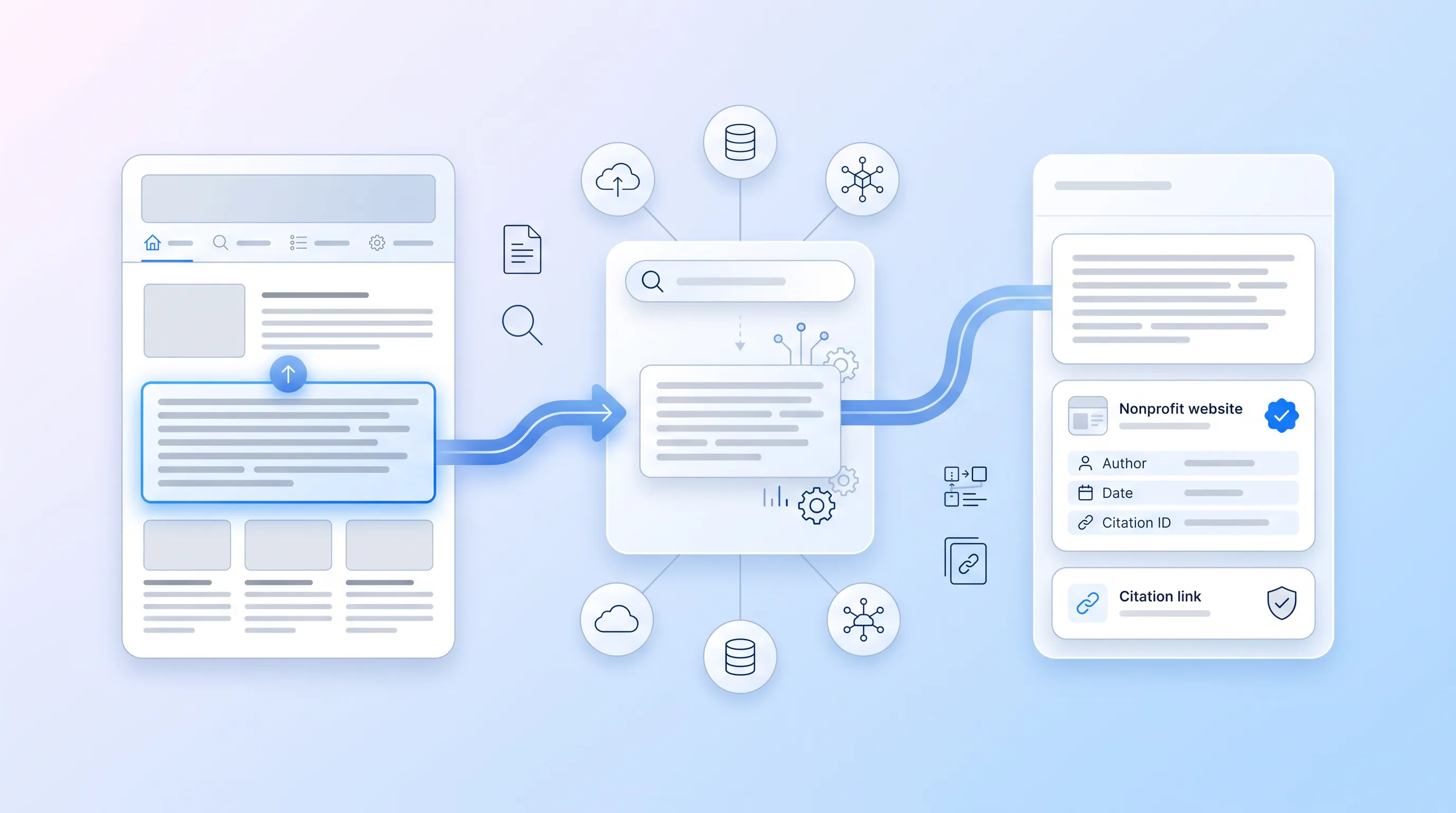
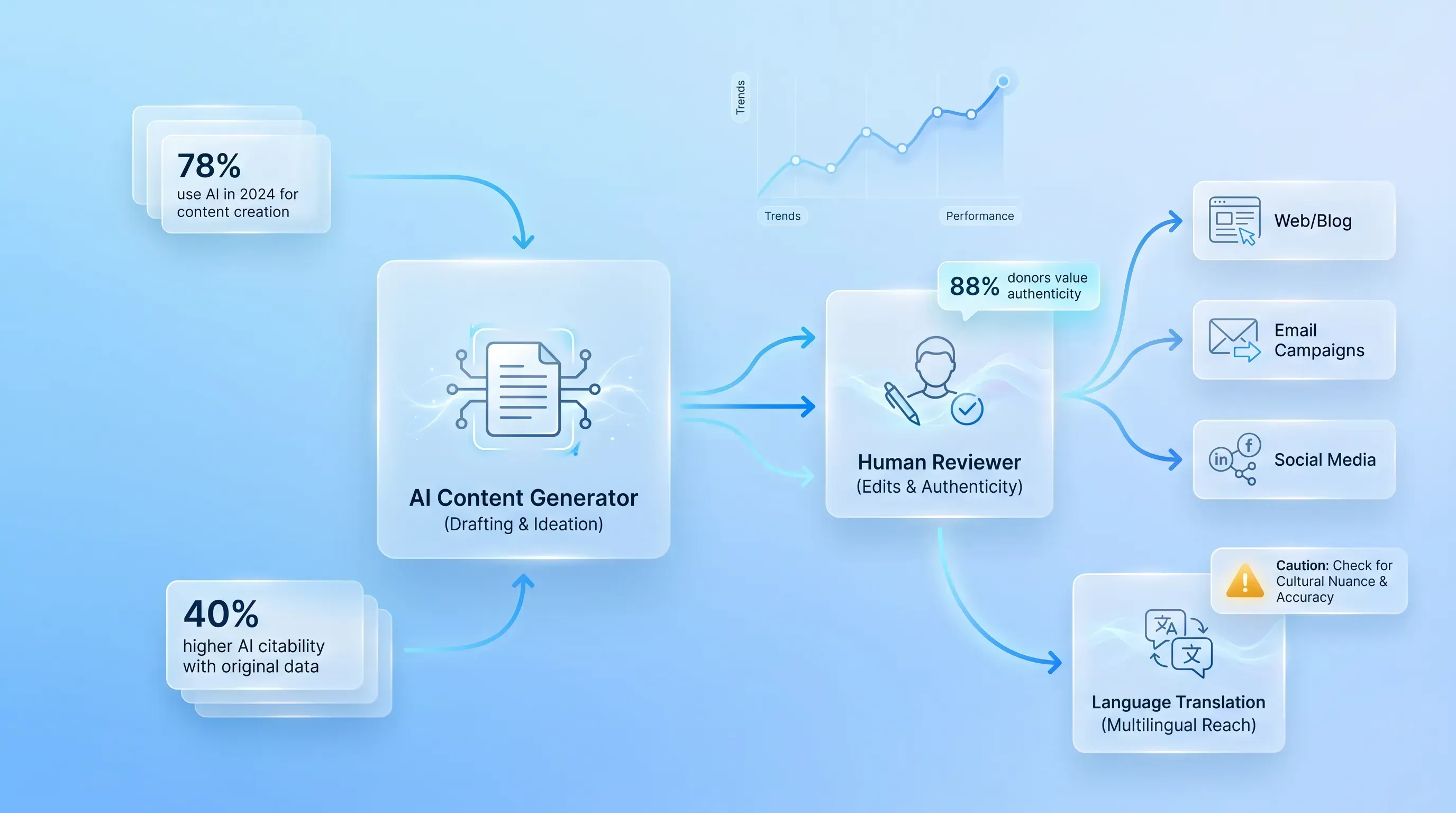
A spacious SaaS infographic featuring translucent cards, icons, and flow lines on a smooth blue gradient background.

This article shows nonprofit communications staff how to use an AI content generator to publish more without flattening the mission-rooted voice that earns trust. It covers where the tools save time and how to keep human judgment in the loop across multilingual outreach and AI search.

Why nonprofits are turning to AI

You already know the squeeze, because you live in it. An AI content generator looks appealing when one person carries the blog and the newsletter while the budget stays flat. Smaller organizations with annual budgets under $1 million devote about one staff member to all of communications, according to the 2024 Nonprofit Communications Trends Report. That's the reality behind the to-do list.

The tools have become hard to ignore. Google for Nonprofits now reaches more than 300,000 organizations and offers AI features to eligible groups free or at discounts of more than 70%. Many nonprofits already qualify through their 501(c)(3) status. So the question stops being whether the tools exist and becomes whether you can use them without sounding like everyone else. That's the tension this article resolves. The goal is more output while you hold onto the human voice that makes donors believe you.

What an AI content generator does

An AI content generator is software that drafts text from a prompt. You describe what you need, a newsletter intro or a set of headline options, and it returns a draft in seconds. The strongest models pull patterns from enormous amounts of writing, which means they're good at structure and reformatting. They're weak at knowing what actually happened in your programs last month.

That distinction matters more for you than for most users. The tool can outline a blog post about your after-school program. It can't know the name of the kid who learned to read there, or why your director changed the curriculum in March. So the honest way to picture an AI content generator is as a fast first-draft machine that sits early in your existing workflow, before the editing and fact-checking you'd do anyway.

Set expectations accordingly, because the tool will sound confident even when it's wrong. ChatGPT-generated medical content contained 16% fabricated references in one study, and it defends false claims when challenged. Treat every output as raw material. You shape and verify it before you decide what reaches your audience.

Where AI content saves nonprofits time

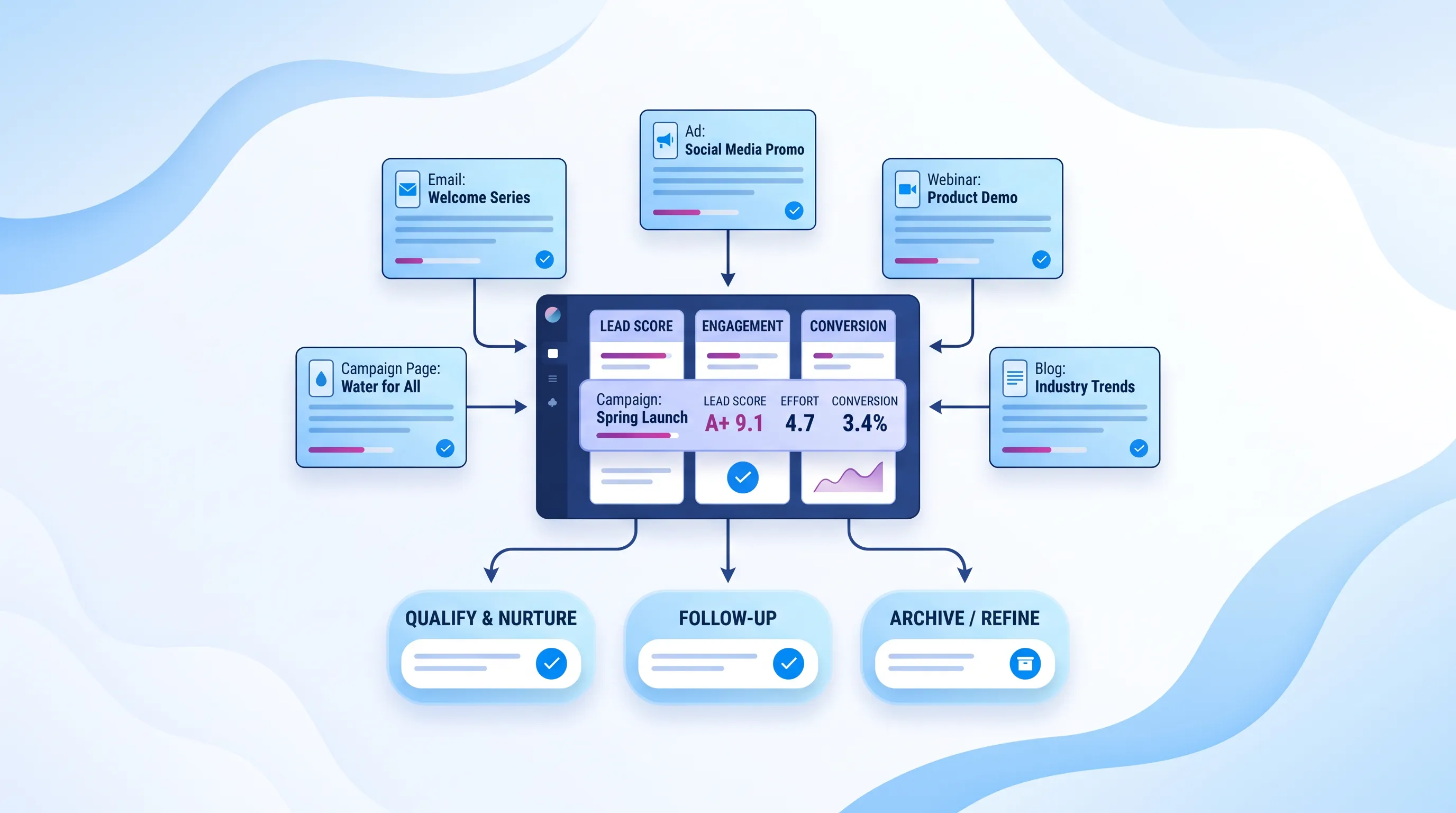
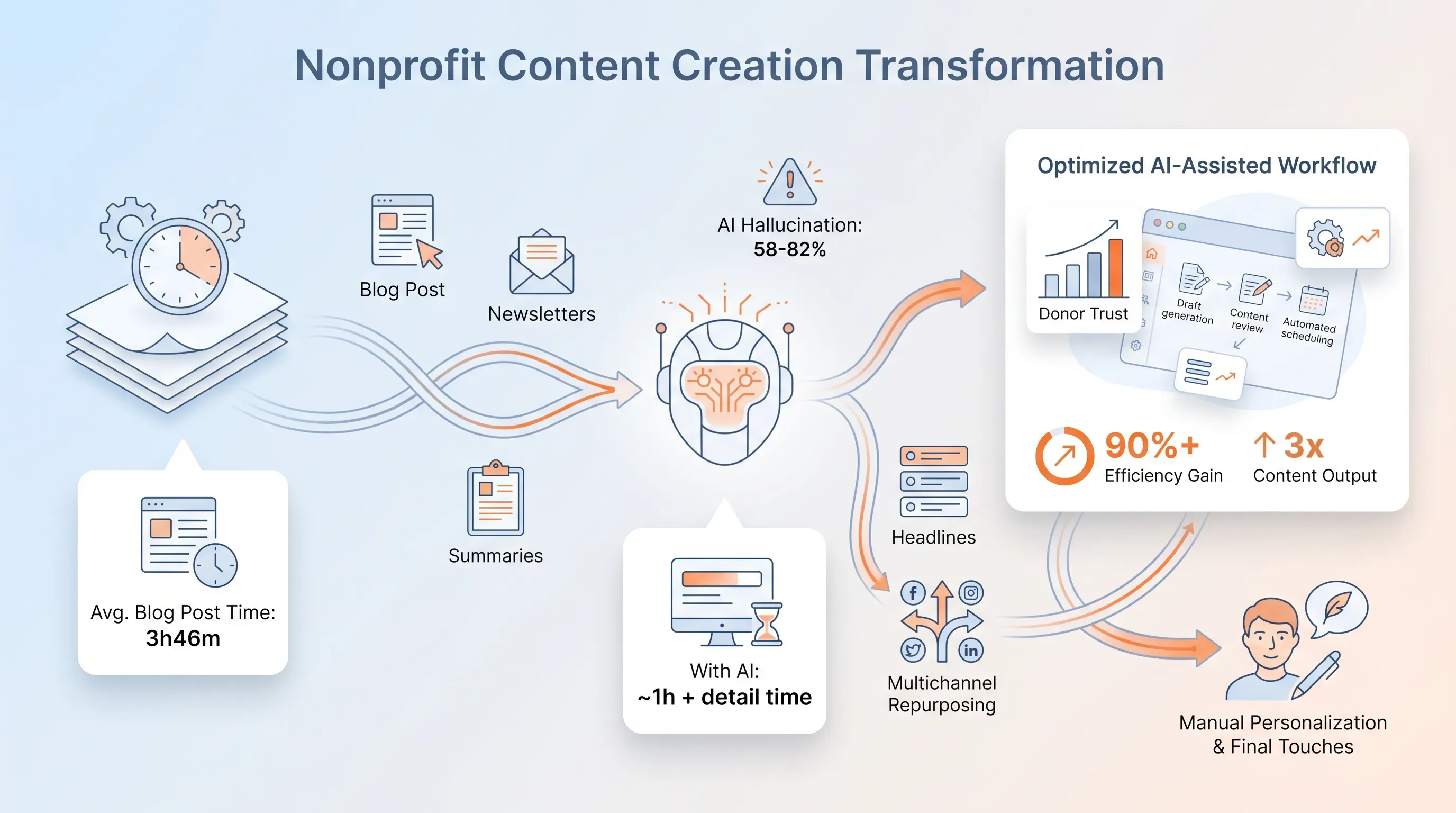
Infographic illustrating nonprofit content creation's evolution from manual tasks to AI-assisted workflows, featuring icons and stats.

The value shows up in specific, repeatable tasks. The use cases below start with the safest and highest-return work, the kind you can hand off without much risk, and move toward the work that still needs your hands on it. Each one assumes you already produce this content manually and want to move faster.

Blog posts and articles

The average blog post takes 3 hours and 46 minutes to write, according to the Content Marketing Institute. An AI content generator compresses the front half of that. Ask it for a rough first draft from your bullet points or eight headline variations, and you skip the blank-page paralysis that eats your morning.

What you save on structure, you spend on substance. The model can't know your program data or the story of one family you serve. Those are the parts that make people read to the end. So the realistic before-and-after for a small team looks like this: a post that used to take an afternoon now takes about an hour of drafting plus the time you reinvest in real detail. You move faster without thinning out what's true.

Need help with your AI visibility?

Book a free consultation with our experts we'll help you determine exactly which services your organization needs.

Newsletters and campaign copy

Newsletters break into predictable parts, which is exactly what these tools handle well. Use an AI content generator to draft section summaries from your raw updates, then ask it for subject-line options you can A/B test. Awareness campaigns work the same way, since you can spin up several message variations and refine the ones that land.

Donor-specific tone still needs your hand. A 20% boost in personal connection drives a 12% increase in donor trust, per the Nonprofit Alliance research on trust drivers. A model doesn't know that your major donor lost a family member to the cause you fight, or that your monthly givers respond to plainspoken gratitude rather than polish. Try this approach this week: draft the skeleton with AI, then write the opening and the ask yourself.

Educational resources

For FAQs and guides, an AI content generator helps you structure information your community needs. It can turn a dense policy change into a plain-language FAQ outline or organize a how-to guide into clear steps. That scaffolding saves real time when you're building resources from scratch.

The accuracy stakes climb here, because people act on what you publish. If your guide explains how to apply for a benefit or what a diagnosis means, an error causes harm. General-purpose models hallucinated on 58% to 82% of queries in a Stanford study of specialized research tasks. Anything your audience will rely on, you verify against a primary source before it goes out. That responsibility stays with you.

Nonprofit content automation workflows

The biggest gains come from chaining tasks together. A single impact report can become a blog post and a newsletter section. That's the core of nonprofit content automation: you write or commission the source material once, then use the tool to reshape it for each channel. Ross Simmonds of Foundation Marketing told Orbit Media that turning one post into channel-ready pieces used to take "an entire afternoon," and now takes seconds with repurposing tools. You don't need engineers to set this up. A lightweight nonprofit content automation routine can run inside the free tools many of you already have.

Here's a simple chain to start with:

  • Feed your finished impact report into the generator and ask for a blog draft aimed at supporters.

  • Pull the same report into a short newsletter section and a handful of social captions.

This multiplies one piece of verified source material without multiplying the verification work, since the facts were already checked once. Done right, nonprofit content automation gives a one-person team the output of three.

Keeping your content authentic

Here's the fear worth naming. You worry that AI will sand your voice down to the same beige copy every other organization is now publishing, and that your supporters will feel it. They will. Authenticity is the ground your credibility stands on. One poll found 88% of donors say authenticity is a key factor in deciding which organizations to support.

The risk is real because the technology pulls toward the average. AI systems are more strongly associated with socially dominant groups in natural language, one 2024 analysis found, which means an unedited draft can quietly misrepresent the communities you serve. The model writes what's statistically common, and your work is valuable precisely because it isn't common.

So the guardrails are about feeding the tool what it can't invent. Brief it on your brand voice with real examples of past writing you're proud of. Give it actual quotes and details from the people you serve instead of asking it to imagine them. Fundraise Up's analysis of donor messaging found that using a community's exact words beats polished buzzwords, and a model can't generate words it never heard. The firsthand experience is yours to insert. When you do, the draft stops sounding like a machine and starts sounding like you again.

Need help with your AI visibility?

Book a free consultation with our experts we'll help you determine exactly which services your organization needs.

Editorial oversight and credibility

Keeping a human in the loop is the difference between a tool that helps and a tool that embarrasses you. The gap is wide right now. In 2024, 78% of organizations used generative AI in marketing or fundraising, yet only 42% had any policy governing it, according to Fundraise Up. That gap is where inaccurate or off-brand content slips through.

A short, repeatable review closes it before each piece publishes:

  1. Fact-check every claim and supporting detail against a primary source, since the model fabricates confidently.

  2. Read for bias or stereotyping of the communities you serve, because biased training data perpetuates stereotypes through generated content.

  3. Assign one named person to give final sign-off, even on a team of one.

That last step matters legally and reputationally. An attorney in Mata v. Avianca filed a brief with nonexistent citations that ChatGPT invented, and the court noticed. Your stakes differ, but the lesson holds. Consistent oversight protects the credibility you spent years building. Skip it once and you can lose more trust than the tool ever saved you in time.

Publishing in multiple languages

For communities you serve in their own languages, an AI content generator opens reach you couldn't afford before. More than 25 million people in the United States were identified as Limited English Proficient in 2019, per the Migration Policy Institute. Translation that once meant hiring contractors you couldn't pay for now starts as a draft in seconds, which puts multilingual outreach within reach of a team without translators.

Be honest about the limits, because translation is where AI fails in ways that wound. One analysis found AI tools misinterpret culturally specific phrases roughly 40% of the time, against an error rate below 5% for professional human translators. Sensitive terminology and cultural nuance are exactly what the model botches. A literal rendering can turn a respectful message into a confusing or offensive one.

That's why native or fluent human review isn't optional before you publish in another language. The AI draft saves the first 80% of the effort, and a fluent reviewer catches the 20% that decides whether the community feels respected or talked down to. Connect this to your mission directly. If you serve people in Spanish or Somali, reaching them in their own language puts equity into practice. The tool gets you started, but a human who speaks the language makes it safe to send.

Staying visible with AI powered publishing

How people find you is changing under your feet. Nearly 60% of Google searches ended without a click in 2024, per SparkToro's study with Datos, because more people read the answer on the page or ask ChatGPT directly. When an AI Overview appears, link clicks fall from 15% to 8%, Pew Research found after analyzing browsing data from 900 US adults. The link list you used to rank on is shrinking.

Visibility in this new AI powered publishing world comes from being the source the AI quotes. The mechanics of AI powered publishing come down to foundational quality. Lead each section with a direct answer and write headings as the questions people actually ask. Content with original data shows a 40% higher AI citability rate than generic content, according to one analysis of AI Overview citations. None of that is a trick. It's good writing, which serves your human readers too.

And this is where you hold an advantage that AI-generated competitors can't match. The qualities AI search rewards, firsthand experience and original insight, are precisely what pure AI output cannot provide. You have real stories and real program data from the field. A competitor publishing mass-produced AI text has none of that. Effective AI powered publishing means leaning into your firsthand authority, because that's the ground truth these systems are hunting for. The same original reporting that wins donor trust is what gets you cited in AI powered publishing ecosystems.

Building a responsible AI workflow

Pull the threads together and the process is simple enough to run every week. Draft with AI, then run a human review before publishing. The tool amplifies your team. It never replaces the judgment and lived experience at the center of your mission.

Start small. Pick one content type, maybe your newsletter, and run it through this workflow for a month before you expand. ContentBomb is an AI content generator built for teams that need to scale output while keeping editorial control, with workflows for nonprofit content automation and multilingual publishing. If you're ready to publish more without losing your voice, try the AI content generator and see how much it frees you to do.
Need help with your AI visibility?

Book a free consultation with our experts we'll help you determine exactly which services your organization needs.

Use donor stories in prompts only after you have consent and have removed private details. Strip out names, addresses, health information, immigration status, and anything that identifies a person without permission. If the story involves a child, get guardian approval and follow your organization’s safeguarding policy before you draft.

Disclose AI use when it materially shaped the final piece, especially for public reports, educational guidance, translations, or fundraising appeals. A short note is enough. For routine internal drafts, disclosure usually belongs in your internal policy rather than in the published content.

Give the AI content generator a clear brief before asking for a draft. Include the audience, purpose, reading level, approved tone, words to avoid, and two examples of past writing that sound right. Add verified facts and instruct the tool not to invent quotes, statistics, or program details.

Your checklist should cover accuracy, consent, voice, bias, and final approval. Compare each number against the source document, confirm permission for personal stories, remove generic wording, and check whether the content describes communities with respect. Name one person who signs off before publication.

AI can help create drafts, but you should always review the final content before publishing. Verify that any images, quotes, statistics, or references are properly licensed or sourced, and avoid copying text directly from copyrighted materials into your prompts. When in doubt, treat AI output as a first draft and ensure it complies with your organization's copyright and attribution policies.

Book a Demo

Book a time that works best for you

You Might Also Like

Discover more insights and articles

Infographic illustrating the transformation of nonprofits hiring a Google Ad Grants agency, featuring a curved arrow and metrics.

Why Nonprofits Need a Google Ad Grants Agency to Maximize Free Ad Spend

This article explains what it takes to turn a Google Ad Grant into real donations and awareness, and where in-house efforts stall. It walks through setup and compliance, then follows the path from targeting to tracking so you can decide whether charity Google Ads support fits your organization.

Infographic comparing four AI marketing automation tools for nonprofits, featuring a central white board with soft shadows and muted blue icons.

Best AI Marketing Automation Tools for Nonprofits and NGOs

This article compares AI marketing automation tools for lean nonprofit and NGO teams across the jobs that eat your week, especially email and segmentation, while the discussion also covers scheduling and the reporting demands that come with multilingual outreach. It weighs honest strengths and trade-offs, then closes with implementation steps sized for a one- or two-person team.

Title:
How an AI SEO Content Generator Helps NGOs Rank in Google and AI Search Engines

Meta description:
With this AI SEO content generator guide, you will learn to write steady posts that rank your

How an AI SEO Content Generator Helps NGOs Rank in Google and AI Search Engines

This article explains how a small NGO communications team can use an AI SEO content generator to publish steady, well-structured content that performs in both Google and AI search engines. It walks through keyword research and a repeatable publishing workflow, with practical steps you can copy.

Title:
AI Blog Writer for NGOs: Faster Content Creation Without Losing Your Voice

Meta description:
When you use an AI blog writer, you can draft nonprofit updates faster and guard your voice.

Artic

AI Blog Writer for NGOs: Faster Content Creation Without Losing Your Voice

This article explains how a small nonprofit communications team can use an AI blog writer to keep up with a demanding content calendar without sounding generic or breaking donor trust. It walks through the content types AI drafts well and the human review steps that keep work accurate, then shows how to protect your voice as you reach more people in more languages.