AI Blog Writer for NGOs: Faster Content Creation Without Losing Your Voice

Content authorArtem LozinskyPublished onReading time12 min read
Title:
AI Blog Writer for NGOs: Faster Content Creation Without Losing Your Voice

Meta description:
When you use an AI blog writer, you can draft nonprofit updates faster and guard your voice.

Artic

This article explains how a small nonprofit communications team can use an AI blog writer to keep up with a demanding content calendar without sounding generic or breaking donor trust. It walks through the content types AI drafts well and the human review steps that keep work accurate, then shows how to protect your voice as you reach more people in more languages.

Why nonprofit teams feel stretched

You run communications for a cause you believe in, and on most weeks that means feeding a blog and supporter updates by yourself or with one other person. The calendar never shrinks. The budget rarely grows. And every piece of content competes with the dozen other jobs you were hired to do.

The pattern is well documented. A 2025 survey of nonprofits by TechSoup found that 33% already use AI tools for content marketing, which tells you how many teams are looking for a way to keep up. Capacity is the wall they keep hitting. Only 25% of nonprofits have a documented content strategy, which has less to do with skill than with time, because the person who would write that strategy is already writing everything else.

That gap between what you want to publish and what you can actually produce is the real problem here. An AI blog writer is one form of blog writing software built as a practical response to it. It is a way to move drafts forward when your hours run out before your ideas do. The rest of this piece is about using that help without losing what makes your organization sound like itself.

What an AI blog writer actually does

An AI blog writer is software that produces written drafts from instructions you give it. You type a prompt that describes what you need and paste in any background material, and the tool returns a draft or a rewrite of something you already have. The output reflects what you feed it, which means a vague prompt gives you a vague draft and a detailed one gives you something closer to usable.

The quality depends almost entirely on context. Give the tool your interview notes and past posts that contain your facts, and the draft starts in the right neighborhood. Give it a one-line request and it fills the gaps with generic phrasing or, worse, invented detail. A 2025 review of large language models found that even strong systems carry a hallucination rate around 5%, and weaker ones reach 20 to 25%. Those fabricated facts arrive in confident, fluent sentences, which is exactly why they slip past a tired reader.

So set the expectation now. An AI blog writer is a drafting assistant that supports the judgment you bring from your mission knowledge and supporter relationships. It speeds up the blank-page part of the job. You still own everything that makes the work true and yours.

Nonprofit content an AI blog writer handles well

Not every piece of content carries the same risk or the same payoff. The smart move is to point AI at the work that's structured and repetitive, where it saves you the most time, and keep tighter control over the work that depends on trust. Here are four formats from your weekly load. Each one shows the tool's draft role, then clarifies your role and the time you get back.

Educational and explainer posts

Posts that explain your cause and how your programs help are a strong fit for blog writing software like an AI blog writer. They follow a predictable structure and lean on research, so AI can produce a clear outline and a readable first draft fast. Ask it to explain why clean water access reduces childhood illness, and it will hand you a framework in seconds that would have taken you an hour to rough out.

What the draft can't supply is your accuracy. You add the local context and link the real numbers from your own programs back to your mission. Every factual claim still needs checking against a real source before it goes live, because the tool will state a wrong statistic as confidently as a right one. The payoff is real though: the structure and the explanatory paragraphs come to you finished, and you spend your time on the facts instead of the scaffolding.

Need help with your AI visibility?

Book a free consultation with our experts we'll help you determine exactly which services your organization needs.

Donor and impact stories

This is where authenticity matters most, so your real material should lead and AI should assist. A donor story or a beneficiary story works because it's true and specific, and supporters can feel when it isn't. So the rule here is simple. You feed the tool real material, and it shapes that material into a draft.

Start with your actual interview notes, where the real quotes you gathered sit alongside the concrete details of what happened. Hand those to blog writing software like the AI blog writer and ask it to organize them into a story arc. Then you add the emotional weight and the specifics that move people to give. What you must never do is let the tool invent story material to fill a thin spot. Trust is the most valuable thing your organization holds, and one fabricated story can cost you years of it. The tool arranges what's real. You guard what's true.

Newsletters and updates

Your newsletter is where an AI content generator earns its keep, because the work is repetitive and the stakes are low. Drop in your scattered updates from the month and the tool will draft a coherent issue. Paste a published blog post and ask it to rewrite the piece as an email. Need options for a subject line? It will give you a handful to choose from, which matters when personalized subject lines lift open rates by 26% according to Campaign Monitor.

This is the biggest efficiency win for a stretched team, and the safest place to start. An ai content generator handles the assembly. You still decide which story leads, which update can wait, and you write the personal sign-off that keeps the email feeling like it came from a human who cares.

Here's the division of labor that works:

  • AI drafts the body and subject line options from existing posts

  • You curate the order and add the closing note in your own voice after you cut what doesn't belong

Campaign and landing pages

When a fundraising push is on a deadline, blog writing software such as an AI blog writer helps you draft campaign copy with calls to action and variations for different supporter segments in a fraction of the usual time. A small team rarely has the hours to build an omnichannel set of assets from a single appeal. AI lets you write the core message once and then adapt it for email and the landing page, with social copy drawn from the same source.

The caution is the same as everywhere else, only sharper because money is involved. Every impact number and every promise on a live campaign page has to be verified before it publishes. An AI content generator will happily round your figures or overstate a result to make the copy punchier. Catch that before your donors do. The speed is the gift, and the verification is the price.

Keeping human review in the loop
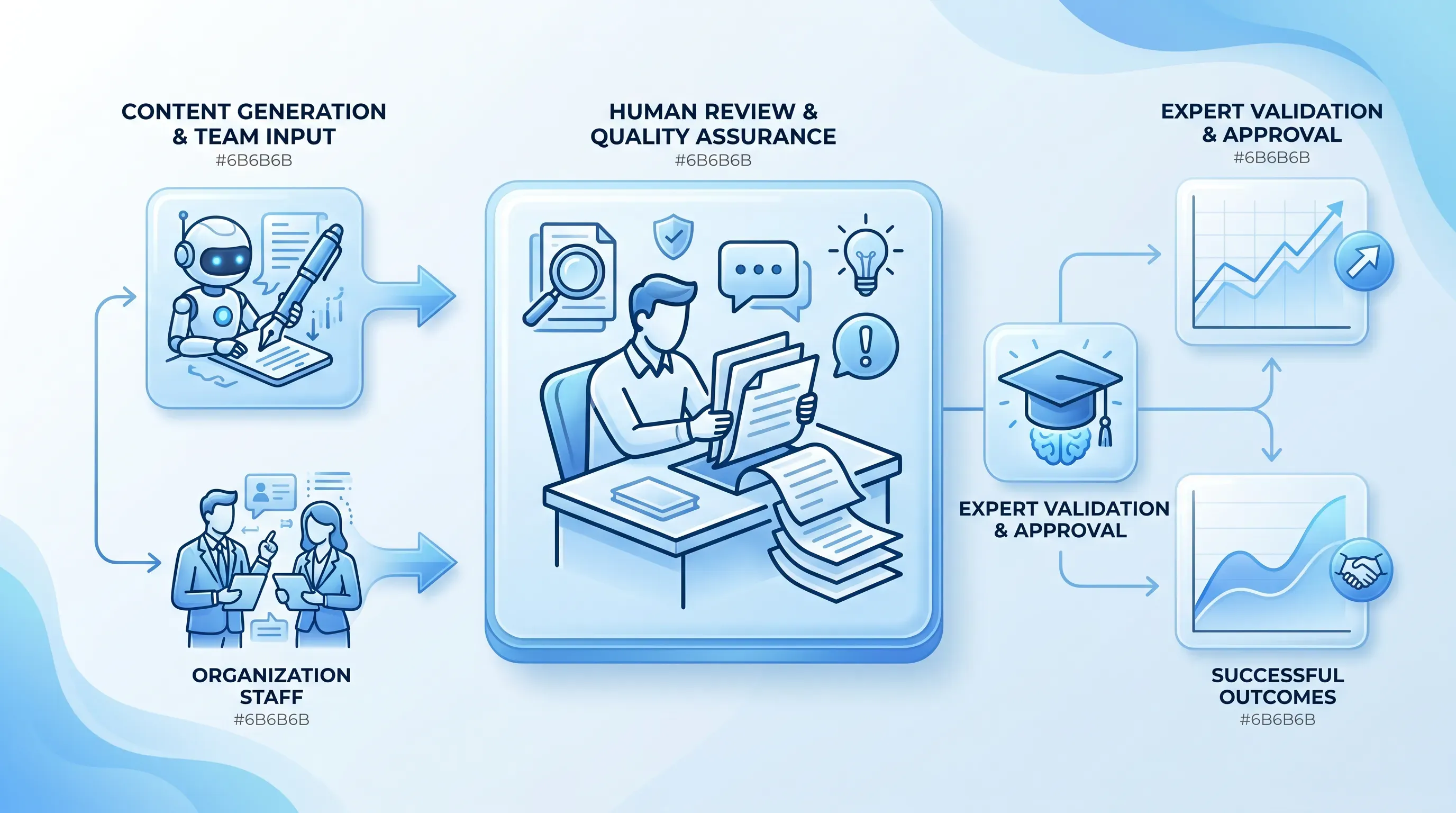
Infographic featuring a blue gradient with a central icon of a reviewer at a desk, surrounded by icons of AI, staff, and experts.

Human review is the step you don't skip. It protects your accuracy and donor trust at the same time, because search ranking is connected to both. Google's own guidance on helpful, people-first content rewards material that shows real experience and genuine usefulness, and demotes content built mainly to game rankings. Donors reward the same thing, for the same reason. They can tell when a page was written to fill space.

The review pass itself is short and repeatable. Read the draft once for facts and confirm every sourceable detail against a real source. Read it again for tone and ask whether it sounds like your organization. Then check that nothing was invented, because a fabricated detail hides best inside an otherwise accurate paragraph. Finally, add the specific knowledge only you have, the thing the tool could never know about your community or your work.

Some content needs a second set of eyes beyond yours. Impact claims and sensitive stories should pass a subject-matter expert before publishing, whether that's your program lead who knows the real outcome numbers or the staff member who built the relationship with the family in the story. The AI blog writer gets you a draft. The people who lived the work make sure it's right.
Need help with your AI visibility?

Book a free consultation with our experts we'll help you determine exactly which services your organization needs.

Protecting your voice and tone

A draft that's accurate but sounds like a robot still costs you. Your supporters know your voice, and consistency across your content channels is part of what builds their trust. The good news is that you can teach the tool to sound like you, and the method is straightforward. Start by gathering your best past content, the posts and appeals that sounded most like your organization. Paste them in and ask blog writing software like the AI blog writer to study them.

Then walk through these steps:

  1. Give the tool three or four pieces of your strongest past writing and ask it to summarize your voice in its own words

  2. Add your tone guidelines and a short list of words and phrases to avoid, the ones that never sound like you

  3. Ask it to draft new content in that summarized voice, then compare the result against your originals

  4. Correct what's off and feed the correction back so the tool can adjust

The point of asking it to summarize your voice first is that you see what it understood before it writes a word, so you can fix the picture early. Even after all this, you stay the voice curator. The tool gets close, and you make the final edits that close the gap between close and right. That last edit is where your organization's character actually lives.

Reaching more people in more languages

Visibility is a goal you share with every nonprofit, and language is one of the hardest walls to get past on a small budget. Hiring translators for every post and appeal isn't realistic for a team of two. An AI content generator changes that math. It can produce a first-pass translation of a blog post or a localized version of an appeal in minutes, which opens your content to the communities you actually serve.

The limit is real and you should respect it. Machine translation stumbles on cultural nuance, and a 2025 analysis found that AI tools misinterpret culturally specific phrases about 40% of the time, against an error rate below 5% for professional human translators. Idioms and the emotional weight of an appeal are exactly the parts machines miss. So a fluent human reviewer has to check every translation for accuracy and cultural fit before it goes out, and sensitive or culturally specific content needs that human even more than routine updates do.

Used this way, an AI content generator extends your reach without pretending the human is optional. The tool gets you a draft in a second language. A person who speaks that language and knows that community makes sure it lands the way you meant it to.

Building a simple AI writing workflow

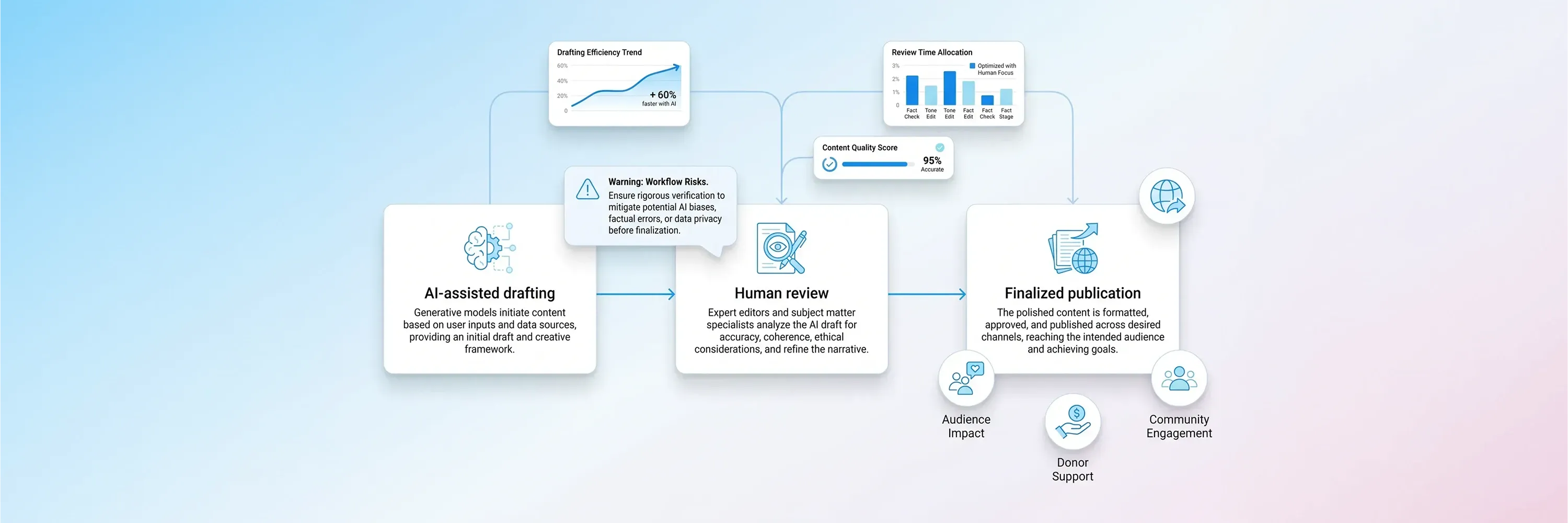
Put all of this together and you get one lightweight workflow a team of one or two can actually run. It moves in a straight line, and you can start it this week without overhauling anything:

  1. Gather your prompt and context from notes and past content that contain the facts

  2. Generate the first draft with your ai blog writer

  3. Run the human review pass for tone and accuracy, with a separate check for invented details

  4. Make the voice edit so it sounds like your organization

  5. Publish, then measure how the piece performs

Don't try to automate everything at once. The 2026 Nonprofit AI Adoption Report from Virtuous, based on a survey of 346 organizations, found that 92% of nonprofits now use AI but only 7% see major impact, because most teams stop at one-off prompts instead of building a repeatable process. Pick your biggest bottleneck, the content type that eats your week, and apply the workflow there with a single tool first. Once it's working, feed your best-performing pieces back into future prompts so the drafts keep getting closer to your voice.

The result is a process that protects the authenticity your supporters expect while giving you back the hours you've been losing to the blank page. Start small and keep your hand on the final edit while the ai blog writer carries the part of the work it does well so you can spend more of your time on the mission only you can serve.

Conclusion

The capacity gap that stretches your team won't close on its own, but you don't have to choose between keeping up and sounding like yourself. Point AI at the structured work and keep human review on everything that touches trust while you stay the curator of your own voice. Start with one content type and one tool this week. Used with care, an AI blog writer lets a team of two publish like a team of ten without trading away the authenticity your donors give back to you.

Need help with your AI visibility?

Book a free consultation with our experts we'll help you determine exactly which services your organization needs.

Yes, but only after you have consent and real source material. Use the tool to organize approved notes, then remove identifying details when privacy is a concern. A staff member who knows the family or community should review the draft before publication.

Give the ai blog writer a clear task, audience, word count, source notes, and tone guidance. Include links or pasted text from approved materials when facts matter. End the prompt by asking the tool to flag missing information instead of filling gaps with made-up details.

Check facts, permissions, tone, and claims before anything goes live. Keep a short review record that lists who checked the draft and which sources supported key details. This helps your team catch errors and explain editorial decisions later.

Yes, AI can help break a report into shorter posts for different reader groups. Start by asking for topic ideas based only on the report text. Then choose the strongest angles and add context from program staff before drafting each post.

Donor data is safe only if your team follows strict privacy rules. Before using Snoika Foundation or another writing platform, check its data policy and avoid pasting names, contact details, donation amounts, or private stories into prompts unless your organization has approved that use.

Book a Demo

Book a time that works best for you

You Might Also Like

Discover more insights and articles

Infographic illustrating the transformation of nonprofits hiring a Google Ad Grants agency, featuring a curved arrow and metrics.

Why Nonprofits Need a Google Ad Grants Agency to Maximize Free Ad Spend

This article explains what it takes to turn a Google Ad Grant into real donations and awareness, and where in-house efforts stall. It walks through setup and compliance, then follows the path from targeting to tracking so you can decide whether charity Google Ads support fits your organization.

Infographic comparing four AI marketing automation tools for nonprofits, featuring a central white board with soft shadows and muted blue icons.

Best AI Marketing Automation Tools for Nonprofits and NGOs

This article compares AI marketing automation tools for lean nonprofit and NGO teams across the jobs that eat your week, especially email and segmentation, while the discussion also covers scheduling and the reporting demands that come with multilingual outreach. It weighs honest strengths and trade-offs, then closes with implementation steps sized for a one- or two-person team.

A spacious SaaS infographic featuring translucent cards, icons, and flow lines on a smooth blue gradient background.

AI Content Generator for Nonprofits: Scale Content Without Losing Authenticity

This article shows nonprofit communications staff how to use an AI content generator to publish more without flattening the mission-rooted voice that earns trust. It covers where the tools save time and how to keep human judgment in the loop across multilingual outreach and AI search.

Title:
How an AI SEO Content Generator Helps NGOs Rank in Google and AI Search Engines

Meta description:
With this AI SEO content generator guide, you will learn to write steady posts that rank your

How an AI SEO Content Generator Helps NGOs Rank in Google and AI Search Engines

This article explains how a small NGO communications team can use an AI SEO content generator to publish steady, well-structured content that performs in both Google and AI search engines. It walks through keyword research and a repeatable publishing workflow, with practical steps you can copy.