Best AI Marketing Automation Tools for Nonprofits and NGOs

Content authorArtem LozinskyPublished onReading time13 min read
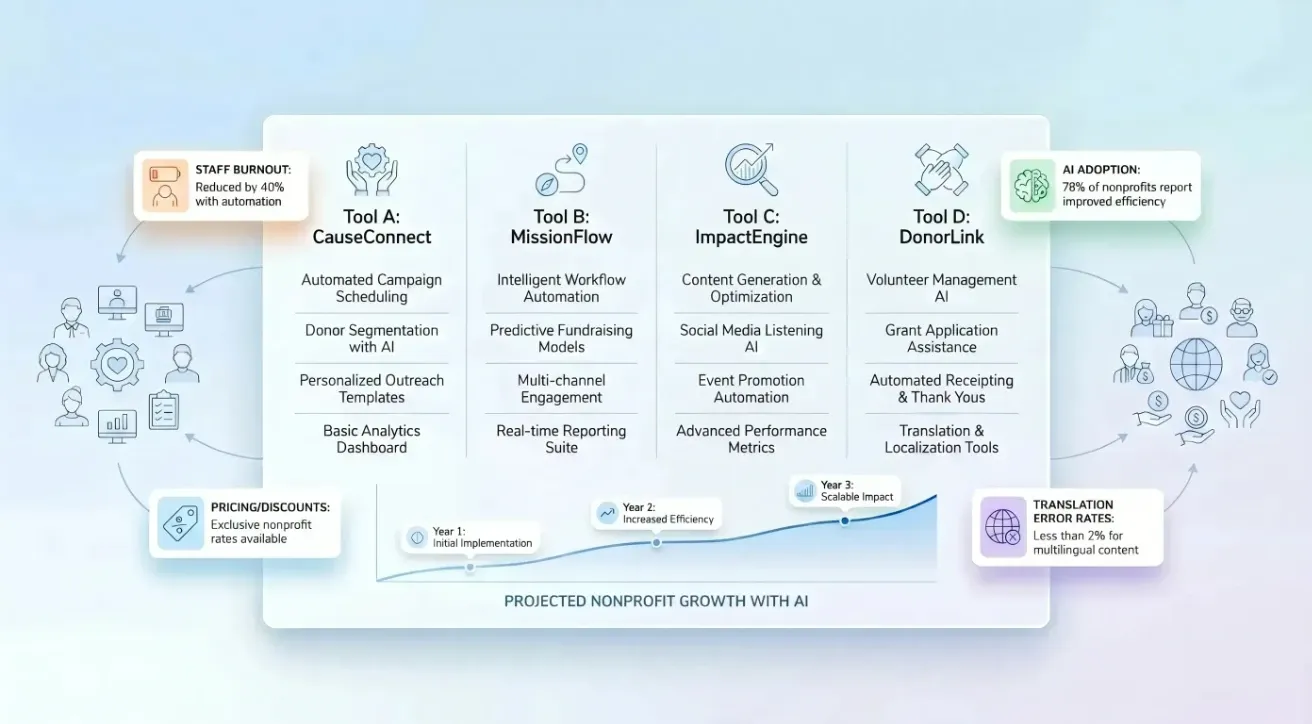
Infographic comparing four AI marketing automation tools for nonprofits, featuring a central white board with soft shadows and muted blue icons.

This article compares AI marketing automation tools for lean nonprofit and NGO teams across the jobs that eat your week, especially email and segmentation, while the discussion also covers scheduling and the reporting demands that come with multilingual outreach. It weighs honest strengths and trade-offs, then closes with implementation steps sized for a one- or two-person team.

Why lean nonprofit teams are turning to AI

You run comms, and probably a lot more than comms. AI marketing automation tools have moved from novelty to a realistic way to claw back the hours you lose to donor emails and campaign work, from social posts to event promotion, while your board still wants reports by Friday. Most weeks, the appeal goes out the night before because that was the only quiet hour you had.

That pace reflects the sector. The Center for Effective Philanthropy found that 95% of nonprofit leaders were concerned about staff burnout, with nearly half struggling to fill vacancies. When a comms function is one person stretched across email and the work around social channels and events, manual work stops being sustainable long before anyone admits it.

AI is already inside the sector, though rarely in an organized way. TechSoup's 2025 report found 85.6% of nonprofits exploring or working with generative AI. The question is which ai marketing automation tools earn their price and setup effort for a team your size. That's what this comparison answers through the work you actually do.

What these tools actually do

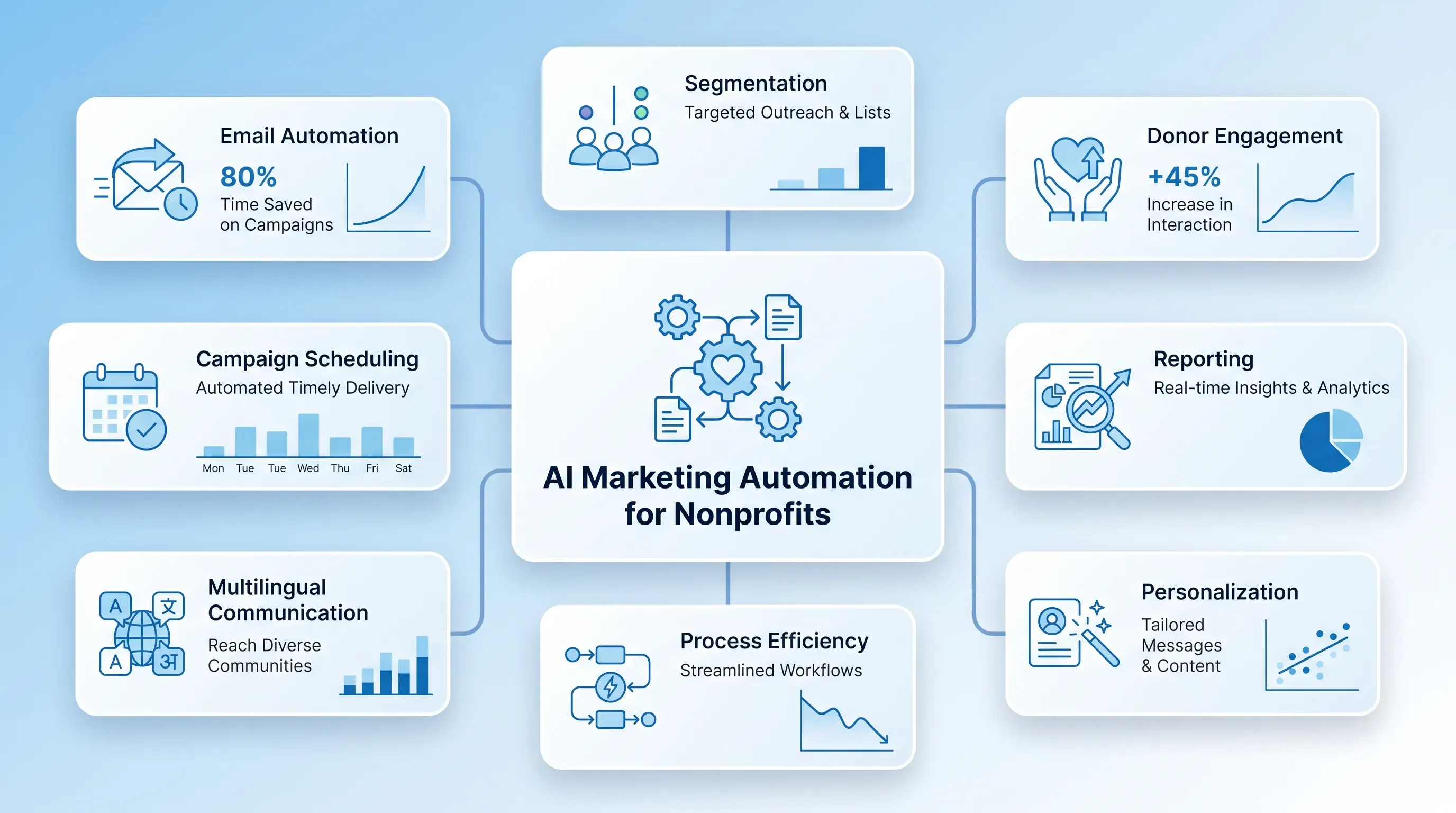
Calm infographic featuring a central card on AI marketing automation for nonprofits, surrounded by feature cards highlighting core benefits.

Before comparing brands, it helps to name the five jobs AI marketing automation covers for a nonprofit, since AI marketing automation tools vary by which jobs they handle well. Map each one to what you already do by hand, and the shortlist gets easier to build.

Email automation

Email automation sends the messages you'd otherwise write one at a time, such as the welcome note to a new subscriber and the thank-you after a gift, while lapsed-donor nudges and renewal reminders can run the same way. You build the flow once, and it runs for every person who triggers it. Welcome emails alone carry an average open rate of 80%, which is the kind of engagement you don't want arriving late because nobody had time to send it.

Simple triggered flows are one thing. Modern AI marketing automation tools add a layer on top because they can suggest subject lines and pick the send time for each recipient based on when they usually open. Send-time optimization alone improves open rates by 15 to 23% compared to a fixed schedule. Most nonprofits need a handful of dependable automations, not an enterprise builder with fifty branches, so don't pay for depth you'll never configure.

Supporter segmentation

Segmentation groups your supporters by what they have in common, such as giving history and engagement level, while location and campaign source can shape the same groups. Instead of blasting one appeal to everyone, you send recurring donors a different message than first-time event attendees or volunteers who have never given. With ai marketing automation tools, segmentation surfaces these patterns for you and leaves the spreadsheet work behind.

The payoff is real even for a small list. According to Mailchimp data, segmented emails drive roughly 101% higher click rates than unsegmented sends. Better segments mean each appeal lands closer to what the person already cares about, which is how a list of a few thousand still raises money.

Automated donor engagement

Automated donor engagement is where email and segmentation combine into a journey. A first-time giver enters a sequence that thanks them and shows the impact of their gift, with a later invitation for a second one, all without you touching each step. This matters because only 14% of first-time donors give again, and the first 90 days decide most of that outcome.

AI raises the ceiling on automated donor engagement by predicting who is about to lapse and who is ready to upgrade, then triggering the right message at the right moment. The trade-off is tone. Recurring monthly donors are retained at nearly double the rate of single-gift donors, so nurturing them is worth the effort, but a journey that feels robotic undoes the trust you're building. Automated donor engagement works best when a person still reviews the voice.

Need help with your AI visibility?

Book a free consultation with our experts we'll help you determine exactly which services your organization needs.

Campaign scheduling and reporting

Scheduling in AI marketing automation tools lets you plan email and social campaigns in advance instead of posting live at 11 p.m. AI can recommend timing based on past engagement, so a Tuesday-morning appeal goes out when your audience actually reads. Reporting dashboards then pull open rates and giving results into one view, with click rates folded into the same picture.

That consolidation matters if you currently stitch numbers together from three tools the night before a board meeting. When your director asks how the spring campaign performed, a single dashboard answers in a screenshot and saves an afternoon of exports. Email messaging drove 16% of all online revenue in 2025, up from 11% the year before, so showing that impact clearly is part of protecting the budget behind it.

Multilingual communications

AI translation and multilingual templates let you reach supporters in more than one language without hiring a translator for every send. This matters most for NGOs with international donors and for nonprofits serving multilingual communities at home, where a Spanish-language appeal isn't optional but a full translation budget isn't there either.

The honest limit is that machine translation still needs a human check, especially for tone and sensitive messaging. Research cited by translation firm BLEND found AI tools misinterpret culturally specific phrases about 40% of the time, while professional review keeps error rates below 5%. Use AI for the first draft and speed, and keep a fluent person on the final read.

How we compared the tools

The recommendations for AI marketing automation tools below run through the same lens, so you can apply it to any tool not listed here. Five criteria carry the most weight for a small or mid-sized org, and each earns its place for a specific reason.

The strongest options usually meet these requirements:

  • Nonprofit pricing and discounts, because a discount that stacks with an annual plan changes what you can actually afford.

  • Ease of setup without a technical hire, since 60% of nonprofits say they lack the in-house expertise to assess tools in the first place.

  • Quality across the five core jobs, weighed against what you'll realistically use.

Data privacy is the fourth, and it's not negotiable. If anyone in the EU interacts with your site or donates, the General Data Protection Regulation (GDPR) applies to you regardless of where you're based. The fifth is support responsiveness, because when a live campaign breaks, a slow ticket queue costs you gifts.

Best AI marketing automation tools for nonprofits

The list of AI marketing automation tools below focuses on the strongest fits, from budget-friendly email automation to fuller engagement platforms. Each profile leads with who it suits and the problem it solves, not a spec sheet, so you can see where your own org fits.

Moosend

Moosend is the low-cost entry point for a team ready to graduate from basic Mailchimp-style sending. It offers real automation workflows and detailed segmentation, with donor flows included at a base price of $9/month for up to 500 subscribers. Its AI Writer suggests subject lines and email copy, and the platform scored 90.1% in deliverability testing, among the highest reviewed.

The nonprofit discount is where it gets interesting. Moosend gives charities 25% off that stacks with its 20% annual discount, which drops a 5,000-contact plan to roughly $28.80/month. It's a strong fit for event-led organizations juggling several campaigns at once.

Be honest about your size, though. A small org with one newsletter won't touch most of the automation depth, and a growing one will want CRM features Moosend doesn't have. Its interface is slower than newer competitors.

GetResponse

GetResponse is a broader suite that bundles automation and landing pages, with webinar hosting in the same place. For a nonprofit running virtual events alongside multi-step donor journeys, that consolidation removes two or three separate subscriptions. Its Marketer plan, which unlocks webinars for 100 attendees and automations built from scratch, starts at $59/month for 1,000 contacts.

The discount is generous. GetResponse gives registered nonprofits 50% off monthly plans, verified through TechSoup, in exchange for placing their logo on your site. That makes the suite far more reachable on a tight budget.

The trade-off is breadth. If all you need is email and a couple of automations, GetResponse is more than a tiny team will use, and the interface reflects that scope. The mid-sized org that gets the most value here is one currently paying for a separate webinar tool and an email platform, with landing pages handled elsewhere, and ready to fold them together.

Need help with your AI visibility?

Book a free consultation with our experts we'll help you determine exactly which services your organization needs.

Keela

Keela is a purpose-built nonprofit Customer Relationship Management (CRM) system that centralizes donor data and combines communications with fundraising workflows built around segmentation. Where Moosend and GetResponse are ai marketing automation tools, Keela is where your donor records live, with automated reports that include LYBUNT and SYBUNT views to flag who gave last year but skipped this one. A dedicated Implementation Specialist migrates your contacts and donation records, recurring gifts included, which matters if a messy CRM switch is the thing keeping you on spreadsheets.

It fits organizations that want donor management and marketing in a single system. Pricing starts at roughly $125/month for up to 1,000 contacts and scales from there, so it's a step up in cost from a pure email tool.

The honest limits: Keela has no mobile app and limited template customization, with some advanced reporting locked to higher tiers. If your team needs to update records from a phone at an event, that gap will show.

Engaging Networks

Engaging Networks is a fuller digital engagement platform aimed at larger or more established NGOs. It combines email and Short Message Service (SMS) automation with advocacy campaigns, while optimized donation pages carry multi-language and multi-currency support for organizations operating across borders. Its marketing side offers automation journeys and audience segmentation, with A/B testing used to lift deliverability.

The results at scale are visible in its case studies. The Salvation Army reached a 60% opt-in rate for donors covering transaction costs on the platform's donation pages. This is real engagement infrastructure for established teams.

Be clear-eyed about what that means. Engaging Networks is a heavier, partner-led investment, and the company positions itself as a partner. It suits organizations that have outgrown lighter tools and have someone who can own the platform.

General AI assistants and add-ons

Some gaps don't need a new platform. General AI tools layer onto whatever core system you already run.

These tools can strengthen your existing workflow without replacing your current system:

  • ChatGPT drafts donor emails and appeal copy, with social captions covered too. Nonprofits get 20% off ChatGPT Team through OpenAI for Nonprofits, and larger orgs can reach 50% off Enterprise.

  • Salesforce Nonprofit Cloud's Einstein AI generates gift proposals and acknowledgments and summarizes donor records; starting around $50 per user per month is the listed pricing, and discounted licensing comes through the Power of Us program. It's built for orgs already on Salesforce with a dedicated admin.

  • Workflow connectors like Zapier stitch your donation form to your email tool so a new gift triggers a thank-you without manual export.

Layer these on when your core platform does the heavy lifting and you need help drafting or summarizing, with app connections handled around the edges. Keep expectations grounded: good output takes clear prompting, and 69% of nonprofit marketers using generative AI have had no formal training, which shows in results that need editing.

How to choose the right fit

The comparison only helps once you match it to your situation. Start with your size and list. A list under 1,000 with one newsletter points toward Moosend, while a database you want to consolidate points toward Keela. Larger NGOs with SMS and advocacy needs land on Engaging Networks.

Then weigh budget against discounts, because the sticker price rarely tells the real story. GetResponse's 50% nonprofit discount can make a broad suite cheaper than a narrower tool at full price. Next, name the languages you serve, since multilingual reach separates the platforms quickly, and only some handle it natively.

The cleanest way to decide is to pick the single job costing you the most staff time and solve that first. If you lose Sunday nights to donor emails, buy for email automation and automated donor engagement, then let the rest follow. Ask one more question before you commit: do you want an all-in-one CRM that owns your donor data, or a lighter email-first tool that syncs with what you already have? That answer alone narrows the field to two or three names.

Nonprofit workflow automation without the overwhelm

The fear here is fair. You've seen software bought with enthusiasm and abandoned three months later because nobody had time to configure it. Nonprofit workflow automation works when you roll it out gradually, one piece at a time, and build only what your next campaign needs.

Start small and protect what's already running:

  1. Test on a small list with proper consent before touching your full database, so a broken flow reaches ten people while ten thousand stay protected.

  2. Migrate data cleanly. Deduplicate and correct records first, because nonprofit workflow automation built on messy data sends the wrong message to the wrong person.

  3. Build only the two or three automations that cover most of your work: the welcome sequence and the donation thank-you, with a lapsed-donor nudge as the third.

  4. Keep a human review step on every AI-generated draft and translated message before it sends.

  5. Measure results on that first workflow before expanding to the next.

The support worry is fair too. This is where a discount that includes onboarding, like Keela's Implementation Specialist, earns its higher price. Nonprofit workflow automation should never require you to become a developer. If a tool demands that, it's the wrong tool for a lean team, and the right nonprofit workflow automation setup is one you can maintain in the hours you actually have.

Getting started this quarter

AI marketing automation works best when it supports your mission instead of adding another tool your team has to manage. The right setup can save hours on donor communication, campaign planning, reporting, and multilingual outreach while keeping your messaging personal and authentic.

At Snoika Foundation, we help nonprofits and NGOs identify the right AI tools, build efficient workflows, and integrate automation in a way that fits their team, goals, and resources. Whether you're starting with your first AI-powered process or looking to improve an existing setup, our experts can help you turn technology into practical support for your mission.

Ready to make AI work for your organization? Book a call with Snoika Foundation and discover how automation can help your team save time and increase its impact.
Need help with your AI visibility?

Book a free consultation with our experts we'll help you determine exactly which services your organization needs.

Yes, but clean the data before any live automation. Merge duplicate donors, standardize email addresses, and tag consent status for each record. If you skip that step, automation can send a renewal ask to a new donor or email someone who opted out.

Use a small consent-based test list and limit the fields you upload. For most trials, name, email, gift date, and segment are enough. Keep sensitive notes out of AI prompts, check the vendor’s data processing terms, and confirm where supporter data is stored.

Ask how the platform handles consent, unsubscribes, and data export before you compare features. Then ask who can fix a broken workflow during a live campaign. Snoika Foundation’s guidance points teams toward tools they can maintain, which matters more than a long feature list.

Choose a CRM when donor records, gift history, and follow-up tasks need one source of truth. Email software is enough when your database already works and you only need campaigns. The break point comes when staff spend hours reconciling donations with contact records.

Measure one workflow against its goal, rather than every dashboard number. For a welcome series, track second-gift rate and unsubscribes. For lapsed donors, compare gifts from the automated group with a similar group that didn’t receive the flow. The same approach applies across ai marketing automation tools.

Book a Demo

Book a time that works best for you

You Might Also Like

Discover more insights and articles

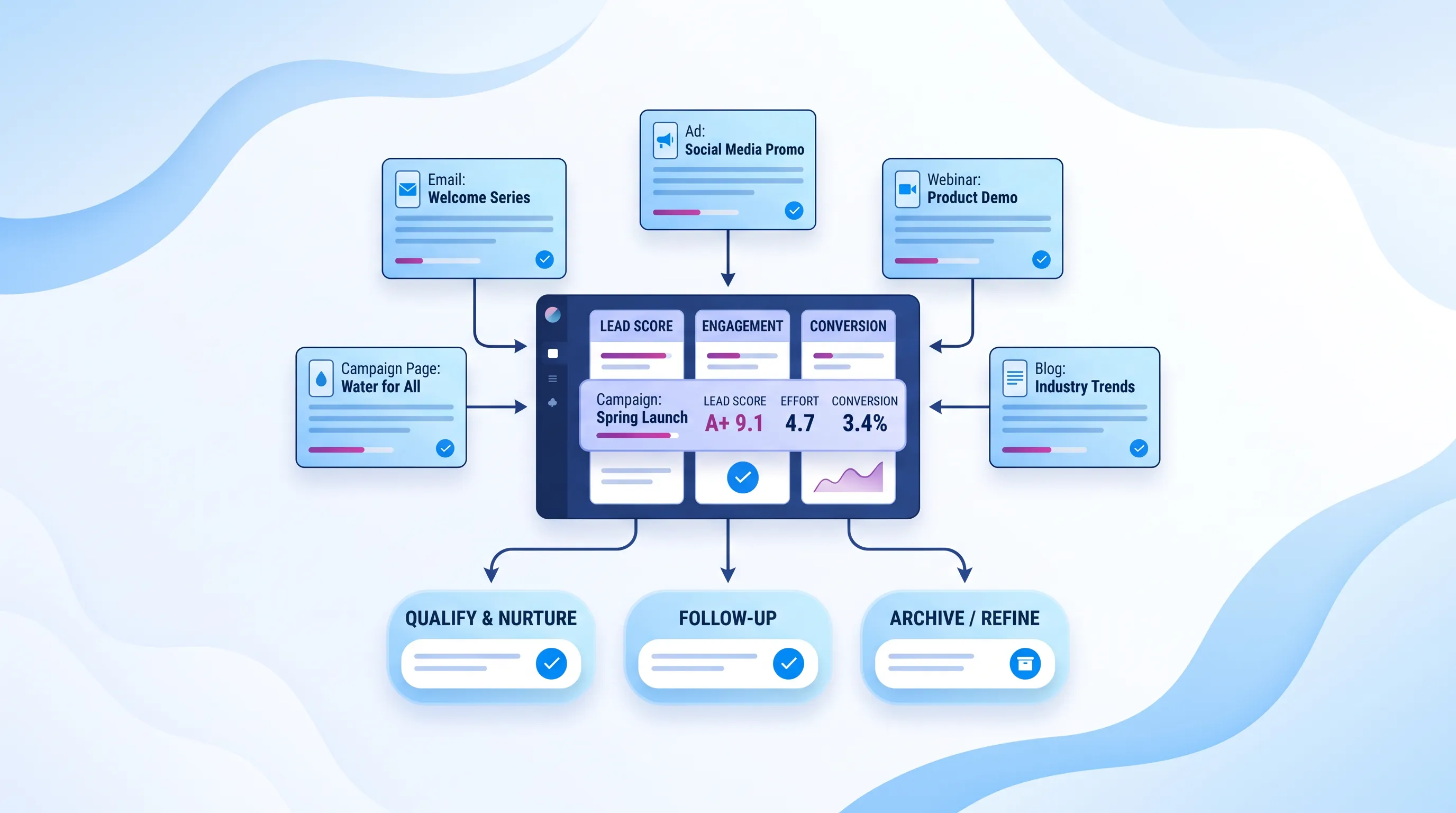
Infographic illustrating the transformation of nonprofits hiring a Google Ad Grants agency, featuring a curved arrow and metrics.

Why Nonprofits Need a Google Ad Grants Agency to Maximize Free Ad Spend

This article explains what it takes to turn a Google Ad Grant into real donations and awareness, and where in-house efforts stall. It walks through setup and compliance, then follows the path from targeting to tracking so you can decide whether charity Google Ads support fits your organization.

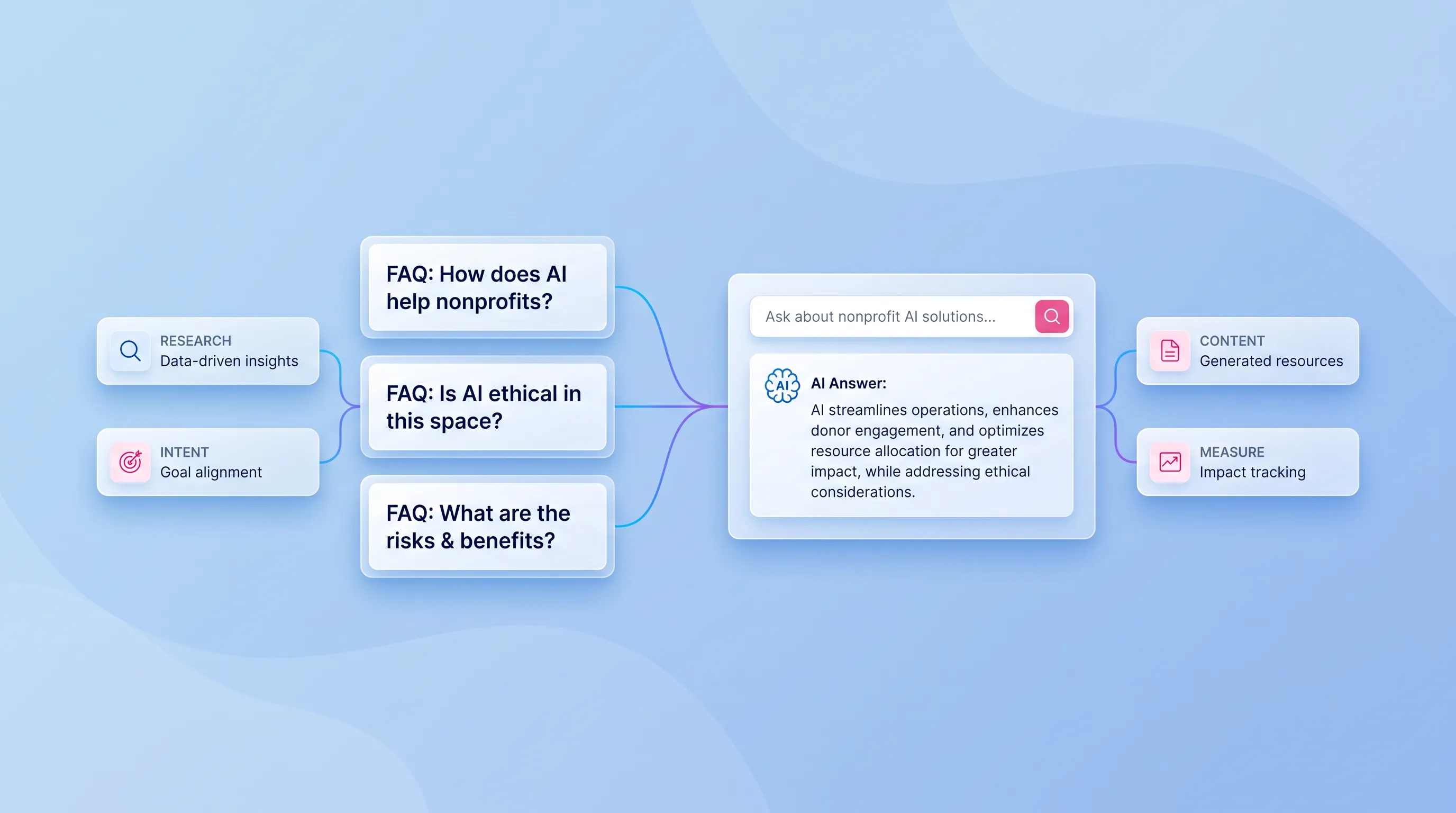
A spacious SaaS infographic featuring translucent cards, icons, and flow lines on a smooth blue gradient background.

AI Content Generator for Nonprofits: Scale Content Without Losing Authenticity

This article shows nonprofit communications staff how to use an AI content generator to publish more without flattening the mission-rooted voice that earns trust. It covers where the tools save time and how to keep human judgment in the loop across multilingual outreach and AI search.

Title:
How an AI SEO Content Generator Helps NGOs Rank in Google and AI Search Engines

Meta description:
With this AI SEO content generator guide, you will learn to write steady posts that rank your

How an AI SEO Content Generator Helps NGOs Rank in Google and AI Search Engines

This article explains how a small NGO communications team can use an AI SEO content generator to publish steady, well-structured content that performs in both Google and AI search engines. It walks through keyword research and a repeatable publishing workflow, with practical steps you can copy.

Title:
AI Blog Writer for NGOs: Faster Content Creation Without Losing Your Voice

Meta description:
When you use an AI blog writer, you can draft nonprofit updates faster and guard your voice.

Artic

AI Blog Writer for NGOs: Faster Content Creation Without Losing Your Voice

This article explains how a small nonprofit communications team can use an AI blog writer to keep up with a demanding content calendar without sounding generic or breaking donor trust. It walks through the content types AI drafts well and the human review steps that keep work accurate, then shows how to protect your voice as you reach more people in more languages.