Why Nonprofits Need a Google Ad Grants Agency to Maximize Free Ad Spend

Content authorArtem LozinskyPublished onReading time11 min read
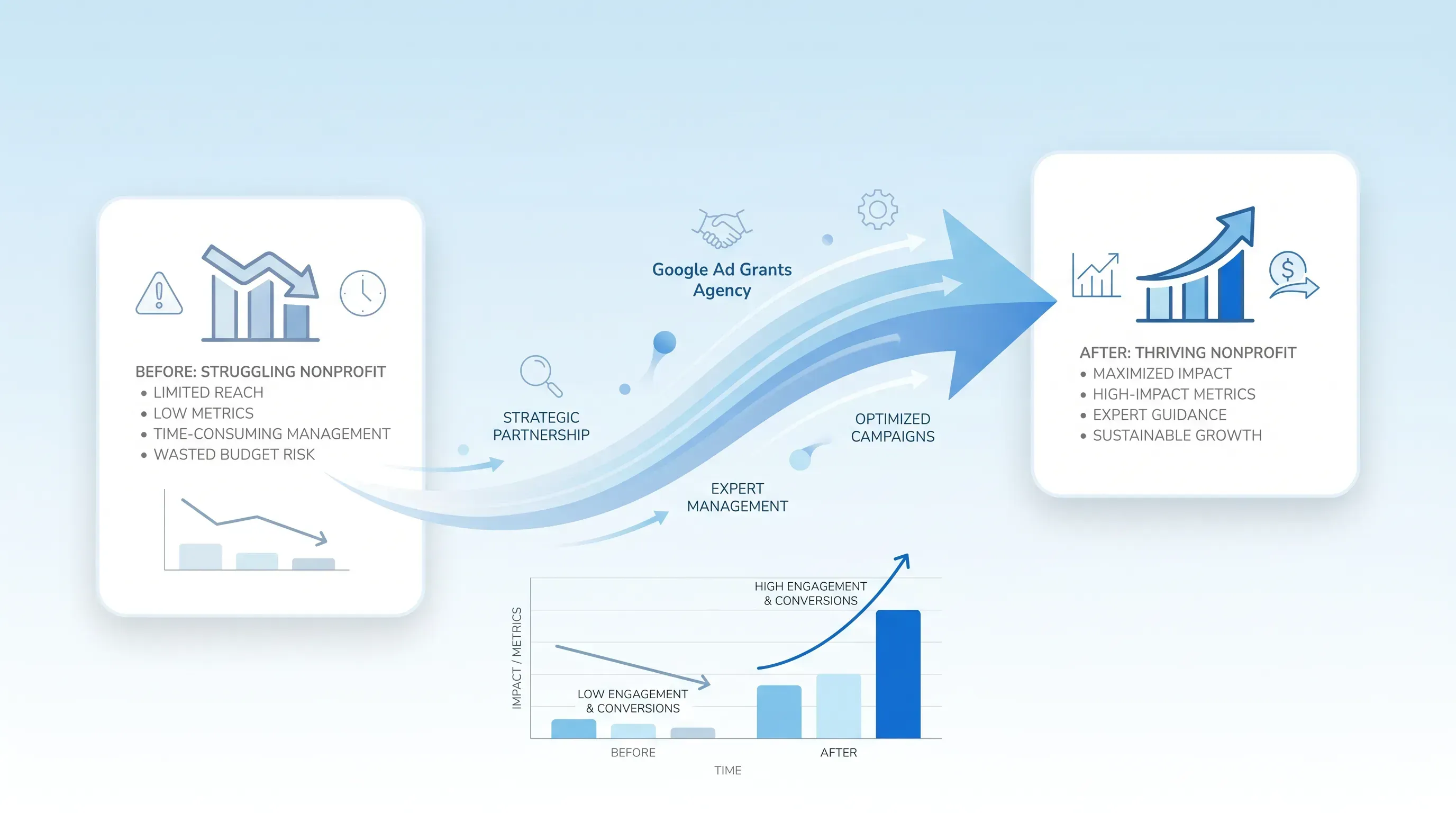
Infographic illustrating the transformation of nonprofits hiring a Google Ad Grants agency, featuring a curved arrow and metrics.

This article explains what it takes to turn a Google Ad Grant into real donations and awareness, and where in-house efforts stall. It walks through setup and compliance, then follows the path from targeting to tracking so you can decide whether charity Google Ads support fits your organization.

Free money that mostly goes unspent

If you have secured a Google Ad Grant, or you are about to, you already sense the catch that most conversations skip, which is exactly where a Google Ad grants agency earns its keep. The program hands eligible 501(c)(3) organizations up to $10,000 a month in free search ads. That is a genuine gift. But free ad credit is not the same as free results.

The numbers tell the story. According to one analysis of self-managed accounts, less than 30% of the available budget gets used by the average nonprofit running the grant alone. Others do worse than underspend. They trip a policy rule and watch the account get temporarily deactivated until they fix what broke.

So the tension is set. You have a valuable asset sitting in your Google account, and the grant does not manage itself. This piece is for you if you are deciding how to run it after a stalled in-house effort or from the setup screen. What follows is a plain account of what real management involves and why it calls for a Google Ad Grants agency.

How the Ad Grant actually works

Before any decision makes sense, you need the mechanics. The grant gives you up to $10,000 per month in text ads, which works out to a daily spend limit of $329 USD. Those ads run on Google Search only. Display placements are off the table, as are video and shopping placements, though Performance Max became available to grant accounts in 2025.

Your ads appear on Google.com search results, either on their own or in positions below the paid ads. That last detail matters. Grant ads sit in a separate auction from businesses paying full price, which is why smart keyword choices matter so heavily to your reach.

Understanding Google Ad Grant requirements

Eligibility is specific. In the US, you need current 501(c)(3) status before you can use a Google for Nonprofits account after registering with TechSoup for verification, and the website attached to the account must meet Google's quality standards. The funds do not roll over between months, and there is no requirement to spend them.

Two constraints make the grant behave unlike a paid account:

That is the foundation: a generous budget with rules that reward precision over spending power inside a narrow set of placements.

Where in-house management breaks down

If you have already tried running the grant yourself and watched it sputter, the reasons are structural. Google built the program to reward well-run accounts and quietly penalize neglected ones, and the penalties arrive fast.

Start with the metric that ends the most accounts. Grant accounts must maintain a 5% click-through rate (CTR) each month at the account level. Miss it for two consecutive months and the account gets deactivated. A paid advertiser can survive a mediocre CTR because they are paying for clicks. You cannot, because your keys to the program depend on proving that real people want what your ads offer.

Need help with your AI visibility?

Book a free consultation with our experts we'll help you determine exactly which services your organization needs.

Managing Google Ad Grants takes ongoing work

Keyword rules add another layer. Google's mission-based policy bans single-word keywords outside a few exceptions like your brand name and forbids overly generic terms such as "free videos" or "today's news." Keywords with a quality score of 1 or 2 must be paused. Each rule exists to keep grant ads relevant, and each one demands regular attention.

Then there is the calendar of obligations. Accounts must log at least one conversion per month, and 60 consecutive days of zero conversions put you at risk. You also have periodic account updates and an annual program survey to complete. This is a standing commitment.

And the commitment costs hours you do not have. Effective nonprofit ad management involves keyword research and performance analysis that can consume 10 to 15 hours per week at the demanding end, and 1 to 2 hours weekly even for a lean, well-organized account. For a team already stretched across programs and fundraising, those hours come straight out of the work you were hired to do. That is the real trade-off, and it builds a clear case for charity Google Ads support.

What a Google Ad Grants agency handles

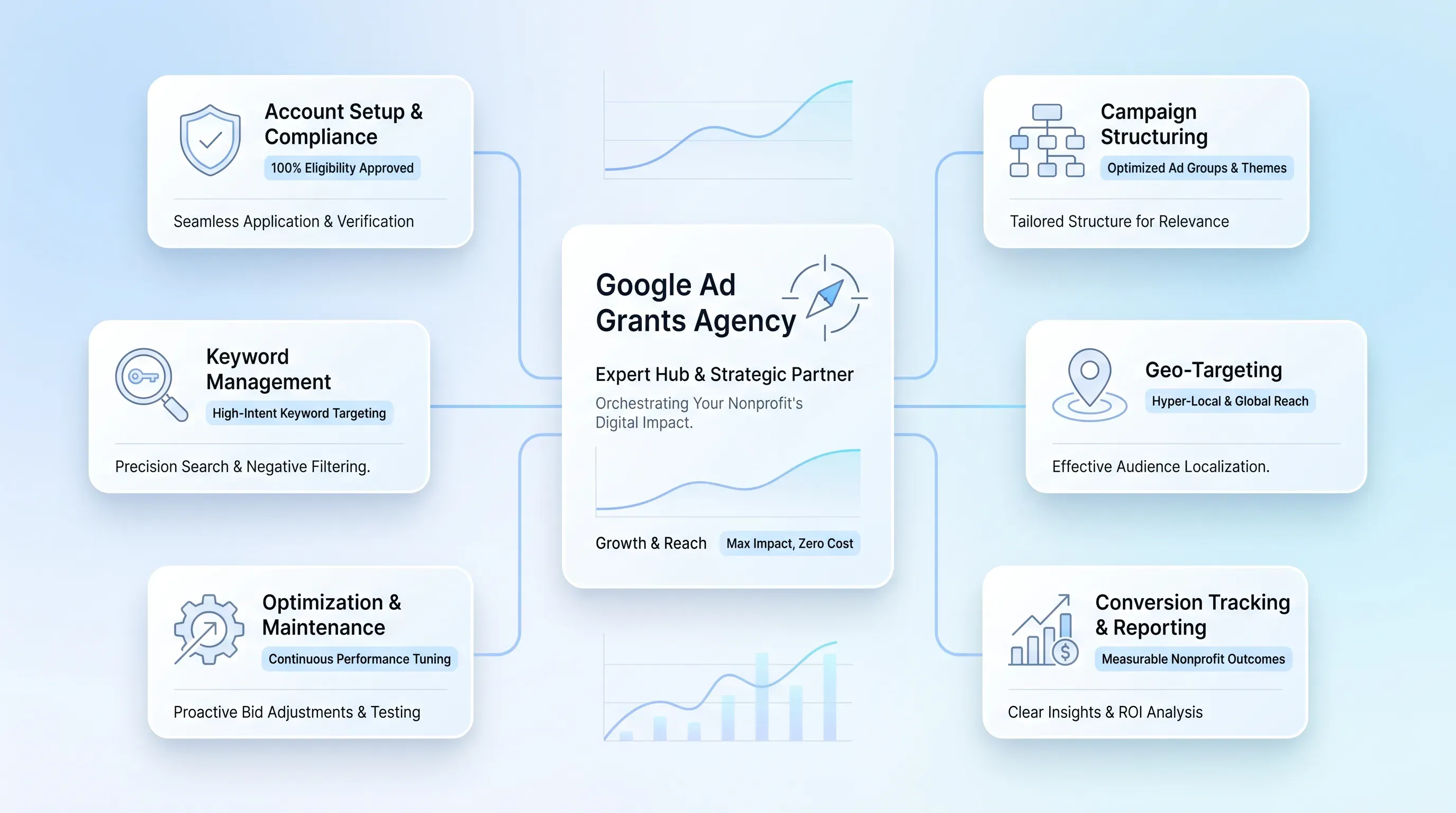
A calm SaaS infographic featuring a central card labeled 'Google Ad Grants Agency' surrounded by six floating cards for agency functions.

A Google Ad grants agency turns credit into measurable outcomes by owning the technical and strategic details your team rarely has time to master. The value breaks into distinct areas of work, each one a concrete responsibility you pay for. Here is what that looks like in practice.

Account setup and compliance

Everything rests on a correct build. A Google Ad grants agency structures campaigns with the required two ad groups per campaign and the minimum two sitelink assets, then organizes those ad groups around tight, mission-aligned themes. Keyword hygiene comes next, which means single-word and off-mission keywords are filtered out before they ever cause a problem, while geo-targeting directs your budget toward the communities you actually serve.

This is where nonprofit ad management earns its cost, because it is where suspension is prevented. A specialist watches the 5% CTR threshold week to week and pauses low-quality keywords before they drag the account down; if the account is ever flagged, the specialist knows how to request reinstatement. The point worth holding onto is that this is ongoing maintenance. A build that looks perfect in January drifts out of compliance by summer without someone tending it.

Keyword targeting and campaign optimization

The grant's $2 bid cap and 5% CTR rule both point toward the same tactic, which is long-tail, specific keywords. A phrase like "after-school tutoring program for low-income families" faces less competition than a broad term and attracts searchers with clearer intent; that specificity helps it win top positions within the cap. A Google Ad grants agency researches these phrases and builds out negative keyword lists so your ads no longer appear for searches that will never convert; location-specific variations belong in that research.

Optimization is the ongoing half of the job. Optimization means A/B tests for ad copy and match-type adjustments, plus regular reviews of the actual search queries that trigger your ads so keywords that underperform can be pruned. Negative keyword management is essential for holding the 5% CTR, because irrelevant impressions pile up without clicks and pull the whole account down. This work is the difference between an account that limps along at a fraction of its budget and one that puts the full $120,000 annual value to use.

Need help with your AI visibility?

Book a free consultation with our experts we'll help you determine exactly which services your organization needs.

Landing pages and conversion tracking

Ads only pay off if the page behind them does its job. A Google Ad grants agency aligns the promise in your ad with a dedicated landing page that loads fast and works on mobile, with one clear call to action. Landing page experience is one of the three factors in quality score, so a weak page hurts both your conversions and your compliance standing at the same time.

Then comes the part in-house teams overlook most. Conversion tracking runs through connected Google Ads and Google Analytics 4 accounts, so donations and volunteer sign-ups are counted accurately alongside event registrations. Without it, you are, as Wired Impact puts it, "throwing darts in the dark": the report shows 100 clicks while the donation question remains unanswered. With tracking in place, you can prove return on effort to your board and see which campaigns deserve more budget. This is where charity Google Ads support delivers clear, reportable results instead of vanity metrics.

Donor and awareness campaigns in action

Tasks are abstract. Results are not. Consider what disciplined targeting and measurement produce when they work together.

On the donor acquisition side, a Google Ad grants agency aims campaigns at high-intent searches, the phrases people type when they are ready to give, and leans into peak giving windows like Giving Tuesday and year-end. Blueprint Digital notes that these periods let nonprofits capture individuals who are ready to give by linking ads straight to a donation page with urgent, specific copy. Paired with conversion tracking on that page, every dollar of grant spend ties back to a counted gift. The Indian Residential School Survivors Society took this route with a search strategy built around high-intent users and saw a 20x increase in online donations in six months, alongside a 61% lift in website traffic.

Awareness campaigns work the other end of the funnel. Here the goal is reaching people searching for your cause or for the services you provide, before they know your name. When Streamworks restructured a health nonprofit's account around mission-aligned themes, the reworked campaigns produced an 80% increase in overall conversions over six months across adoption form submissions and donation clicks; in-person visits were included in the total. The restructuring drove the gain. That is the pattern nonprofit ad management is built to repeat. Professional targeting turns clicks into tracked sign-ups and real visibility, while measurement proves it happened.

When hiring an agency makes sense

So which path fits your organization? The honest answer depends on your situation, and it is worth laying the options side by side before you decide.

Running it yourself costs nothing but your time, and if you have someone with paid-search experience and a few free hours each week, DIY can work. Assigning nonprofit ad management to existing staff shifts the cost to opportunity cost, since the hours spent tending the account are hours pulled from fundraising or programs. Hiring a Google Ad grants agency carries a fee that, across the market, runs from $500 to $2,000 a month, though some Ad Grants-focused providers charge less. Set any of those figures against the grant's $120,000 annual value and the math favors protecting the asset.

These signals point toward professional charity Google Ads support:

  • Your spend has stalled well below the $329 daily cap and you cannot figure out why.

  • You have already received a suspension notice, or you fixed one and fear the next.

  • No one on staff can reliably give the account four to five hours a week.

  • Your team lacks hands-on Google Ads experience and the learning curve keeps eating your calendar.

There is also a case against hiring. As Thomas Costello of REACHRIGHT points out, if your audience is so small that you can only spend $1,500 to $2,000 a month at a healthy CTR, an agency fee eats a quarter of your spend before you reach anyone. Small, brand-focused accounts are better off DIY until they grow. The decision is yours, and it rests on your spend and your appetite for the compliance work, with staff capacity treated as part of that calculation.

Getting the most from your grant

A Google Ad Grant is only valuable when it reaches the right people and supports your mission goals. From account setup and compliance monitoring to keyword strategy, campaign optimization, landing pages, and conversion tracking, every detail affects how much of your grant potential you actually use.

At Snoika Foundation, we help nonprofits and NGOs turn Google Ad Grants into effective growth channels. Our team supports organizations with strategic campaign management, performance optimization, and data-driven improvements that help attract donors, increase awareness, and maximize the value of available ad spend.

If your grant is underperforming or you want expert support building a stronger Google Ads strategy, book a consultation with Snoika Foundation and discover how your organization can get more from its Google Ad Grant.
Need help with your AI visibility?

Book a free consultation with our experts we'll help you determine exactly which services your organization needs.

No, fiscal sponsorship alone doesn't qualify a US organization for Google Ad Grants. Google requires the organization that applies to hold valid 501(c)(3) status and pass Google for Nonprofits verification. If your sponsored project lacks its own status, the fiscal sponsor would need to apply and control the account.

Useful results usually take a few weeks after tracking, keywords, and landing pages are set correctly. Early data shows which searches bring qualified visitors. Donation volume or volunteer sign-ups often need a full month of clean conversion data before you can judge campaign quality.

Track actions that connect to your mission, such as volunteer forms and newsletter sign-ups. Event registrations and service inquiries also count when they show meaningful engagement. Avoid tracking page views as primary conversions because they don't prove that a visitor took a valuable action.

Yes, you can run paid Google Ads separately from the grant account. Keep the accounts distinct so budgets and reporting don't get mixed. Paid campaigns can cover competitive keywords or display placements that the grant doesn't handle, while the grant account stays focused on eligible search traffic.

Compare each google ad grants agency by its compliance process and reporting plan. Ask how it handles CTR risk and conversion setup. Then ask how reports tie campaigns to donations or sign-ups. If Snoika Foundation is on your shortlist, request the same details from its team so every proposal is judged the same way.

Book a Demo

Book a time that works best for you

You Might Also Like

Discover more insights and articles

Infographic comparing four AI marketing automation tools for nonprofits, featuring a central white board with soft shadows and muted blue icons.

Best AI Marketing Automation Tools for Nonprofits and NGOs

This article compares AI marketing automation tools for lean nonprofit and NGO teams across the jobs that eat your week, especially email and segmentation, while the discussion also covers scheduling and the reporting demands that come with multilingual outreach. It weighs honest strengths and trade-offs, then closes with implementation steps sized for a one- or two-person team.

A spacious SaaS infographic featuring translucent cards, icons, and flow lines on a smooth blue gradient background.

AI Content Generator for Nonprofits: Scale Content Without Losing Authenticity

This article shows nonprofit communications staff how to use an AI content generator to publish more without flattening the mission-rooted voice that earns trust. It covers where the tools save time and how to keep human judgment in the loop across multilingual outreach and AI search.

Title:
How an AI SEO Content Generator Helps NGOs Rank in Google and AI Search Engines

Meta description:
With this AI SEO content generator guide, you will learn to write steady posts that rank your

How an AI SEO Content Generator Helps NGOs Rank in Google and AI Search Engines

This article explains how a small NGO communications team can use an AI SEO content generator to publish steady, well-structured content that performs in both Google and AI search engines. It walks through keyword research and a repeatable publishing workflow, with practical steps you can copy.

Title:
AI Blog Writer for NGOs: Faster Content Creation Without Losing Your Voice

Meta description:
When you use an AI blog writer, you can draft nonprofit updates faster and guard your voice.

Artic

AI Blog Writer for NGOs: Faster Content Creation Without Losing Your Voice

This article explains how a small nonprofit communications team can use an AI blog writer to keep up with a demanding content calendar without sounding generic or breaking donor trust. It walks through the content types AI drafts well and the human review steps that keep work accurate, then shows how to protect your voice as you reach more people in more languages.