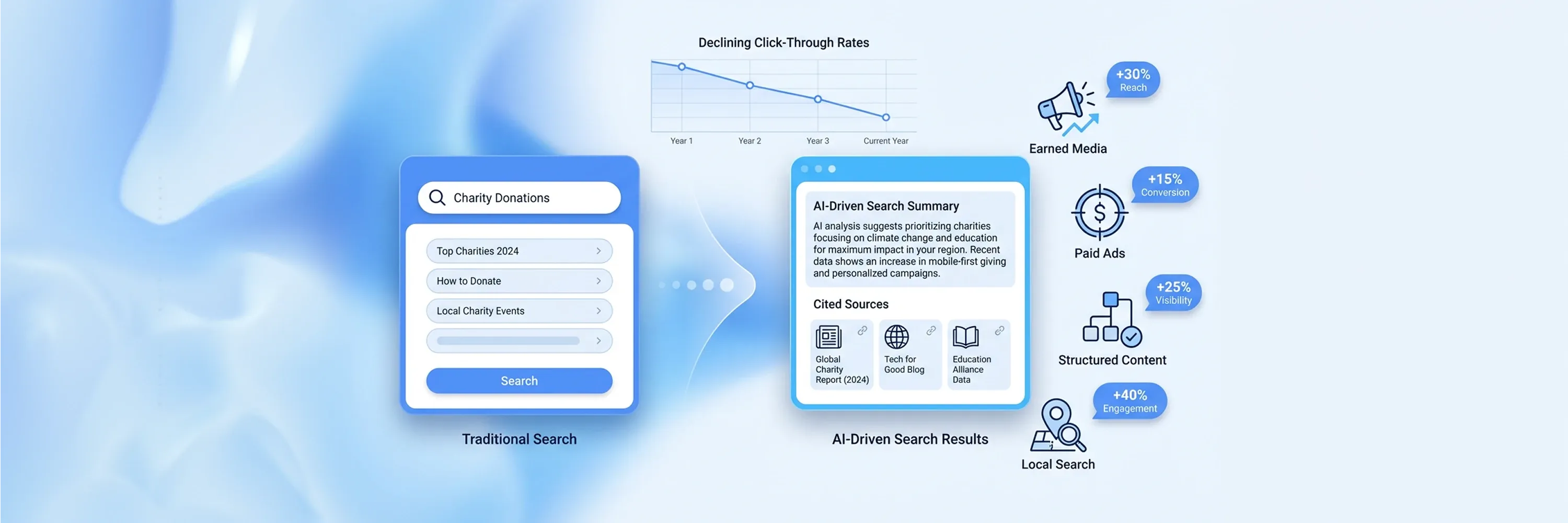
Infographic comparing traditional search with AI-driven search results, showing improved engagement, visibility, and conversion rates.

Search Engine Marketing for Charities in the Age of AI

In this article, we explore how the transition to AI-generated search results impacts digital visibility for causes. We break down the exact steps organizations take to secure AI citations through third-party media and use paid advertising grants.

Content authorSnoika FoundationPublished onReading time11 min read

Introduction

Search engine marketing for charities now requires adapting to a fragmented environment that features AI-generated answers and ad-heavy local results. Previously, organizations optimized their websites for traditional keywords to rank high on search engine result pages. Today, AI engines pull information from diverse sources, and organic link clicks have plummeted. Bain & Company surveyed consumers and found that 80% of consumers rely on zero-click results in at least 40% of their searches, and this behavior reduces organic traffic significantly.

Organizations secure visibility for donors and volunteers when they blend third-party earned media with strong paid search infrastructure. Charities risk losing access to high-intent supporters who no longer visit primary domains if they fail to adapt. The following sections detail how causes shift their digital strategies to maintain relevance, capture local intent, and succeed in this new search environment.

Fragmented Search Reality

This new search environment features AI Overviews and tools like ChatGPT that change how donors discover causes online. Algorithms extract information from various sources and answer user questions immediately on the results page. Because users get their answers and do not click links, organizations face a drop in traditional website traffic. Search engine marketing for charities requires a new approach to overcome this shift.

Measurable Decline in Visibility

Recent data shows how much visibility organizations lose in this environment. A Seer Interactive study found that the organic click-through rate dropped 61% for queries that trigger AI Overviews, while paid click-through rates fell 68%. Nonprofits suffer more than other industries. After the AI rollout, charity websites experienced a 28.9% decline in ranking pages. This decline represents the largest drop among 16 studied sectors.

Strategic Implications for Nonprofits

Organizations feel confident about their core mission, but they struggle to reach new supporters when their primary domains lose search ranking. These groups need a new strategy that adapts to new algorithms. If a nonprofit relies solely on website optimization, it will not reach potential donors and volunteers. Search engines prioritize instant summaries over direct website referrals. Organizations must change how they position their digital content to remain visible to their communities.

Earned-First Visibility Rule

Organizations position their digital content differently because generative engines build their answers and pull information from trusted, independent sources rather than organizational websites. This preference makes media citations the primary driver of visibility. Organizations must integrate public relations into their digital strategy. Nonprofits secure spots in AI summaries when they earn mentions in news outlets and authoritative publications.

This structural shift redefines AI powered SEM and forces organizations to adopt an earned-first visibility rule. The data confirms this heavy reliance on external validation. Alana Gold serves as Group Vice President at The Bliss Group, and she notes that 89% of AI-cited links originate from earned media sources rather than brand-owned pages. Another research analysis from xfunnel.ai found that AI search engines cite third-party content more frequently than brand-owned domains across all analyzed platforms.

How Organizations Earn AI Citations

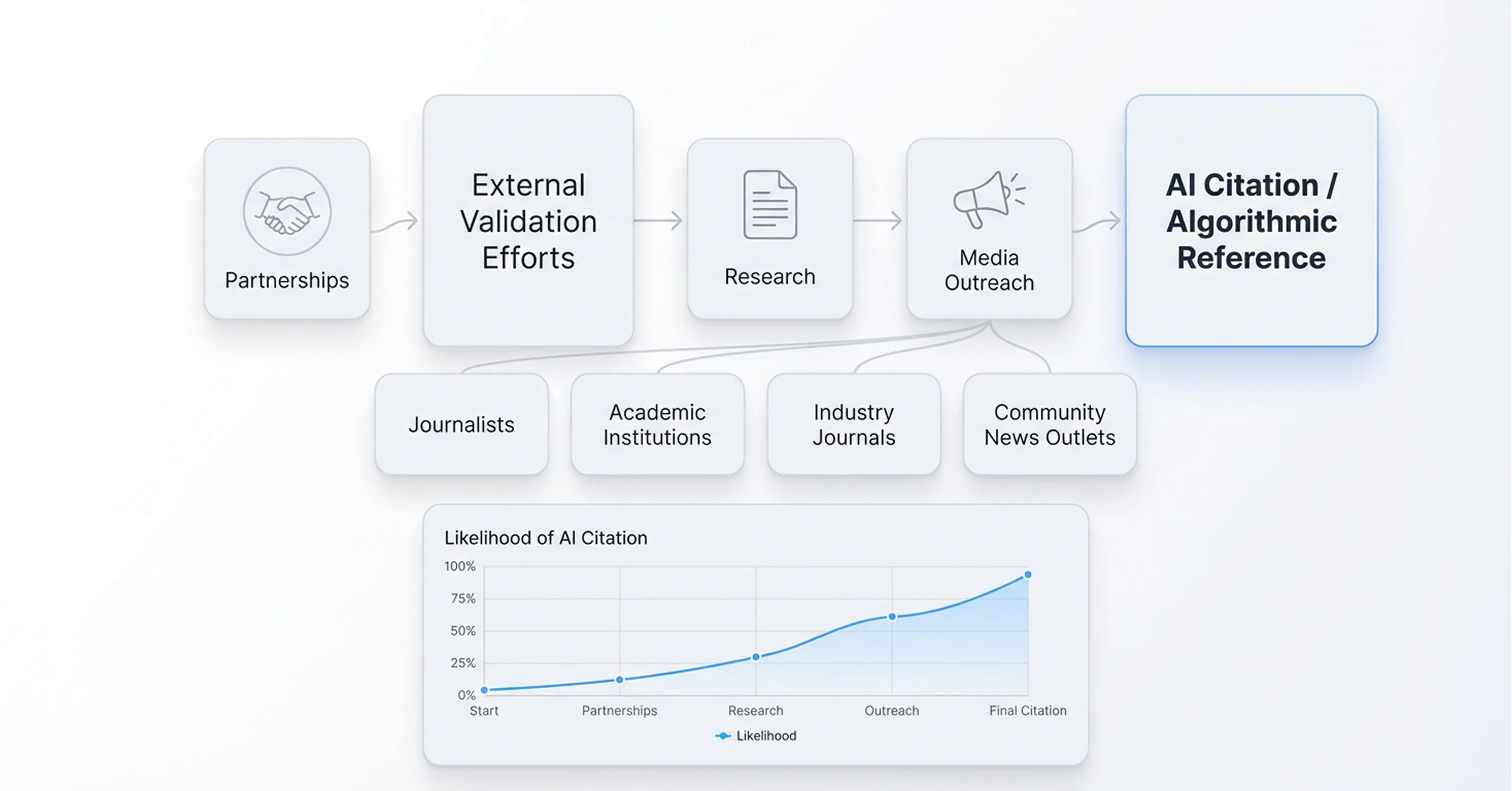
Diagram showing how partnerships, research, and media outreach contribute to AI citation and algorithmic reference in search results.

To translate the earned-first visibility rule into practice, organizations must take a proactive approach to external validation. Rather than relying on owned channels, they intentionally create opportunities for third-party coverage and recognition. These efforts increase the likelihood that their content will surface in AI-generated results.

Organizations secure these citations when they use specific media tactics:

  • They distribute original research reports to local journalists.

  • They partner with academic institutions and publish joint studies.

  • They pitch human-interest stories to community news outlets.

  • They publish expert opinions in recognized industry journals.

When organizations earn these external mentions, they feel confident that algorithms will reference their work. Search engines view third-party validation as a signal of accuracy and relevance.

Paid Search Infrastructure

Even though third-party validation signals accuracy, overall organic website visibility continues to shrink. Organizations must rely on paid advertising to capture audience attention. Search algorithms fill the top of the results pages with sponsored links and sponsored map listings. This layout pushes unpaid results further down the screen, and this forces users to scroll past multiple ads before they see standard links. Organizations understand that when they ignore paid infrastructure, they lose high-intent traffic to other groups. Local search results demonstrate this shift toward monetization. Places Scout tracking data reveals that local pack ads increased from less than 3% to 22% of tracked mobile keywords in just three months. When someone searches for a nearby food bank or animal shelter, they see sponsored map listings first.

Organizations use charity paid search so they do not lose their presence at the top of these local results. They secure immediate visibility for specific campaigns, community event registrations, and donation drives. With a confident approach to paid infrastructure, nonprofits offset their organic traffic losses and continue to reach people who want to help. These groups control what message appears, who sees it, and where it directs the user.

Google Ad Grant

Organizations control these paid messages through specific funding sources. Many nonprofits do not use available advertising funds that could replace their lost organic traffic. Google provides a $10,000 monthly ad grant to eligible charities, but a large portion of this money remains untouched. As of 2022, just over 65,000 nonprofits actively use Google Ad Grants monthly. This low adoption rate indicates a missed opportunity across the sector.

Organizations maximize these funds when they build a campaign framework. They divide the grant money across brand awareness, specific program promotions, and volunteer recruitment. Organizations allocate the budget to target long-tail search phrases that relate directly to the cause. Nonprofits fully spend the monthly allocation and ensure their message consistently appears above the AI summaries and organic listings.

Local Ad Packs

Organizations ensure their message appears above general listings, and they also target users who search for community services and volunteer opportunities in their immediate geographic area. Organizations capture this local intent and run ads that appear within map results. These location-based advertisements highlight physical proximity and make it easy for local supporters to find nearby facilities. Supporters do not have to scroll through endless pages.

Organizations target specific postal codes and neighborhoods where their physical events take place. When a user searches for weekend volunteer work, the sponsored map listing displays the organization's address, operating hours, and a direct link for directions. This strategy works well for food pantries, thrift stores, and community health clinics. Causes secure positions in the local pack and intercept users when they look for nearby opportunities to engage.

Charity Paid Search Tactics

Organizations secure these local pack positions and intercept users when they build specific campaign structures, and modern algorithms require these structures to deliver measurable results. Organizations organize their charity paid search accounts into themed ad groups that focus on single user intentions. One ad group targets monetary donations, while another focuses strictly on the collection of physical goods.

These paid campaigns must connect digital ad spending to real-world offline activities. Nonprofits track how many users click an ad and subsequently attend a fundraising gala or drop off supplies at a collection center. Organizations configure the analytics software to measure these physical interactions. If they do not track offline conversions, they cannot prove the financial value of their advertising efforts. This data helps them adjust their bidding strategies to support their mission goals.

Search Engine Marketing for Charities Through Content Structure

Organizations adjust their bidding strategies for paid campaigns, and they also adapt to Generative Engine Optimization to improve organic visibility. These groups implement specific on-page structures that signal authority to algorithms. AI algorithms scan digital content for credible data rather than simple keywords. Organizations use ai powered sem and structure their website pages to answer complex questions directly.

These organizations ensure every article includes expert quotes and specific facts. Search engines view these elements as indicators of trustworthy information. According to a Ziptie study, adding statistics increases AI visibility by 22% across generative search platforms. The same research indicates that adding source citations produces a 115.1% visibility increase in AI platforms. Organizations do not ignore these technical requirements.

Structuring Content for Algorithmic Selection

To remain visible in AI-driven search environments, organizations must go beyond what they say and focus on how they present it. Generative engines prioritize clarity, credibility, and structured information when selecting sources. As a result, formatting and evidence become just as important as the message itself.

These groups revise their online materials carefully to match these exact algorithm preferences:

  1. Specific statistics from recent reports support claims.

  2. Quotes from recognized field experts establish topic authority.

  3. Direct links to original research papers and academic journals provide evidence.

  4. Clear headings organize content and reflect common user questions.

Search engine marketing for charities requires this exact structural precision to capture algorithm attention. Organizations standardize these formatting rules across all digital publications to maintain consistency. AI engines select content to build their immediate answers when websites present information clearly and cite credible sources. This structural approach helps organizations secure citations and prepares them to use the unique engagement patterns of AI search engines.

Advanced AI Search Capabilities

Organizations use these unique engagement patterns to achieve higher engagement rates from their digital visitors when they focus on AI engines specifically. Users who interact with generative platforms display different behaviors than traditional search engine users. People ask conversational questions to an AI model, and they seek specific solutions to immediate problems. These users do not want generic links. This high intent translates into measurable actions when those users eventually click through to an organizational website.

Organizations track these visitors and notice distinct performance differences between traffic sources. Snezzi analyzed recent Semrush data and showed that ChatGPT traffic converts 4.4 times better than Google traffic. Some sites report a 14.2% conversion rate compared to Google's 2.8%. This difference proves that AI referrals bring highly motivated supporters to the cause.

Strategic Shift to AI Interfaces

Organizations practice AI powered SEM and shift their attention toward these conversational interfaces to capture this audience. These organizations build content that answers complex ethical and logistical questions about their mission. Charity paid search captures local intent through traditional ad packs, and organic AI visibility delivers supporters who want to read deep research and make informed donation decisions. Organizations recognize this behavioral shift and allocate resources to optimize for both platforms simultaneously. These groups evaluate their success through different metrics than traditional website clicks to understand the true value of these highly motivated AI users.

Modern Conversion Metrics

These different metrics form modern measurement strategies that require organizations to shift their focus from basic click-through rates to mission-aligned metrics. The transition to AI search marketing changes how websites receive visitors. Traffic volume often decreases because generative engines answer user questions directly on the search page. However, the users who click through to the website arrive with stronger intentions to engage. Organizations understand that a smaller group of dedicated visitors provides more value than thousands of passive readers. These organizations track multi-channel journeys and physical interactions like volunteer registrations and charity shop visits instead of page views. These groups know that simple clicks do not tell the whole story. This approach proves that lower traffic volume often yields higher quality conversions.

Real-World Performance Evidence

Real-world applications demonstrate this principle clearly. During a recent digital transition, Mercy Corps experienced a 37% drop in organic search sessions, but the remaining traffic converted much better. After the organization adjusted its digital strategy, ChatGPT became the second-highest referral source for their website. Search engine marketing for charities relies on this exact perspective to prove financial return.

Organizations evaluate how digital discoveries lead to offline donations and community participation. These organizations build sustainable strategies that survive algorithmic changes when they measure the right actions. Charities adapt to the evolving digital environment and secure long-term support when they redefine successful interactions.

Conclusion

Organizations secure this long-term support through modern search engine marketing. In summary, search engine marketing for charities requires adaptation to AI answer engines and the use of paid tools. This new marketing environment hides organizations from a new generation of high-intent donors when groups ignore the changes because donors rarely scroll past the initial AI summaries. The future search landscape will continue to favor authoritative third-party sources over traditional brand-owned pages. An effective campaign requires an audit of Google Ad Grant use and local media outreach to secure critical AI citations. A review of Pinecone's vector database architecture helps explain the core technology that powers these search shifts.
You can partner with Snoika Foundation to amplify your organization's voice in the digital age. They empower nonprofits to become visible and cited in AI search engines like ChatGPT and Perplexity. Their proven frameworks help mission-driven organizations build trust and global partnerships.

You usually see measurable outcomes within three to six months after you launch your campaigns. Effective search engine marketing for charities requires time for algorithms to index new content and recognize your third-party media citations. This waiting period allows search engines to evaluate your authority.

Social media engagement doesn't directly improve your search rankings. However, active social profiles help journalists discover your cause and write stories about your mission. These news articles then generate the authoritative citations that AI algorithms need to feature your organization in their answers.

You shouldn't ignore video content when you plan your digital strategy. You can use educational videos to capture donor attention and increase your website traffic. Search engines regularly display mission documentaries above standard text results. You must transcribe your videos to help algorithms understand your message.

You must publish accurate data and positive community stories to replace outdated or incorrect information. AI algorithms prioritize recent and factual content from trusted news sources over older complaints. You can invite local reporters to tour your facilities and document your current operations to generate positive coverage.

Book a Demo

Book a time that works best for you

You Might Also Like

Discover more insights and articles

Infographic showing responsible AI-powered content workflow for NGOs including tool selection human review content structuring SEO and credibility maintenance

AI Tools for Content Creation Every NGO Should Know

In this article, we explain how organizations can increase their search visibility and maintain credibility. We detail how to strategically implement generative workflows to ensure institutional information appears in conversational search engine answers.

Infographic showing transition from traditional marketing methods to AI-driven system with automation structured data personalization and improved efficiency

How AI Is Transforming NGO Digital Marketing

In this article, we examine the changes in digital discovery and explore how organizations adapt to new algorithms. We outline strategies to integrate content automation, transparent analytics, and structured data into marketing operations.

Infographic showing transition from classic SEO to AI-powered digital discovery for NGOs, highlighting analytics, audience insights, precision targeting, and increased funding performance.

What to Look for in a Digital Marketing Agency for NGOs

In this article, we explain how AI response engines changed online discovery. We explore the specific capabilities organizations need to look for when they choose an agency, and we discuss how they can secure AI visibility, maintain rigorous data governance, and measure true impact.

Infographic showing nonprofit digital transformation process from outdated systems to AI-driven optimization, highlighting data unification, automation, donor engagement, and increased funding impact.

NGO Digital Marketing Strategies That Drive Trust and Visibility

In this article, we examine the recent changes in online discovery and donor engagement. We explore how organizations adapt their outreach frameworks to establish reliable connections alongside artificial intelligence and new funding models.