Why paid search matters for NGOs now
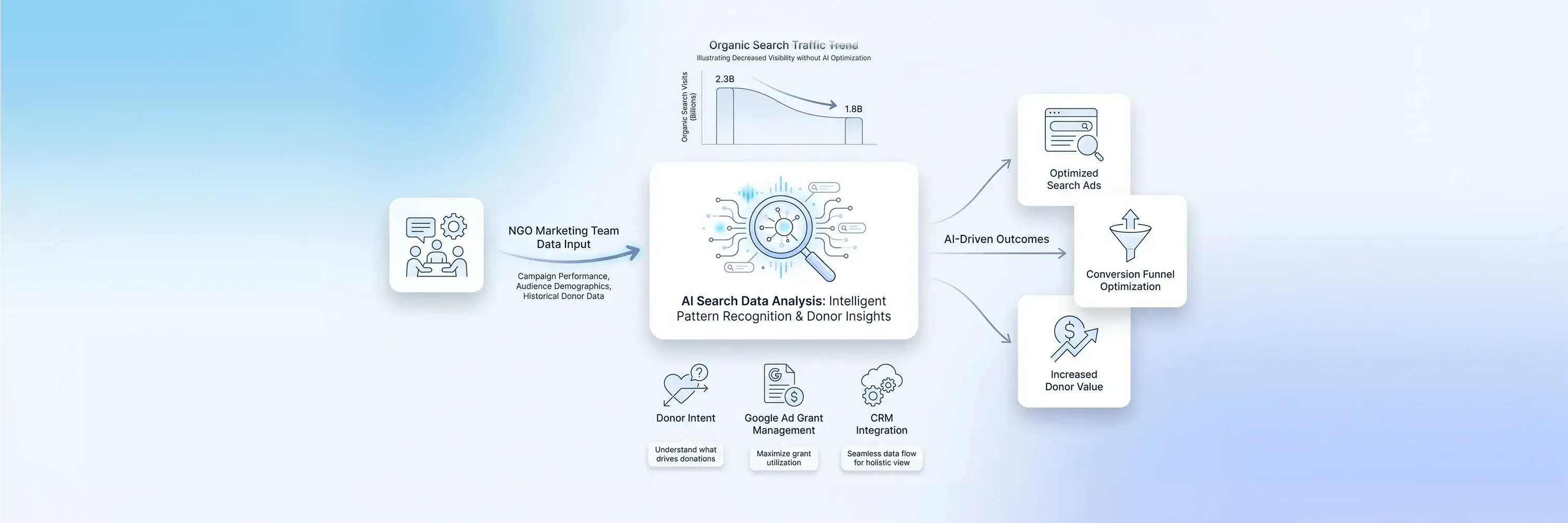
Donor attention is harder to win than it was even two years ago. Organic search referral traffic to publishers and nonprofits has dropped sharply, from over 2.3 billion U.S. visits in July 2024 to 1.8 billion in June 2025 according to Similarweb data reported by Digiday. At the same time, paid channels are absorbing more budget. M+R's 2026 Benchmarks report found that nonprofit digital ad spend grew by 18% in 2025, and organizations reinvested ten cents in advertising for every dollar of online revenue.
That pressure is exactly why paid search for NGOs has moved from a side experiment to a core fundraising channel. Search ads still deliver the highest return on ad spend of any digital channel, at $2.23 for every dollar invested, based on M+R's analysis. The Google Ad Grant gives eligible 501(c)(3) organizations $10,000 per month in free search advertising, but with a $329 daily cap and strict click-through rules. Those constraints make AI-informed planning urgent.
The shift from keywords to intent
Paid search for NGOs used to reward organizations that bid on the right phrases. That is no longer enough. Users now ask conversational questions in Google and ChatGPT, which reached 700 million weekly active users by September 2025 according to Business of Apps. A query like "how can I help kids in Sudan right now" carries different intent than "Sudan charity," and the bid logic must reflect that.
NGO paid search teams classify queries by what the searcher actually wants:
-
Donation-ready intent, where the user is looking to give immediately
-
Research intent, where the user is comparing causes or checking credibility
-
Volunteer or sign-up intent, where the action is non-financial
-
Crisis response intent, where urgency drives the click
Consider a wildlife NGO bidding on "save elephants." A generic keyword bid pulls in students writing essays and curious browsers. An intent-led bid on "donate to anti-poaching unit Kenya" pulls in a smaller audience with a much higher conversion rate. The first wastes Ad Grant impressions. The second turns a $2 click into a recurring donor.
Using AI insights in paid search for NGOs
AI is most useful in paid search for NGOs when it scales judgment that a small NGO team cannot replicate by hand. A two-person marketing department cannot manually review 400 search terms a week, but it can review the patterns AI surfaces. Use the technology as an analyst. The decisions about which causes to amplify and which language to use stay with the humans who know the mission.
This is also where NGO paid search separates from generic ecommerce PPC. Donors are not buyers, and a donation page is not a checkout. AI applied without that distinction will optimize toward the wrong outcome.
AI for audience and keyword discovery
Generative AI clusters long-tail queries into themes a human misses. For climate education campaigns, an NGO prompts a model to map every adjacent search a parent runs, from "how to talk to kids about climate change" to "climate-themed birthday party." Those long-tail terms rarely show up in standard keyword planners, but they convert because they reveal a values-aligned audience.
Google's own audience insights tools, paired with third-party platforms like Semrush or SparkToro, let teams move past assumed personas. The Sierra Club, for example, has used digital ads to test segments well outside its traditional membership base. A practical starting prompt: ask the model to list ten search themes a first-time donor to your cause uses in the 30 days before giving. Then run those through Google's keyword planner to size demand.
AI for ad copy and creative testing
Responsive Search Ads let advertisers feed Google up to 15 headlines and four descriptions, and the system tests combinations against each query. AI accelerates the input side. A model can draft variations tuned to different emotional registers, from urgency for disaster appeals to reassurance for legacy giving, and translate them into the languages an NGO's audience actually speaks.
The risk is tone-deaf copy on sensitive causes. A refugee charity cannot publish AI-drafted ads about displacement without a human editor who understands the dignity of the people involved. Use AI to widen the creative pool, then have a program staffer review every line before it runs. Nonprofit PPC copy that sounds generic loses to copy that sounds specific to the cause and the donor.
AI for bidding and budget pacing
Google's Smart Bidding strategies use machine learning to predict the likelihood of conversion in each auction. In paid search for NGOs, the most relevant nonprofit ppc options are Maximize Conversions for sign-ups and Maximize Conversion Value when a donation amount is being tracked. Google's nonprofit help documentation confirms that Smart Bidding removes the standard $2 CPC cap on Ad Grants accounts, which is what allows NGOs to compete in higher-cost auctions like "donate now" branded terms.
Value-based bidding works only when the data feeding it is clean. As Search Engine Journal puts it in its Smart Bidding guide, "Garbage in, garbage out." Pass the actual donation amount back to Google Ads through enhanced conversions, and segment one-time gifts from recurring ones. If you assign every email signup the same $5 value, the algorithm will chase signups at the expense of major gifts.
Visibility data as a campaign compass

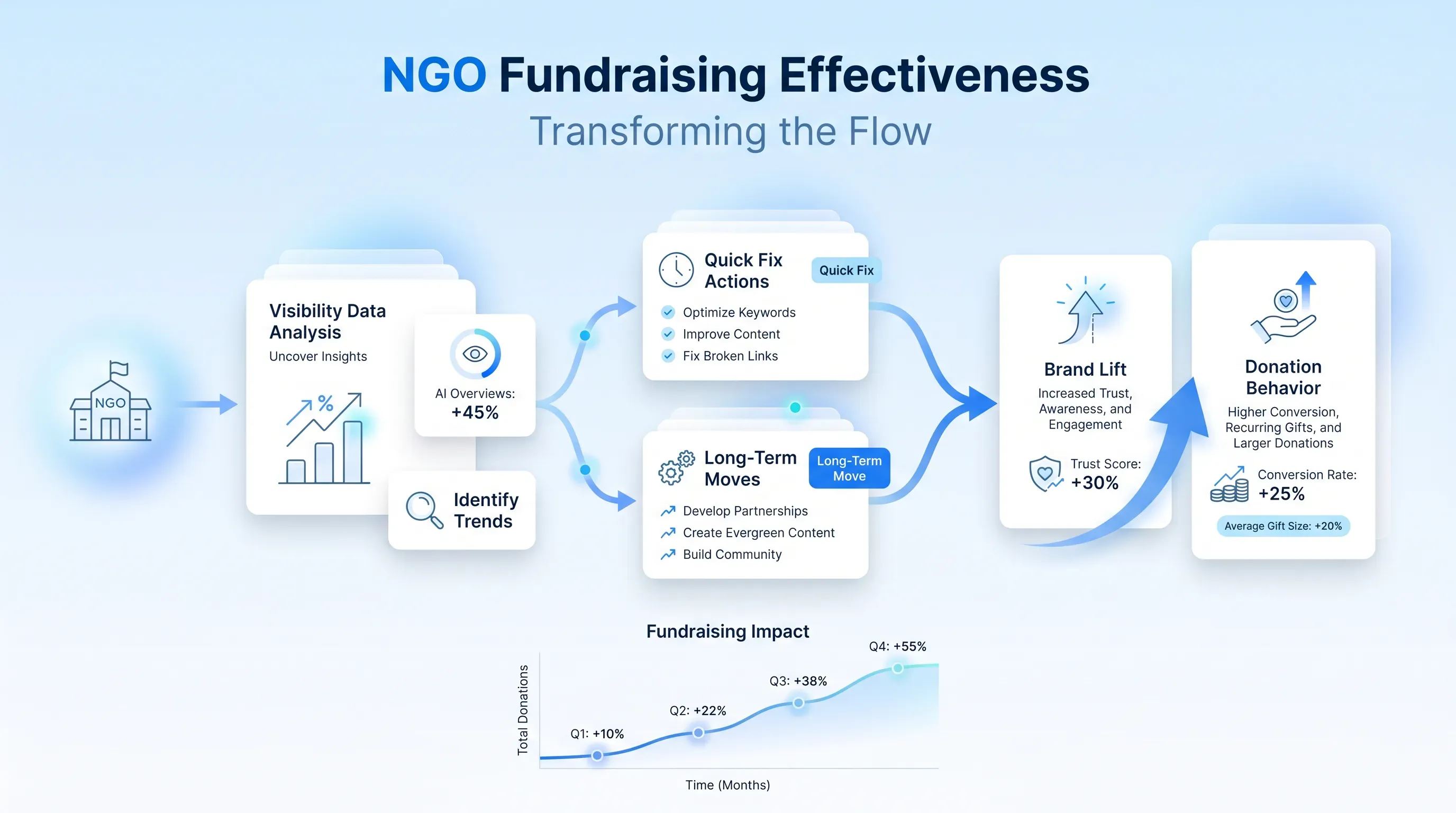
Visibility data tells you where your NGO is missing from the conversation. Share of voice across cause-related queries and presence in AI Overviews are now as important as ranking position. AI Overviews appear in 13-19% of all searches as of mid-2025, with health and scientific queries triggering them most often. For an NGO working in those exact areas, invisibility in AI Overviews is a fundraising problem.
Use visibility audits to answer two questions. Where does our cause get talked about without us in the answer? And where are competing organizations showing up in spaces we need to own? When the gap appears on high-intent commercial queries, paid search for NGOs is the faster fix. When the gap appears on informational queries that feed AI summaries, content investment is the better long-term move. Tie both back to brand lift studies so the board sees that awareness gains track with later donation behavior.
Building a deadline-ready campaign workflow
A giving day or emergency appeal compresses everything. There is no time to A/B test five landing pages. A repeatable workflow helps the team move fast without skipping safeguards.
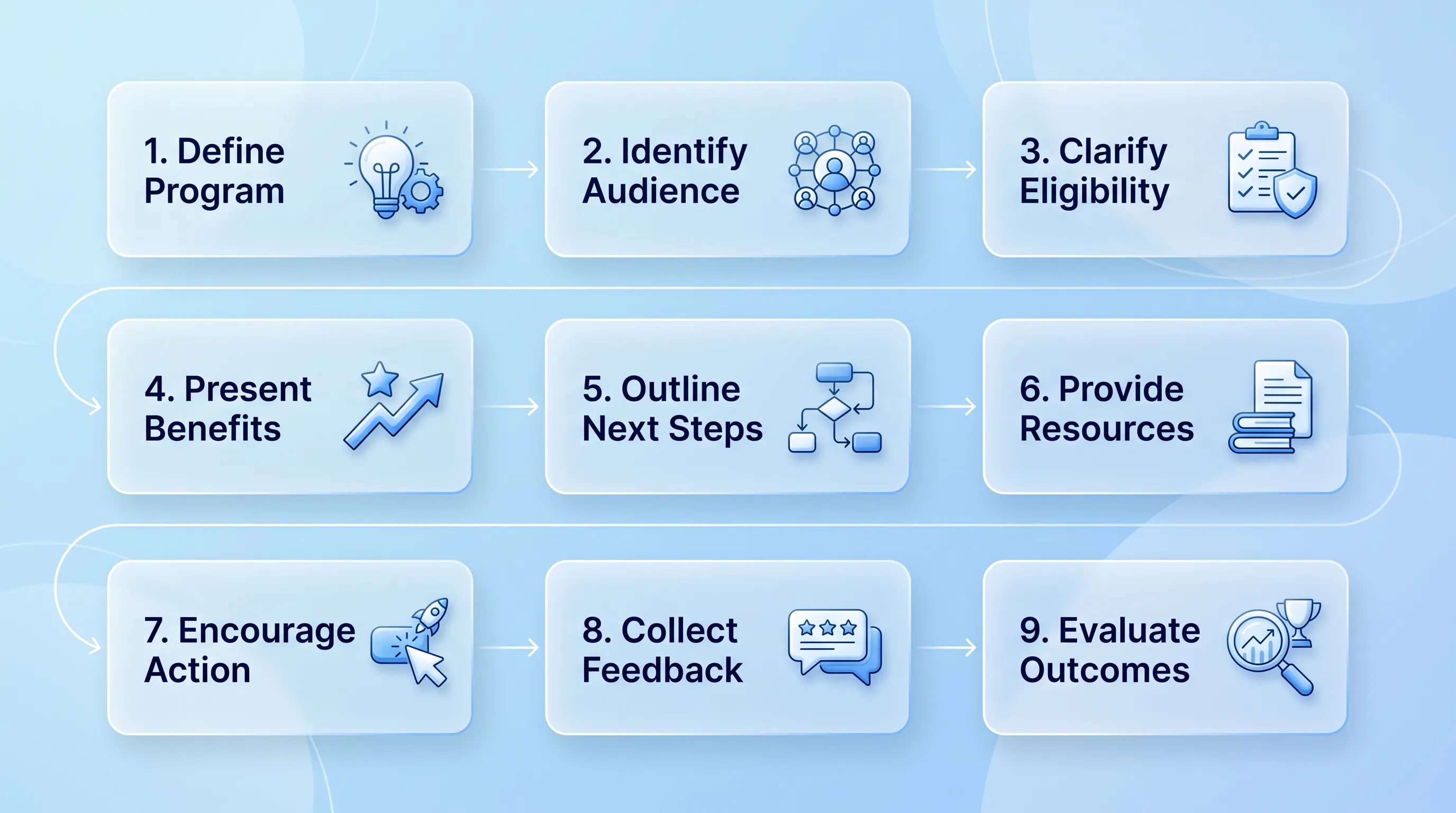
Teams maintain speed and consistency when they follow a structured process for campaign execution:
-
Map intent first. List the queries a donor runs in the 72 hours before giving to this specific appeal.
-
Draft assets with AI, then edit. Generate 20 headlines and trim to the eight that feel true to the cause.
-
Align the landing page. The promise in the ad must match the headline on the page within five words.
-
Set conversion tracking before launch. Test the donation flow end to end, and confirm the thank-you page fires.
-
Monitor live for the first six hours. Pause underperforming ad groups before they burn budget.
Speed is no excuse for skipping basics. Run accessibility checks against WCAG 2.1 standards so screen readers can process your donation forms. Confirm brand safety placements, and double-check that AI-generated images do not misrepresent the communities your NGO serves. A campaign that raises $200,000 and triggers a backlash is not a win.
Common mistakes to avoid
Campaign pressure often forces nonprofit teams to prioritize speed over process. Teams launch campaigns quickly, reuse old settings, or trust automation without reviewing the details. Most paid search failures do not come from major strategic mistakes. They come from small operational issues that quietly reduce efficiency and waste budget over time.
A quick self-check for paid search for NGOs teams under deadline pressure:
-
Relying only on Ad Grant keywords without a paid Google Ads account. The grant cannot bid on competitor brand terms or run display, so it caps your ceiling. Add a small paid account for the queries the grant cannot reach.
-
Ignoring negative keywords. Without a negative list, an animal welfare NGO will pay for clicks on "animal crossing game." Build the list weekly from the search terms report.
-
Under-measuring micro-conversions. Email signups and petition signatures predict future donations. Track them as secondary conversions.
-
Trusting AI outputs without auditing. Generative tools hallucinate program names and invent statistics. Every AI-drafted line needs a human source check.
-
Treating the Ad Grant as the whole strategy. Account suspension is real if you drop below the 5% click-through rate for two consecutive months.
Small corrections in these areas often create larger improvements than major campaign redesigns. Teams that identify these issues early protect both budget efficiency and long-term campaign performance.
Measuring what actually matters
Cost per click is the wrong headline metric for paid search for NGOs. It says nothing about whether the click became a donor. Track cost per donor acquired and 12-month retention of donors who came in through search. Assisted conversions matter for advocacy too, where a petition signer today is a major donor in three years.
Closed-loop reporting is what makes those metrics trustworthy. Connect Google Ads to your CRM, whether that is Salesforce Nonprofit Cloud or Bloomerang, and pass donation values back through enhanced conversions. M+R's benchmark for nonprofit ppc lead generation is a $2.81 average cost per lead, with health nonprofits closer to $9.25. Set your own benchmarks per campaign type. An emergency appeal will not perform like a year-round legacy giving campaign, and judging them against one universal KPI will mislead the team every quarter.
A short list of metrics worth wiring into your dashboard:
-
Cost per donor acquired, by campaign and by channel
-
Donor retention rate at 90 days and 12 months
-
Assisted conversions from advocacy actions to first gift
-
Revenue per visitor from paid search, against the M+R benchmark of roughly $1.33 across all sources
Next steps for your NGO
Paid search for NGOs delivers the strongest results when campaigns combine clear donor intent, reliable tracking, and data-informed optimization. AI can help teams move faster and uncover opportunities, but it works best when paired with strong campaign structure and human judgment. Organizations that connect search behavior, visibility data, and fundraising outcomes gain a stronger understanding of where budgets create measurable impact.
At Snoika Foundation, we help nonprofits build paid search systems that go beyond clicks and focus on real mission outcomes. From Google Ad Grant optimization and AI-informed campaign strategy to visibility audits and conversion tracking, we help teams create campaigns that attract the right supporters at the right time. If you want to strengthen your next fundraising campaign or improve how your paid search budget performs, book a call with Snoika Foundation and discuss the opportunities for your organization.