What to Expect From a Nonprofit Digital Agency in 2026

Content authorArtem LozinskyPublished onReading time10 min read
Title:
What to Expect From a Nonprofit Digital Agency in 2026

Meta description:
Learn how a nonprofit digital agency helps you connect web design with marketing to increase your recurring donations.

This article explains how a nonprofit digital agency connects web design with marketing-led fundraising into one supporter journey instead of treating the work as separate projects. It walks through the strategy and phased delivery that make this work inside real budget and staffing limits, with integrations and analytics built into the process, so you can judge whether Snoika fits your organization.

Why fragmented digital efforts cost nonprofits

A nonprofit digital agency exists because the way most organizations run their digital presence is broken in a specific, expensive way. Your website was built by one vendor a few years back. Email goes out through a tool a volunteer set up. Donation pages live somewhere else entirely, and nobody can see the whole thing at once. You feel the friction every week, but you have not had time to name why it keeps happening.

Here is what it costs you. When a supporter clicks a link in your newsletter and the page takes too long to load, they leave. The probability of a bounce climbs 32% as load time goes from one to three seconds, according to Google's research. That donor was ready. The handoff between your tools lost them.

The leak runs deeper than speed. Only 1% of nonprofit website visitors become donors or subscribers, which means 99 of every 100 people who find you click away without a trace you can act on. When your website and donation processor don't share data with your email platform, you can't tell which of those 99 almost gave. You're guessing.

And the guessing eats your team alive. A development specialist logs into three systems to answer one supporter's question. A prospect list sits in a spreadsheet for weeks because nobody had time to move it. For a small staff where communications effectiveness jumps once an organization reaches three full-time people, every hour lost to switching tools is an hour not spent on the mission. Fragmentation quietly drains donations and time until you decide to fix the system instead of the symptoms.

What a nonprofit digital agency does

A nonprofit digital agency builds and connects your digital presence around one goal: turning a stranger into a committed supporter. That's the line that separates it from a general web shop, which sells you a site and moves on, and from a fundraising consultant who knows donor psychology but can't touch your code. The nonprofit digital agency owns the whole path, so the pieces actually talk to each other.

The value is in the connection between them. A pretty website that doesn't feed your email list is a brochure. An email program that drives traffic to a clunky donation page is wasted effort. The work has to move as one system, because your supporters experience it as one experience whether you planned it that way or not.

When you compare providers, a real partner should already understand the things that make nonprofit digital work different:

Post-launch support belongs on that list too. A partner that disappears at launch leaves you exactly where you started, unable to change a headline without filing a ticket. The category you're looking for treats the launch as the beginning.

Need help with your AI visibility?

Book a free consultation with our experts we'll help you determine exactly which services your organization needs.

How the core services work together

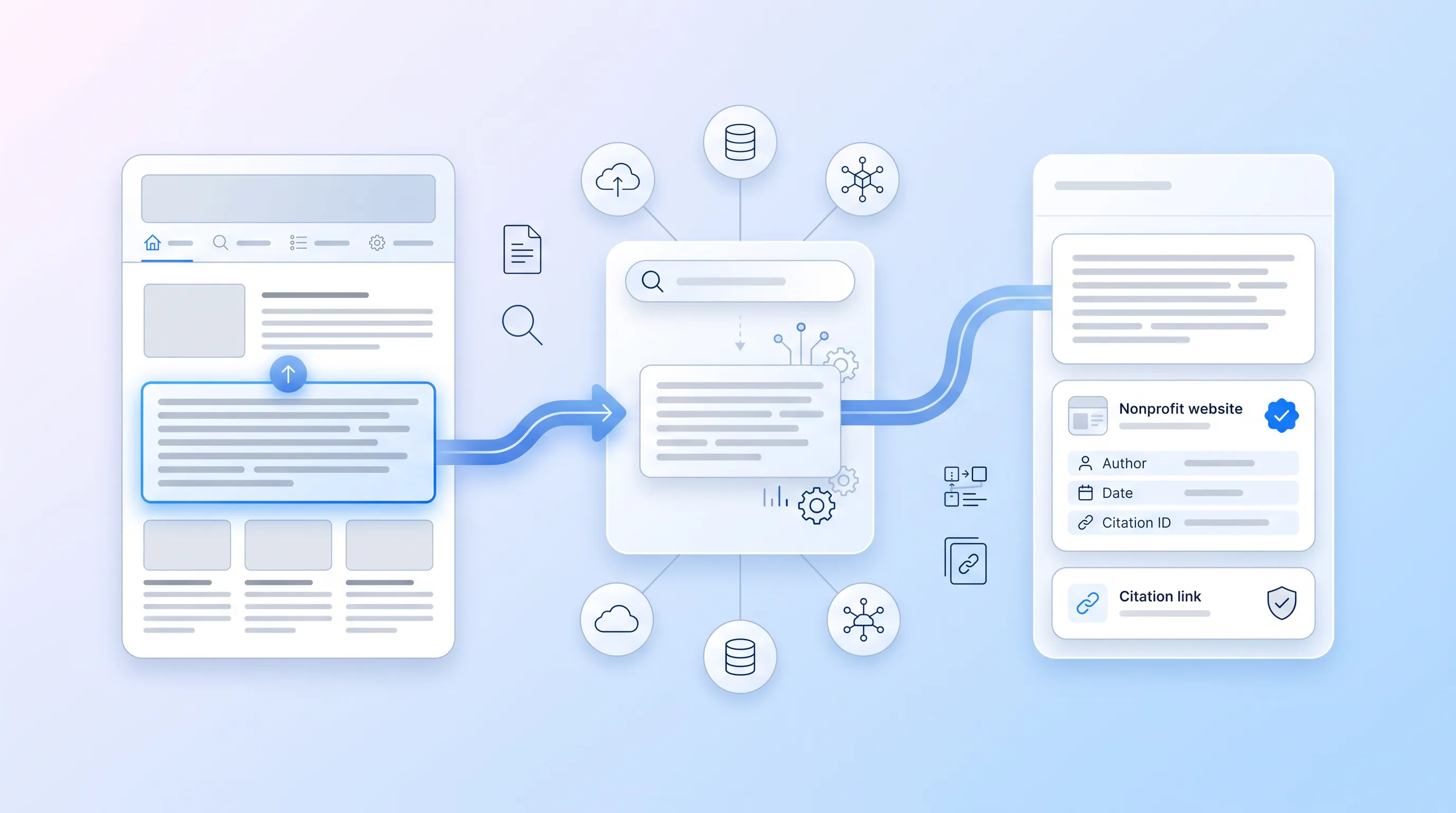
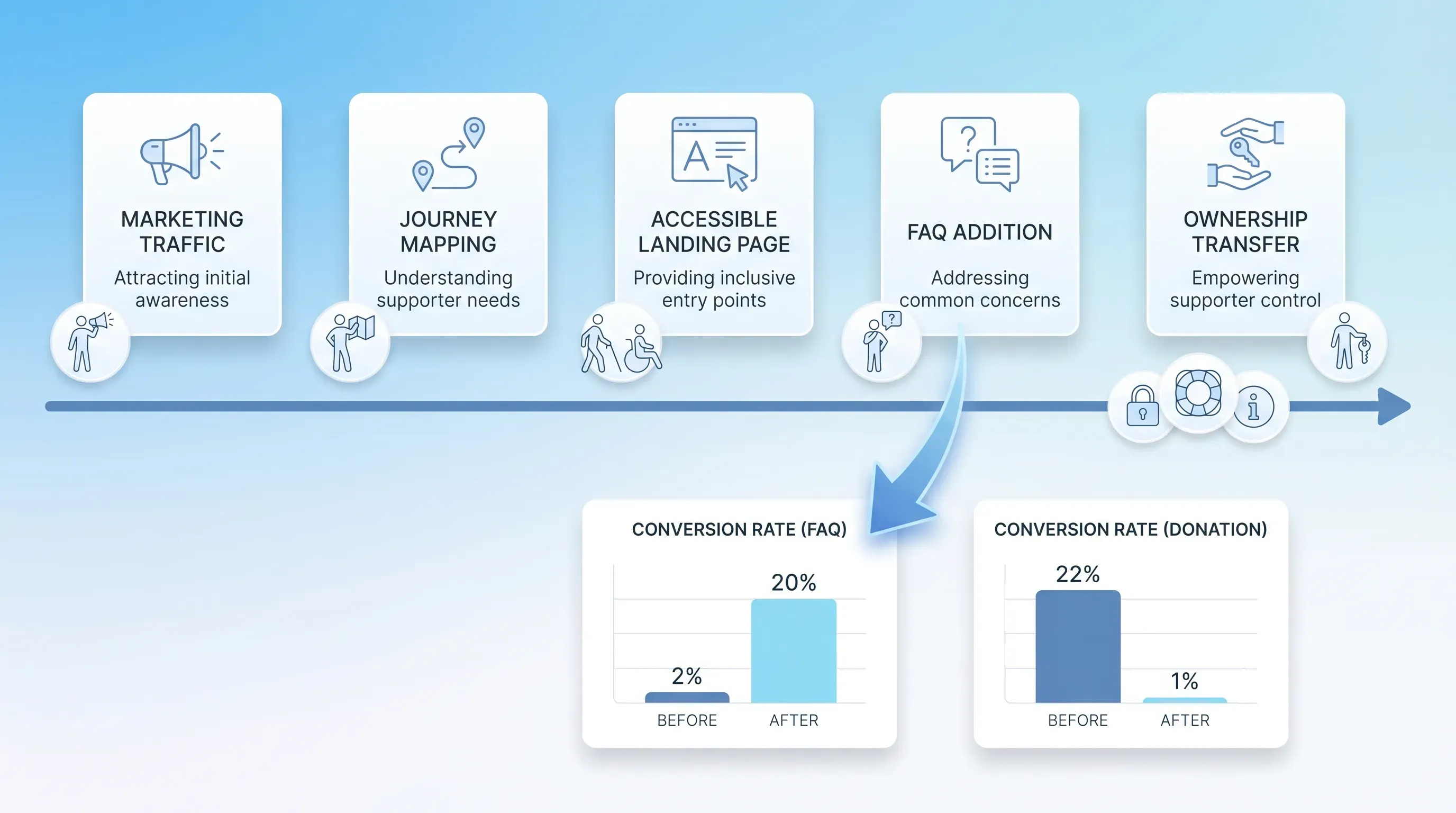
Calm infographic depicting a supporter journey flow with digital service steps, mini bar charts, and trust signal icons on a gradient background.

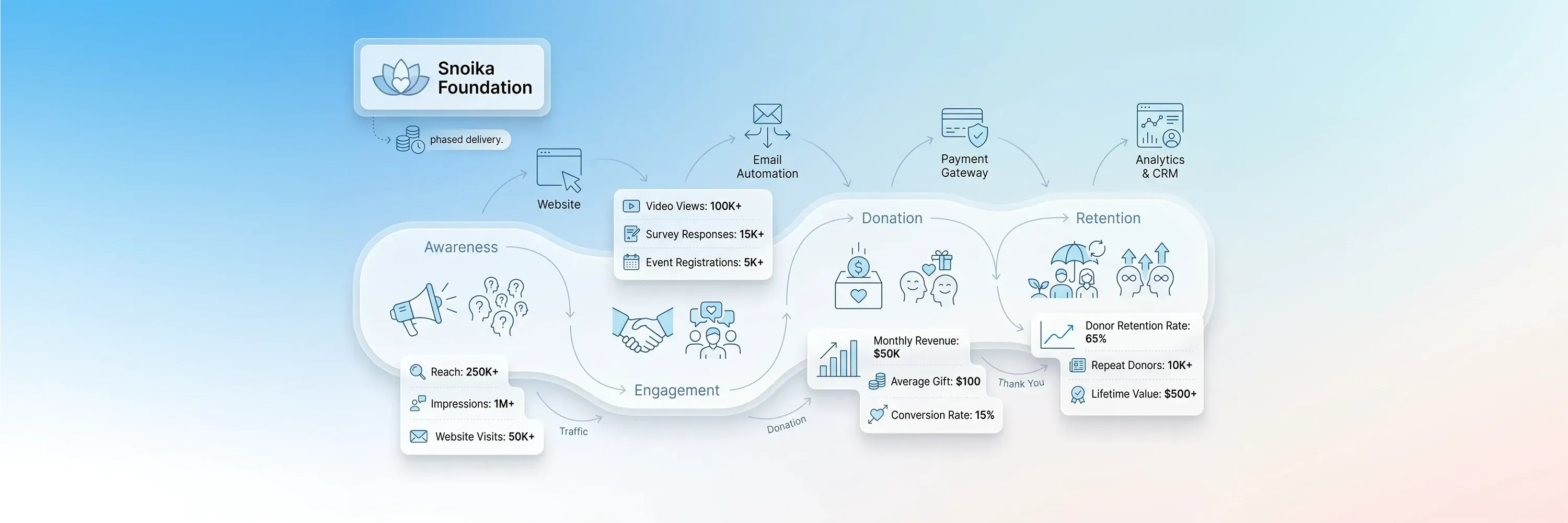
This is where the integrated model earns its keep. Strategy comes first, because without it you get three good projects that don't add up to anything. The nonprofit digital agency maps the supporter journey from the first visit through the repeat gift, then builds each service to carry the supporter to the next step. Digital outreach and fundraising stop being separate line items and start being one pipeline.

Think of it as a single flow with three jobs. Marketing brings the right person to the door. The website earns their trust and their first gift. The fundraising layer turns that first gift into a relationship that lasts years. The sections below detail each job, but the same supporter runs through all of them: one person moves forward while the system tracks the whole path.

Nonprofit web design that converts

Good nonprofit web design removes every reason a ready donor has to leave. That starts with the donation page, where intent is highest. Donation pages convert at an average of 22% versus the 1% of general site traffic, so the design job is getting more of your visitors there and then keeping the form frictionless once they arrive.

The mechanics matter more than the mood board. Forum One described a nonprofit that discovered 98% of people who clicked "donate" never finished, then lifted its conversion rate from 2% to 20% by adding an FAQ that answered tax questions right beside the form. Nothing revolutionary. Just trust signals placed where doubt lives. Campaign landing pages with clear impact statements and built-in accessibility do the same quiet work of holding onto people who were already inclined to give.

One thing separates nonprofit web design that helps you from the kind that traps you. The site has to be yours to run. A site that requires agency payment for every campaign banner or story leaves you renting your website. A site built for your team to manage keeps the cost of every future edit at zero and the speed at your own pace.

Nonprofit marketing services that engage

Nonprofit marketing services are the engine that fills the journey. The website can convert beautifully, but it converts nobody if no one arrives. So the work here drives qualified traffic through search and warms it up through email, with content shaped by a brand that looks the same everywhere a supporter meets you.

Email does the heaviest lifting. It drove 11% of all online nonprofit revenue in 2024 per the M+R Benchmarks report, and a third of donors say email is the channel that most inspires them to give. The catch is consistency. Personalized emails see open rates more than 82% higher than generic ones, which is exactly the kind of detail a stretched team can't sustain alone. That's the gap nonprofit marketing services fill: a steady program you don't have to run by hand.

Branding is the other place small teams quietly bleed. Lidia Varesco Racoma, a nonprofit brand strategist, put the problem plainly to Business.com: "Limited budgets, small teams and time constraints often mean materials are created on the fly," which produces an inconsistent brand experience. The fix is a clear brand system tied directly to the website, so the email and donation form feel like one organization. When marketing and web are built together, the supporter never feels the seam.

Need help with your AI visibility?

Book a free consultation with our experts we'll help you determine exactly which services your organization needs.

Fundraising and supporter journeys

Acquisition gets the attention. Retention pays the bills. The fundraising layer is where the integrated model proves its worth, because nonprofit marketing services pull web and marketing together around donor retention. The sector average donor retention rate sat at 42.9% in late 2024, down year over year, which means most organizations lose more than half their donors annually and replace them at far higher cost.

The math on recurring giving is the reason this layer exists. GivingUSA's research found that a recurring donor's lifetime value reaches $7,604 against $3,620 for a non-recurring donor, because the recurring supporter sticks around 8.08 years while the one-time donor lasts 1.68. So the journey is designed to move people toward monthly giving, then to keep them there with recognition and impact updates that make the commitment feel worth it.

Personalization is the tool that does it. Setting personalized ask amounts based on a donor's history produces an average 29% increase in gift size compared to showing everyone the same numbers, according to research cited by Virtuous. Pre-selecting monthly giving on the donation page can lift recurring conversions by up to 35%. None of that works unless the fundraising tools know what the supporter did on the website and in their inbox. That's the whole point of building the three services as one.

Integrations and analytics behind the work

All of this depends on your tools talking to each other. The nonprofit digital agency connects your CRM and donation processor with your email platform, so data flows into one place instead of sitting in three. The alternative is the chain reaction nonprofit data strategist Tracy Kronzak described, where disconnected systems force staff to log into multiple tools just to answer one question and prospect lists go stale in spreadsheets.

Shared data is what finally lets you see which channels and which pages actually drive gifts. Without it, you're spending blind. With it, you can trace a donor from the email that caught them to the landing page that held them to the gift they made. One CRM analysis found that nonprofits without a centralized system lose nearly half their donors within a year because follow-up becomes impossible to manage by hand.

Measurement is what turns a hunch into a decision. When you can see that email returns $58 per 1,000 messages sent while another channel returns far less, you know where to put your next dollar. For a budget that has no room for waste, that visibility is the difference between investing and gambling. Analytics makes the spending defensible.

Phased delivery for real budgets

No nonprofit should bet its annual technology budget on one giant project that either works or doesn't. Phased delivery breaks the work into stages, so you start with the highest-impact piece and expand only as results and budget allow. The risk stays small at every step because you're never committing to more than the last phase justified.

Each phase ties to your capacity and your return. The order runs like this:

  1. Fix the donation page and core conversion path first, since that's where ready donors are leaking and the return shows up fastest

  2. Connect your systems and stand up the analytics, so you can measure everything that comes next

  3. Build the marketing engine and the recurring giving journey once the foundation proves it holds

This structure answers the fear that sits under every nonprofit budget conversation: the fear of overspending on something that won't pay off. Transparent pricing and a phased plan mean you can walk into a board meeting with a number tied to the timeline and the results from the last phase in hand. You're showing evidence and asking to fund the next step.

How Snoika Foundation fits your team

Snoika Foundation is a nonprofit digital agency that applies this integrated and phased approach to your situation, with measurement built into the work. We connect nonprofit web design with marketing-led fundraising into one supporter journey that your team can run, with every phase tied to a return you can show your board. The qualities that matter when you choose a nonprofit digital agency are the ones we hold ourselves to: real nonprofit experience and clear support that lasts past launch.

If your website and outreach are underperforming and you need proof before you commit, start with a scoping conversation. Snoika Foundation will map your current journey and propose a first phase you can fund with confidence after it identifies where donations leak. Reach out to begin, and let our nonprofit digital agency build the connected system your mission has been missing.
Need help with your AI visibility?

Book a free consultation with our experts we'll help you determine exactly which services your organization needs.

Prepare access to your website analytics, donation platform, CRM, email tool, and recent campaign reports. A nonprofit digital agency needs this view to find where supporters drop off and which channels produce gifts. Bring staff pain points too, since workflow problems can explain missed follow-up.

Fix the step closest to a gift first. If donors reach the donation page but don’t complete it, improve that form before rebuilding the full site. If traffic is low, focus on search, email capture, or campaign landing pages after tracking is in place.

Yes, your team can keep current tools if they support clean data sharing and reporting. The key test is whether donation, email, and CRM records connect without manual copying. If a tool blocks that connection, replacing it becomes a practical budget decision rather than a preference.

Review results after a fixed window, such as 30 days, or after enough donation page visits to compare behavior fairly. Track completion rate, average gift size, and recurring gift selection. Use the same date range before and after the change so the comparison stays consistent.

Yes, Snoika fits a small team when the first phase matches staff capacity and board approval limits. The work should reduce admin load, not add another system to manage. Ask for the proposed phase, required staff time, and the metric used to judge success.

Book a Demo

Book a time that works best for you

You Might Also Like

Discover more insights and articles

Infographic illustrating the transformation of nonprofits hiring a Google Ad Grants agency, featuring a curved arrow and metrics.

Why Nonprofits Need a Google Ad Grants Agency to Maximize Free Ad Spend

This article explains what it takes to turn a Google Ad Grant into real donations and awareness, and where in-house efforts stall. It walks through setup and compliance, then follows the path from targeting to tracking so you can decide whether charity Google Ads support fits your organization.

Infographic comparing four AI marketing automation tools for nonprofits, featuring a central white board with soft shadows and muted blue icons.

Best AI Marketing Automation Tools for Nonprofits and NGOs

This article compares AI marketing automation tools for lean nonprofit and NGO teams across the jobs that eat your week, especially email and segmentation, while the discussion also covers scheduling and the reporting demands that come with multilingual outreach. It weighs honest strengths and trade-offs, then closes with implementation steps sized for a one- or two-person team.

A spacious SaaS infographic featuring translucent cards, icons, and flow lines on a smooth blue gradient background.

AI Content Generator for Nonprofits: Scale Content Without Losing Authenticity

This article shows nonprofit communications staff how to use an AI content generator to publish more without flattening the mission-rooted voice that earns trust. It covers where the tools save time and how to keep human judgment in the loop across multilingual outreach and AI search.

Title:
How an AI SEO Content Generator Helps NGOs Rank in Google and AI Search Engines

Meta description:
With this AI SEO content generator guide, you will learn to write steady posts that rank your

How an AI SEO Content Generator Helps NGOs Rank in Google and AI Search Engines

This article explains how a small NGO communications team can use an AI SEO content generator to publish steady, well-structured content that performs in both Google and AI search engines. It walks through keyword research and a repeatable publishing workflow, with practical steps you can copy.