Why timing decides fundraising results
Donors decide in narrow windows tied to news cycles, payroll dates, tax deadlines, and giving days. The Blackbaud Institute's 2025 report found that 36.1% of annual revenue arrived in Q4 alone, with December accounting for roughly 18% of all giving. That's where the decision happens, and that's where most nonprofits are invisible. Campaigns rarely fail because the cause is weak. They fail because the organization wasn't present at the moment a donor typed a query into Google or asked ChatGPT where to send $50 for hurricane relief. Here, Search visibility through SEO for fundraising campaigns is the bridge between donor intent and the donation form.
This is where SEO for fundraising campaigns earns its keep. It closes the gap between someone deciding to give and someone landing on a page that lets them. The rest of this article is a walkthrough of how to be there when that gap is shortest.
How search behavior shapes giving
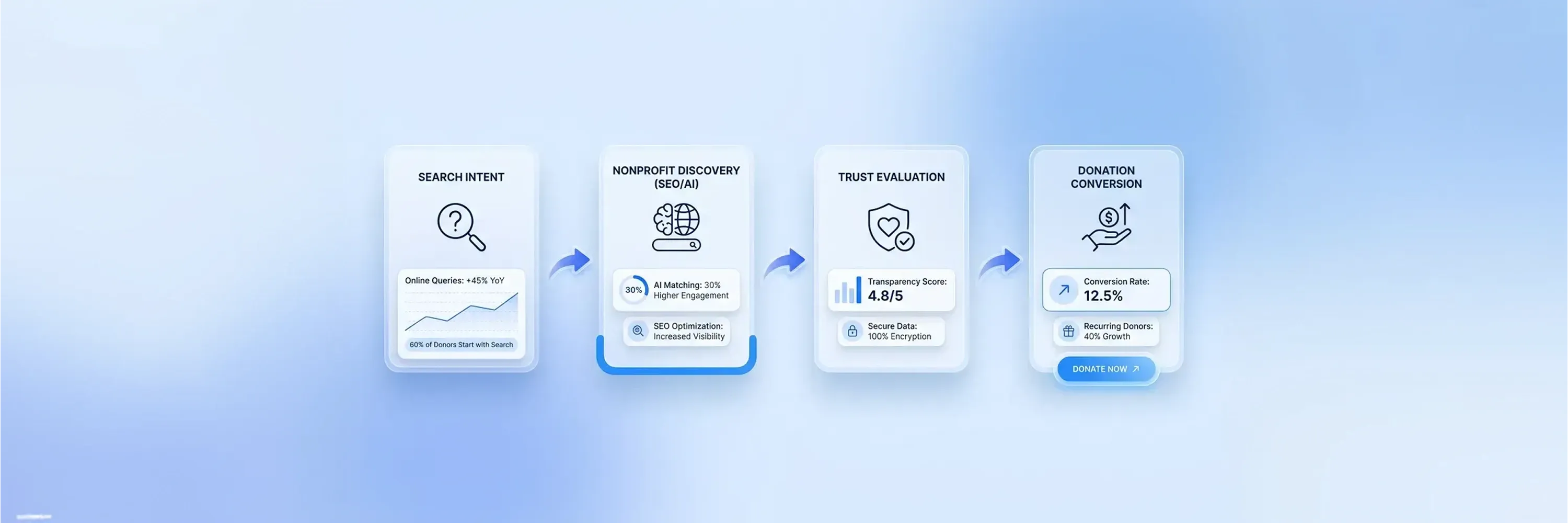
A donor's path from interest to gift moves through different query types, and each one signals a different readiness. Someone searching "why are wildfires getting worse" is still in awareness mode. Someone searching "donate to Maui fire relief 2024" has their wallet open. Treating those two visitors with the same page wastes the second one. The vetting stage matters just as much. Before sending money, donors check third-party validators. Charity Navigator describes its mission as helping donors give with confidence using IRS and partner data to power unbiased ratings, which is why "organization name + rating" queries spike right before a gift. If your nonprofit has nothing useful to say on its own site about financials or outcomes, the donor's research stalls or moves to a competitor.
The final stretch is the deadline rush. According to Donorbox research, online giving on December 31 clusters between 12 p.m. and 7 p.m. local time, which is the prime window for deadline-driven copy. If you ignore that journey, warm donors end up at the larger nonprofit that ranked above you because it was easier to find.
SEO for fundraising campaigns that convert
Three pillars of SEO for fundraising campaigns decide whether a campaign converts search traffic into gifts. Skip any one of them and the others get weaker. Donor-intent keyword research tells you which searches are worth chasing. Landing page structure decides whether those searchers give. AI discovery decides whether you show up in the new layer of answer engines that increasingly sit between donors and your website.
The rest of this section breaks down each pillar. Treat it as the shared checklist your team rallies around before launch.
Donor-intent keyword research
Keyword volume is a trap if you ignore intent. The query "What is food insecurity" gets searched a lot by people still in research mode. "Donate food bank Atlanta" gets searched less, yet a high share of those visitors complete a gift. Effective SEO for fundraising campaigns is the discipline of finding queries with a verb in them. Donate, support, sponsor, help families in, give to. Map each high-intent query to a specific page. Generic queries point to cause hubs. Location plus cause modifiers point to chapter or program pages. Disaster-response queries point to a campaign page built for that event. If two queries share a landing page, you've fused two donor moments into one, and the message dilutes for both.
Seasonal spikes are predictable, so plan for them. GivingTuesday 2023 generated $3.1 billion in donations in the U.S. alone, and search volume for terms like "Giving Tuesday donate" or "end of year donation tax deduction" climbs sharply in the two weeks before. Your fundraising SEO calendar should mirror that curve, with pages published and indexed by mid-October so they can earn links before the campaign.
Watch for these high-intent keyword patterns:
-
Cause plus location modifiers ("donate to homeless shelter Chicago")
-
Deadline triggers ("year end giving 2025," "last day to donate for tax deduction")
-
Beneficiary-specific asks ("sponsor a child in Kenya," "help veterans with PTSD")
-
Crisis-response phrases ("donate to earthquake relief Turkey")
Campaign landing page structure
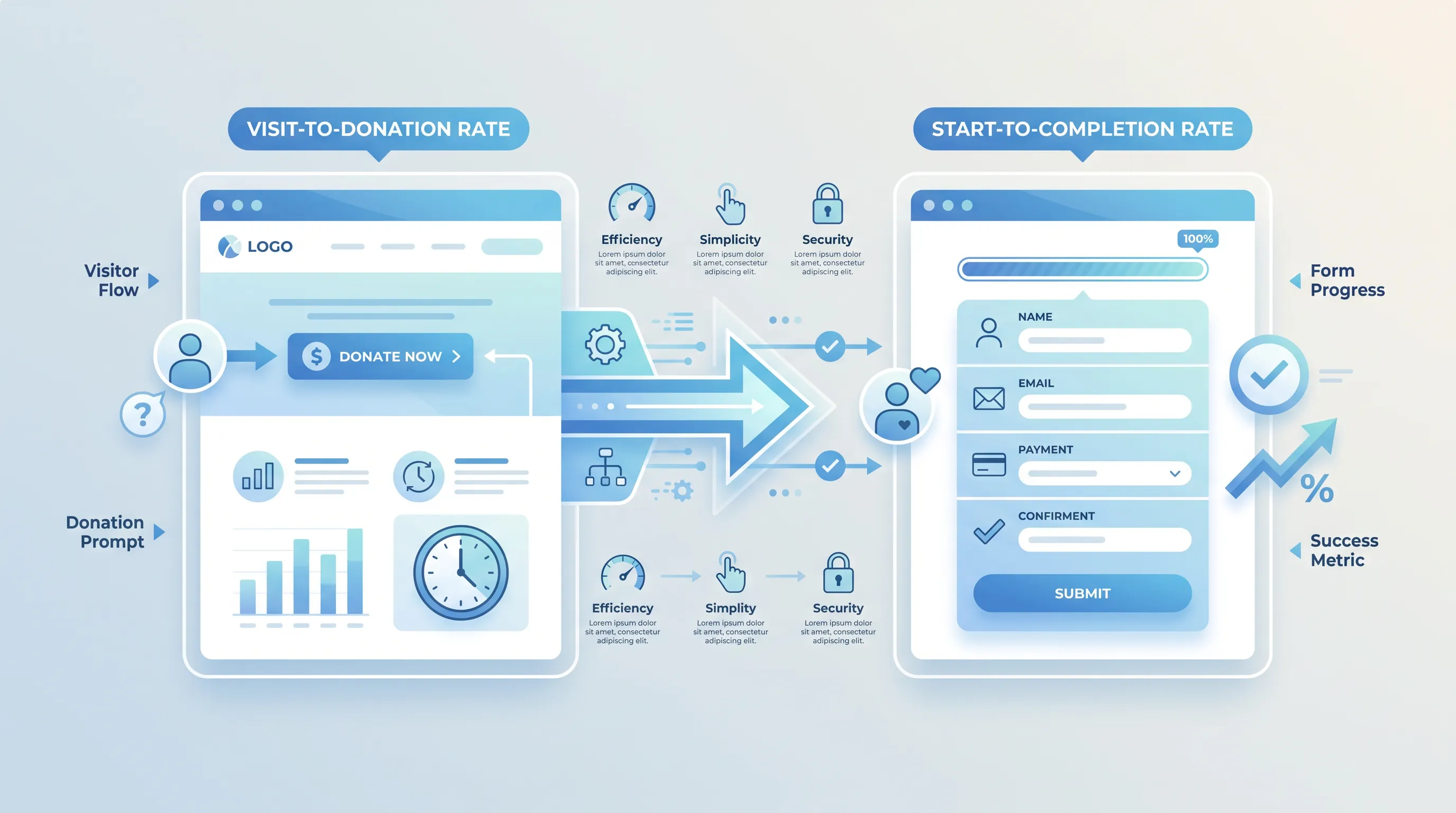
A donation page has one job. Most of them try to do five. The page that converts opens with a single clear ask and puts the donation form within the first scroll on mobile, with the deadline visible nearby. Program history and board bios belong elsewhere on the site.
Trust signals carry weight because donors read them as risk reduction. Recent impact figures and a Charity Navigator or Candid badge do more work than a paragraph of mission language. Schema markup matters here too. Adding Organization and NonprofitType schema in JSON-LD helps Google understand what you are and surface your knowledge panel correctly, and FAQ schema can answer donor questions about tax deductibility or recurring gifts directly in the search result.
Speed is the silent conversion killer. Google's research found that 53% of mobile site visits are abandoned when pages take longer than three seconds to load. A donation page that crawls on December 31 refunds the marketing budget you spent driving traffic to it.
Donor acquisition strategy for AI discovery
Answer engines now sit between many donors and your site. ChatGPT alone crossed 3.7 billion monthly visits by December 2024, and a growing share of those sessions involve people asking which charities to support. Google's AI Overviews appear for 13.14% of all search queries, which means a meaningful slice of donor research now ends without a click to anyone's website unless that website was cited in the answer.
What gets cited is transparent and easy to quote. Comparison pages that explain how your work differs from peer organizations and impact reports with specific numbers are the formats language models pull from. The donor acquisition strategy that wins here is content built to be referenced. At the 2026 Nonprofit Fundraisers Symposium, Alisa Scharf and TJ Peeler framed the shift this way: "Now this is really changing because it's less about page views as a measurement, and it's more about are you being pulled into AI and cited as a source of information?"
A strong donor acquisition strategy treats AI discovery as a primary channel for first-time donors. Write pages that answer the donor's question in the first 100 words. Use plain language for your mission. Publish numbers a language model can quote without ambiguity. Then check whether ChatGPT and Perplexity actually return your organization when prompted with the queries your campaign targets, and update the pages they ignore.
Content that earns donor trust

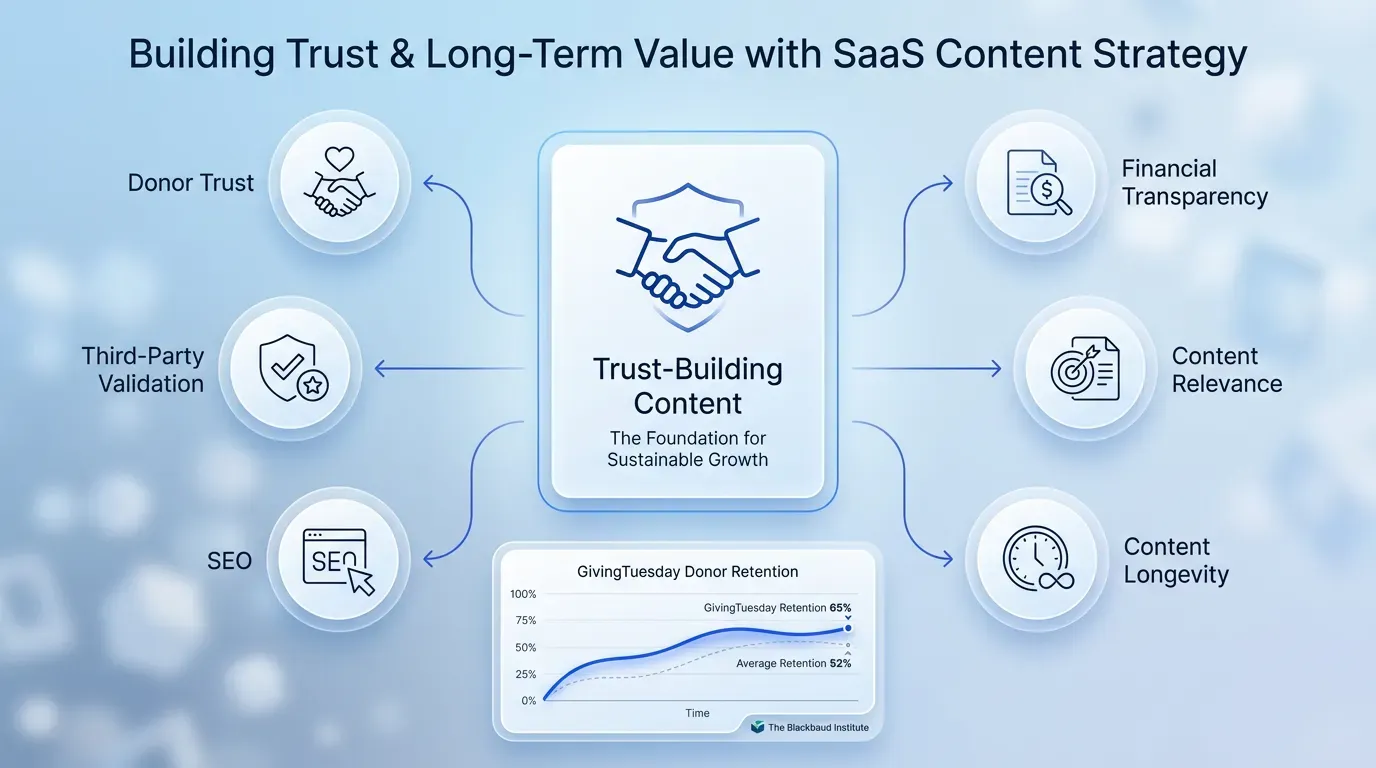
Ranking gets the click. Trust gets the gift. Donors vet before they give, and the content that satisfies that vetting also signals relevance to search engines. Impact reports with named programs and financial transparency pages that show how each dollar is spent do double duty.
Third-party validation matters more than self-description. Linking to your GuideStar Platinum seal or showing a Charity Navigator rating reassures donors who arrived through unbranded search and don't yet know you. The Blackbaud Institute found that GivingTuesday donors retain at 65% versus 52% for the average donor, because organizations that earn that first gift have the trust content that survives the second look.
This content compounds. An impact report you publish for the spring campaign still answers donor questions in November. A donor story you record in March feeds your year-end appeal and the AI Overview that summarizes your cause. The same story supplies the meta description that wins a click in February. Strong SEO for fundraising campaigns rewards the organizations that treat content as infrastructure. Recurring donors come from this layer, which is why a thoughtful donor acquisition strategy invests here even when no campaign is live.
Tracking performance before the deadline
Raw traffic is the vanity metric that has sunk more campaigns than any other. A 40% spike in sessions tells you nothing if the conversion rate dropped at the same time. The metrics that matter during a live push are the ones tied to gifts.
Build your dashboard around four signals:
-
Assisted conversions from organic search, segmented by landing page
-
Branded versus unbranded query growth in Google Search Console
-
Landing page conversion rate, tracked daily during the final two weeks
-
Average gift size by traffic source, so paid and organic can be compared honestly
Set recurring checkpoints. A two-week checkpoint and a 48-hour checkpoint give the team room to adjust copy or fix a broken form before the deadline closes. Waiting until January 2 to discover the donate button was hidden behind a cookie banner on iOS is the kind of mistake that costs a quarter of December revenue.
Good SEO for fundraising campaigns also rewards attribution discipline. AI-referred traffic from ChatGPT or Perplexity won't show up cleanly in GA4 without custom segments, and pipeline data from AI-sourced visitors converts at 14.2% compared with 2.8% for standard Google organic in commercial benchmarks. That gap is too large to leave unmeasured. If your team can't see which channel produced the gift, you'll renew the wrong contracts next year.
Common mistakes to avoid
Deadline pressure produces predictable errors. The most expensive one is launching a campaign on a brand-new URL with zero domain authority and expecting it to rank in three weeks. It won't. Campaign pages belong on the main domain as subfolders, where they inherit existing authority. A separate microsite makes sense only if the campaign runs for multiple years and earns its own backlinks.
Mobile checkout speed is the second recurring error. The Trajectory Web Design analysis of nonprofit pages found that when a donation page takes four seconds to load instead of one, conversion rates can drop by more than 450%. That metric represents lost gifts from donors who already decided to give.
Duplicate content across regional chapters is the third. National headquarters writes one appeal, and chapters paste it verbatim onto their own pages, which forces Google to choose which version to rank. It picks the one with the strongest backlinks and ignores the rest. Each chapter needs its own local angle and call to action. An audit for SEO for fundraising campaigns before launch catches this in an afternoon, and the fix is rewriting the local intro paragraphs.
Other mistakes worth flagging:
-
Burying the donation button below 800 pixels of program history
-
Forgetting to update the year in evergreen pages, so "Donate for 2023" still shows in 2025
-
Running paid ads to a page Google has deindexed, which signals quality problems back to the algorithm
-
No 301 redirect when last year's campaign URL is replaced, which kills the link equity built up over the prior season
Preparing for your next campaign
The weeks before a campaign launches decide whether the campaign succeeds, especially for SEO for fundraising campaigns. The Fundraising Effectiveness Project reports first-time donor retention at roughly 19.4% on average, which means the donors you find now have to be earned twice, first through visibility and then through follow-up. Treat the prep period as the work.
A realistic sequence for the eight weeks before launch:
-
Run a donor-intent keyword audit and map each query to a specific page
-
Refresh impact and transparency pages with current-year figures
-
Add or update Organization, NonprofitType, and FAQ schema across donation pages
-
Audit mobile load speed and fix anything above three seconds
-
Build the dashboard and confirm GA4 segments for AI referral sources
-
Set the two-week, one-week, and 48-hour checkpoint meetings on the calendar
A strong donor acquisition strategy is ongoing infrastructure that gets sharper with every campaign, and the next deadline is winnable if the audit starts this week.
Wrapping up
SEO for fundraising campaigns increasingly depends on timing, donor intent, technical structure, and AI visibility rather than keyword rankings alone. Organizations that align landing pages, trust content, and search discovery with donor behavior are more likely to capture donations during high-intent giving windows.
This is where Snoika Foundation fits in. We help nonprofits build the search and AI visibility systems that turn donor intent into completed gifts, from keyword research and landing page architecture to dashboards that survive a December 31 deadline. If you want a single donor-intent audit before your next campaign goes live, reach out to our team and we'll walk you through what SEO for fundraising campaigns can do for your numbers this giving season.