AI Blog Writing Tools: How Nonprofits Can Publish High-Quality Content Faster

Content authorArtem LozinskyPublished onReading time12 min read
Title:
AI Blog Writing Tools: How Nonprofits Can Publish High-Quality Content Faster

Meta description:
Find out how AI blog writing tools speed up your work. You will publish more nonprofit posts and

This article shows how a thin nonprofit comms team can use AI blog writing tools to publish more without sounding generic or getting facts wrong. You'll get a human-led workflow that protects both speed and trust, from the first brief through final publishing.

Why nonprofits feel stuck on content

You run the blog and the newsletter. The social accounts are yours too, probably along with the event recap, and AI blog writing tools keep showing up in your feed as the fix. But the calendar still wins. There's a gala to promote, and a grant report is due while the program update was needed yesterday. The blog post that was supposed to go out Tuesday slides to next month.

The numbers say you're not alone in this. 92% of nonprofits use content marketing, yet only 25% have a documented strategy to guide it. You have more stories than you'll ever publish. The bottleneck is capacity, because one or two people can't keep a steady publishing rhythm while fundraising and events eat the week.

So here's the tension this piece resolves. You want to publish more to stay visible to donors, but you're afraid that handing drafting to a machine will make your content sound hollow or, worse, get a fact wrong under your organization's name. Both fears are reasonable. The answer is to build a process where AI blog writing tools do the heavy lifting and a person stays accountable for what readers actually trust.

What AI blog writing tools actually do

Strip away the marketing and the job is narrow. At their simplest, ai blog writing tools draft text and build outlines. They can also condense long source material or turn one piece into another format. They predict the next likely word based on patterns in their training data, which is what makes them fast and what makes them unreliable when left alone. An ai writing assistant is good at producing a structured first pass from rough notes. It's good at turning a 40-minute interview transcript into a tight summary.

What it can't do is supply the things your blog runs on. It doesn't know your beneficiary's real name or what she said after the camera stopped. If your prompt leaves room, it will invent a statistic. A Stanford HAI study found that general-purpose chatbots hallucinated on 58–82% of legal research queries on 2023-era models, and even specialized tools grounded in curated databases got it wrong more than 17% of the time. The blog post generator will write a confident sentence whether the fact behind it exists or not.

You've met the familiar names already. ChatGPT and Claude handle general drafting, while ai blog writing tools like Jasper or Grammarly lean toward marketing copy and editing. The point here isn't which one you pick. Any blog post generator in this category produces roughly the same raw material, and the raw material is never the finished post.

That's the core argument of this whole piece. The value lives in how you use the tool inside a workflow that keeps a human at the controls. A weak process with the best ai blog writing tools produces fast garbage. A strong process with an average tool produces publishable work. Let's build the strong process.

Building an AI assisted blog workflow

Think of this as a system your team can actually run every month. Ai blog writing tools carry the drafting load so you're not staring at a blank page on a Monday with three other deadlines. A person owns accuracy and voice at every step, because those are the two things that protect your reputation. Each step below exists for a reason. Some steps buy you speed. Others guard the trust your audience extends to you. When you're tempted to skip one, ask which it protects, and you'll keep it.

Here's the path at a glance:

  1. Write a strong brief before any drafting starts.

  2. Generate and reshape a draft as raw material.

  3. Repurpose the finished story across your other channels.

To run this, bring your source material and a clear sense of who you're writing for, then stay in the editor's seat.

Need help with your AI visibility?

Book a free consultation with our experts we'll help you determine exactly which services your organization needs.

Brief the AI writing assistant well

The quality of what comes out depends almost entirely on what you put in. Vague, under-specified prompts are exactly what increase the likelihood of hallucinated content, according to researchers writing in the Harvard Kennedy School's Misinformation Review. So before you ask for a single sentence, write the brief.

Tell the AI writing assistant who the reader is and what your mission voice sounds like. Then give it the one message the post must land and the angle for this specific piece. Most of that brief stays the same from post to post, which is why you build it once as a reusable template and fill in the variable parts each time.

A workable brief covers a short list:

  • The audience and what they already know or care about

  • Your voice, described in plain terms, with a sentence or two of real example copy

  • The single key message and the angle for this post

  • The source material the draft must stick to, pasted in or linked

Say a volunteer recorded a 30-minute interview with a beneficiary named Maria who finished your job-training program. You paste the transcript into the brief and name the angle ("how steady employment changed her family's week"). Then tell the tool to use only what's in the transcript for any factual claim. Now ai blog writing tools use your truth as their source material. The brief took ten minutes. It saves you an hour of fixing invented details later.

Draft and shape with a blog post generator

With the brief ready, generate the first version fast, then treat that version as clay you still need to shape. Ask for an outline first and approve the structure before any prose exists. Then draft section by section instead of demanding a full post in one shot, which gives you control over each part and keeps the tool from drifting. Ask plainly for plain language, the kind a general supporter reads without a dictionary.

A blog post generator gets you to a messy first draft quickly, and that's its real job. One survey cited by content agency GetBlend found a typical 500-word post takes around 4 hours to write from scratch. Cutting the blank-page stage is where the hours come back. But know the failure points. The blog post generator will invent statistics and pad sections with filler that says nothing. It also settles into a flat tone that sounds like no organization in particular.

That flat tone is the giveaway. Generative AI has a recognizable voice, described in one writers' forum as "eloquent" but "empty". Your job at this stage is to reshape the structure and rewrite for voice until the post reads like your nonprofit. Cut the filler. Replace the generic with the specific detail only you have. Read a paragraph aloud, and if it doesn't sound like something your director would say, rewrite it until it does.

Repurpose one story across channels

Here's where a small team gets real leverage. The story you just drafted can travel beyond the blog post. One strong story can become a social post and an email feature; it can also support a campaign-page update and a direct mail insert without any additional production time, as the fundraising platform Givebutter puts it. You did the hard reporting once. Now you stretch it.

Maria's story is the example again. The blog post is the long version. The AI blog writing tools workflow adapts it into a 150-word newsletter feature and two or three social captions with different hooks, then turns the same material into a short paragraph for the next donor update. Each version gets a human pass so the message stays on point and the tone fits the channel. The leverage matters because reach compounds across platforms. Nonprofit Hub found that organizations using multiple platforms to share their stories raised up to three times more donations than those relying on a single one.

This is the antidote to your biggest constraint. You can produce one strong story and let it work in five places.

Need help with your AI visibility?

Book a free consultation with our experts we'll help you determine exactly which services your organization needs.

Keeping trust and accuracy intact
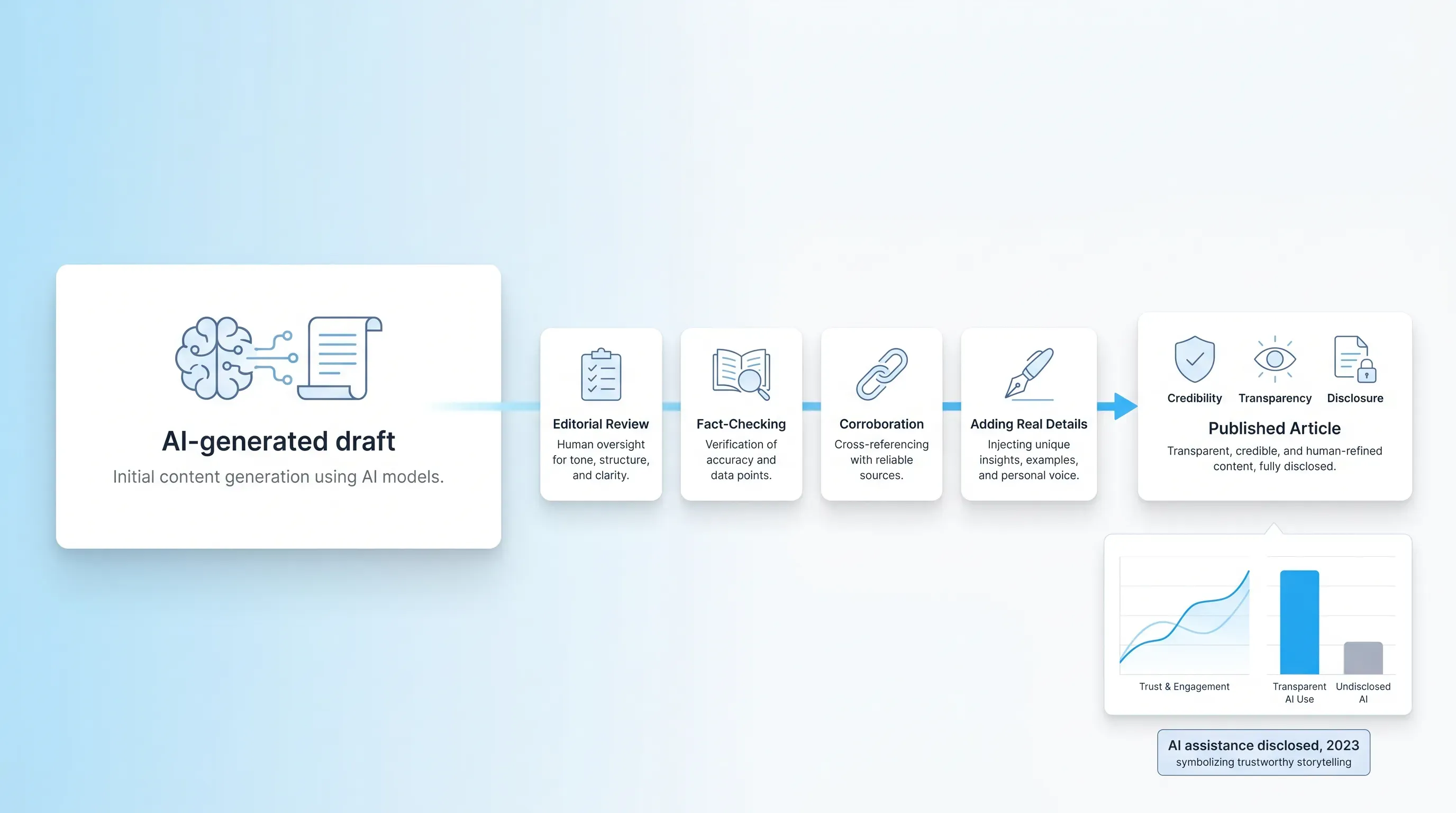
Infographic illustrating the AI drafting process with floating cards for editorial review, fact-checking, and publication, on a light gradient background.

Now the step that's not optional. An AI draft is not safe to publish under your name until a person has checked it against reality. This is the editorial review, and it's the difference between speeding up your work and quietly damaging it. Authors carry the responsibility to corroborate the facts an AI provides and ensure references are accurate, as a 2023 review in the journal Maturitas put it. The tool won't do this for you, because it can't tell what's true.

Start with fact-checking against primary sources. Every name and date in the draft gets matched to where it came from. The same check applies to each figure and quote, whether the source is the interview transcript or your internal records, such as program data and your annual report. If a claim has no source, it goes, because that's how you catch the invented statistics before a donor does. Then add the human material: the real detail and the specific scene that carries the lived experience and makes the story yours. Finish with a readability pass for short sentences and clear structure.

Transparency belongs here too. Put a real author's name on the post, because Google's own guidance treats trust as the most important of its quality signals and asks you to be clear about how content was produced, AI use included. Where it fits your culture, a short note that AI blog writing tools assisted with drafting costs you nothing and builds credibility with readers who care. Once this becomes a habit, this process stays quick and protects the trust your mission depends on from the damage of one careless post at a time.

Publishing for long term discoverability

A capacity-strapped team can't afford posts that vanish a week after publishing. The point of the work is to keep earning attention for months, which means publishing in a way that stays findable. The good news is that a few accessible habits help here.

Write for the reader first and the structure follows. Use clear headings that describe what each section covers. Break text into scannable paragraphs and short lists so a skimming donor finds what they need. Link internally to your related posts and program pages, which keeps people on your site and helps search engines understand how your content connects. Write in natural language, because both human readers and the AI summaries now sitting above search results understand plain sentences better than keyword-stuffed ones.

Strong authorship feeds discoverability directly. Google's framework, known as E-E-A-T, rewards experience and expertise; authoritativeness and trustworthiness also matter because content created by someone with firsthand experience of the topic is what it aims to surface. That's a built-in advantage for you. Your accurate sourcing and your real author byline are trust signals for donors and the same signals that help you rank. Keep a few of these habits consistent and you'll outlast teams chasing every new tactic.

A realistic publishing rhythm

Set a cadence you can hold without burning out. The advice from nonprofit storytelling practitioners is to start with one story per month, and one strong monthly post beats four rushed ones that read like the machine wrote them alone. The workflow above is what makes a steady rhythm possible, because the drafting time that used to sink a post now gets handled fast and the human hours go to review and voice.

A light monthly structure works for most thin teams:

  • Week one: pick the story and build the brief from source material

  • Week two: draft and reshape with your tools

  • Week three: fact-check the draft and publish it after the voice edit

  • Week four: repurpose into newsletter and social, then review what landed

Track a small handful of metrics so you know it's working. Watch organic traffic to the post over time and email open and click rates on the feature version. Then compare whether story-engaged donors give or stay longer than the rest. Consistency over volume is the goal. A predictable monthly post your audience comes to expect does more than a flurry they never see again.

Getting started this month

AI is worth adopting on one condition: it lives inside a human-led process that protects accuracy and voice. The path is short to remember. Brief it well, then draft and reshape. After the fact-check against your sources, publish and repurpose. That sequence is what lets one or two people produce work that supporters and search engines both trust.

Start with one post already on your calendar and run it through this workflow start to finish. You'll feel where the time comes back and where your judgment still matters. Do it once and refine it; then you have a system you can repeat. That's how AIi blog writing tools earn a permanent place on a small team, by making your steadiest, most trusted work faster to produce. Start with the next post.
Need help with your AI visibility?

Book a free consultation with our experts we'll help you determine exactly which services your organization needs.

Choose ai blog writing tools that let you add source material, save prompt templates, edit drafts, and track changes. The tool should fit your review process rather than replace it. Test it on one real post and judge the output by accuracy, voice, and editing time.

Yes, but only after you remove private details and confirm consent. Use first names, changed names, or composite details only when your organization’s policy allows it. Keep full transcripts and internal notes outside public prompts if the tool’s privacy terms don’t meet your standards.

Disclose AI use when the tool helped draft or substantially revise the post. A short note near the byline or at the end is enough. Keep the named human author accountable for the final text, including facts, quotes, and source choices.

Give the AI the interview transcript and approved program data before drafting. Add your target audience, the post angle, and any claims the draft must avoid. If a fact isn’t in those materials, instruct the tool to leave a placeholder instead of inventing a detail.

Measure whether the content attracts the right readers and supports your goals. Track organic visits, newsletter clicks, and donor actions tied to the post. If you use Snoika Foundation’s content generator, compare the AI-assisted post against a previous human-only post using the same metrics.

Book a Demo

Book a time that works best for you

You Might Also Like

Discover more insights and articles

Infographic illustrating the transformation of nonprofits hiring a Google Ad Grants agency, featuring a curved arrow and metrics.

Why Nonprofits Need a Google Ad Grants Agency to Maximize Free Ad Spend

This article explains what it takes to turn a Google Ad Grant into real donations and awareness, and where in-house efforts stall. It walks through setup and compliance, then follows the path from targeting to tracking so you can decide whether charity Google Ads support fits your organization.

Infographic comparing four AI marketing automation tools for nonprofits, featuring a central white board with soft shadows and muted blue icons.

Best AI Marketing Automation Tools for Nonprofits and NGOs

This article compares AI marketing automation tools for lean nonprofit and NGO teams across the jobs that eat your week, especially email and segmentation, while the discussion also covers scheduling and the reporting demands that come with multilingual outreach. It weighs honest strengths and trade-offs, then closes with implementation steps sized for a one- or two-person team.

A spacious SaaS infographic featuring translucent cards, icons, and flow lines on a smooth blue gradient background.

AI Content Generator for Nonprofits: Scale Content Without Losing Authenticity

This article shows nonprofit communications staff how to use an AI content generator to publish more without flattening the mission-rooted voice that earns trust. It covers where the tools save time and how to keep human judgment in the loop across multilingual outreach and AI search.

Title:
How an AI SEO Content Generator Helps NGOs Rank in Google and AI Search Engines

Meta description:
With this AI SEO content generator guide, you will learn to write steady posts that rank your

How an AI SEO Content Generator Helps NGOs Rank in Google and AI Search Engines

This article explains how a small NGO communications team can use an AI SEO content generator to publish steady, well-structured content that performs in both Google and AI search engines. It walks through keyword research and a repeatable publishing workflow, with practical steps you can copy.