Title:
Donor Acquisition SEO: Turning Visibility into Support

Meta description:
Learn how to use donor acquisition seo to find new supporters and turn their searches into reliable gifts that grow you

Donor Acquisition SEO: Turning Visibility into Support

This article explains how nonprofits can use search engine optimization and AI-driven visibility to attract new donors and grow a base of lasting support. It walks through how to be found by the right people, earn their trust, and guide them from a curious search to a first gift and beyond.

Content authorSnoika FoundationPublished onReading time10 min read

Why donors search before they give

The donor journey rarely starts at the donation button anymore, which makes donor acquisition SEO important before the ask. It starts with a question typed into a search bar, and that question is where donor acquisition SEO begins to matter. Before anyone parts with money, they want to know who you are, what you do with their gift, and whether the cause is worth their trust. The wallet opens only after the searching is done.

The behavior is well documented. A 2023 RKD Group survey of 1,630 U.S. donors found that higher trust leads to more years of giving and a higher lifetime value, and donors build that trust when they review information first. Candid's research on giving habits put it plainly when it reported that the most common reason people give online is "something I saw on the charity's website".

Here's the gap. Plenty of nonprofits have a website, yet they're invisible at the exact moment a prospective donor goes looking. Having a page online and being discoverable when it counts are two different things. For donor acquisition SEO, visibility is the first step toward support. The rest of this article is about closing the distance between the two.

What donor acquisition SEO really means

Donor acquisition SEO is the practice of optimizing your online presence so the people most likely to support your mission can find you in search, then guiding them toward giving. It borrows the mechanics of search engine optimization, but it answers to a different scoreboard. Generic marketing SEO chases raw traffic. This work chases supporters.

That difference changes what counts as success. A blog post about a trending topic might pull thousands of visitors who never give a cent. A focused page about your cause might pull far fewer visitors, but a real share of them will donate. In donor acquisition SEO, the second outcome is the win, because revenue per visitor matters more than the headcount at the top of the funnel.

Think about what a healthy metric looks like under this lens:

  • Qualified visitors who match your cause and arrive with intent

  • First gifts and recurring sign-ups, measured against the traffic that produced them

Nonprofits raise about $1.29 per website visitor and only 1.5% of visitors complete a donation, according to the 2025 M+R Benchmarks. So when you reframe the goal around qualified visitors instead of pageviews, you stop celebrating numbers that never reach your mission. Donor acquisition SEO keeps the focus on the searchers who are ready to act.

From visibility to trust

A high search position gets you noticed; funding depends on what visitors believe after they arrive. A visitor who finds you but doubts you will close the tab as fast as one who never found you at all. Trust is the bridge between being seen and being supported, and it is built deliberately.

The evidence here is hard to argue with. Villanova University and University of Wisconsin-Milwaukee researchers studied more than 6,300 nonprofits and found that those earning a GuideStar Seal of Transparency averaged 53% more in contributions the following year. Trust moves money. The next three sections break the work into parts you can tackle separately.

Need help with your AI visibility?

Book a free consultation with our experts we'll help you determine exactly which services your organization needs.

Matching donor intent keywords

Search terms reveal what donors want. Donor intent keywords are the terms and questions that signal someone is looking for a cause to back rather than reading for curiosity. Someone searching "how does deforestation affect rivers" is learning. Someone searching "best charity for clean water transparency" is closer to giving.

That second example shows the split you need to understand. Informational searches feed the top of the funnel and build awareness. High-intent giving searches, the ones tied to impact, proof, and specific issues, belong much closer to the gift. Donor intent keywords sit on the donation side of that line, and pages built around them bring in people who came to support.

Why does this targeting pay off? Because familiarity drives giving. RallyUp's analysis found that more than half of American donors give where they've given before, which outweighs influence from friends and family at 36%. When you map your content to donor intent keywords, you reach people while their interest is active and turn first-time searchers into the repeat supporters who carry your budget. Donor intent keywords also tell you which pages deserve your best credibility content, since that's where decisions get made.

Building credibility on the page

Once the right person lands, the page itself has to do the convincing. The on-page elements that reassure a first-time donor are concrete. Impact stories with real outcomes, financial transparency a visitor can verify, and testimonials from people you've helped all reduce the hesitation that kills a gift.

Give.org's Donor Trust Report found that a charity's accomplishments are the number one factor in establishing donor trust, followed by reputation and financials. So show the work. Publish your results, link your 990, and let supporters speak in their own words. These signals do double duty. They satisfy search engines and answer the silent questions running through a hesitant donor's mind.

Earning authority off the page

What happens away from your site shapes how both donors and search engines judge you. Backlinks from respected organizations, press mentions, partnership pages, and independent reviews build a reputation you can't write yourself. Search engines read these as votes of confidence, and donors read them as proof you're known beyond your own marketing.

A large budget is unnecessary to earn them. A nonprofit can pitch local journalists a story about a measurable outcome, co-publish research with a university partner, or claim and update its profile on third-party platforms. More than 75,000 nonprofits have earned a GuideStar Seal, and those holders make up 19% of nonprofits that get grants while receiving 32% of total grant funding. When a donor checks you out at the moment of decision, that external reputation is what reassures them you're the real thing.

Need help with your AI visibility?

Book a free consultation with our experts we'll help you determine exactly which services your organization needs.

Turning traffic into gifts
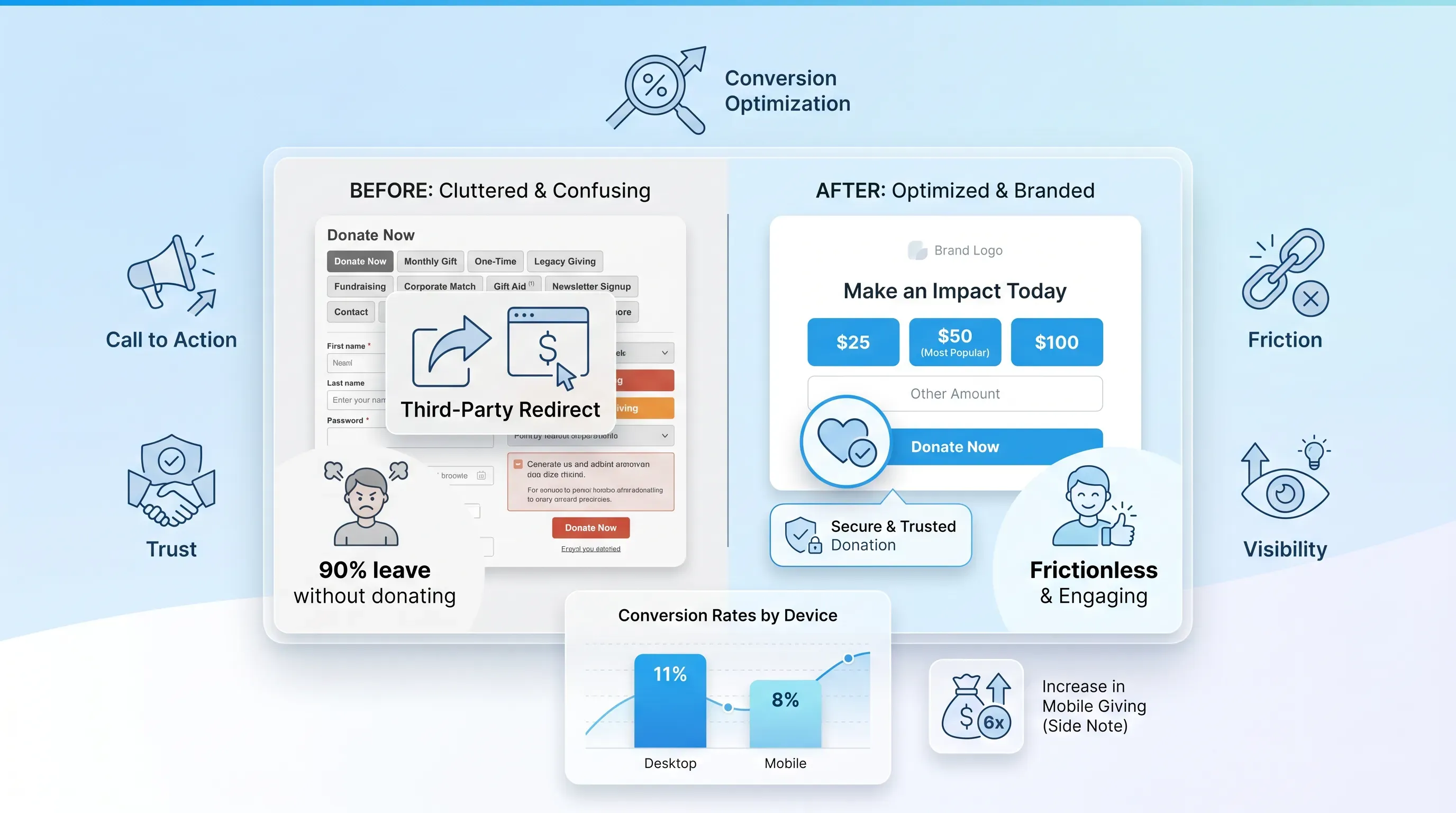
Infographic showing a before-and-after donation form transformation, highlighting clutter vs. streamlined design, with conversion stats.

All the visibility and trust in the world means little if the donation page leaks. This is where nonprofit conversion SEO earns its keep, because it focuses on the step where interest becomes a gift. The numbers show how much is at stake. The 2025 M+R Benchmarks pegged donation page conversion at 11% on desktop and 8% on mobile, which means roughly nine in ten visitors who reach the page leave without giving.

Closing that gap is the heart of nonprofit conversion SEO. The fixes are practical:

  1. Write a clear call to action that names the next step instead of hoping visitors guess it.

  2. Strip friction from the donation flow so a gift takes seconds, especially on mobile.

  3. Match the page to what the searcher came for, so a person who clicked about clean water lands on a page about clean water.

Small changes in nonprofit conversion seo move real money. Researchers found that reducing preset donation options from five to three increased the number of people who donated, because too many choices create friction at the moment of action. Embedding a branded donation form on your own site rather than redirecting to a third-party page helps raise six times as much money. Nonprofit conversion seo treats these details as the payoff for all the visibility work that came before it, and it keeps the donation flow honest by always asking whether a visitor can give without effort.

How AI search changes discovery

The route from search to website has narrowed. AI-powered answer engines now hand users a summary instead of a list of links, and the data is stark. SparkToro's 2024 study found that about 58.5% of Google searches ended without a click to any result, and that figure climbed as AI Overviews spread. For news queries, Similarweb tracked zero-click rates rising from 56% to nearly 69% in a single year after AI Overviews launched.

Meanwhile, donors are adopting these tools fast. ChatGPT saw a 44% traffic boost in November 2024, and Bain's survey found that 68% of large language model users turn to these platforms to research and summarize information. That's exactly the vetting behavior donors used to do on your website. Now an AI does it for them and summarizes who you are before they ever visit.

This shift cuts both ways. The risk is being left out of the summary or, worse, being described inaccurately by a model that scraped stale information. The opportunity is being cited as the trusted source an AI points to. To earn that, publish clear, factual, well-structured content that states your mission, impact, and finances in language a model can quote correctly. The credibility signals that win donor trust are the same ones that get you cited, which means the work compounds. Staying discoverable as search behavior changes is no longer optional for any organization that depends on public generosity.

Building long-term donor relationships

Acquiring a donor is only worth the effort if they come back. The brutal truth is that first-time donors are the hardest to keep. The 2023 Fundraising Effectiveness Project reported new donor retention at just 19.4%, meaning roughly four of five first-time givers never give again. Once a donor makes that second gift, retention jumps to about 58.2% for repeat donors. The second gift is the real prize.

The work continues after the thank-you page. Ongoing content and email follow-up that shows where the money went keep new donors connected long after the first gift through consistent storytelling. Recurring donors reward this attention. Classy's research found that recurring donors have a lifetime value five times greater than one-time donors, and 85% take another action like giving again or recruiting a friend.

This is why donor acquisition SEO is a long game for nonprofits. Sustained visibility builds a steady pipeline of new supporters who enter a relationship you then nurture into loyalty. The acquisition work and the retention work feed each other.

Putting it into practice

The central idea is simple to state and harder to execute. Visibility only matters when it converts into trust, and trust only matters when it converts into lasting support. Every section here has pointed back to that single idea, from donor intent keywords at the top of the funnel to the second gift that proves a relationship has taken hold.

Start by auditing where you lose people between being found and being funded. Walk your own site as a first-time donor would, and mark every point where doubt or friction could cost you a gift. Fix the most obvious leak first.

Snoika Foundation works with NGOs, nonprofits, and public institutions to make their missions visible and trusted across AI search engines like ChatGPT, Perplexity, and Gemini, where more donors now begin their search. If you want help turning your visibility into real donor acquisition seo results, request a free AI visibility report or book a consultation with our team to take that first concrete step.

Need help with your AI visibility?

Book a free consultation with our experts we'll help you determine exactly which services your organization needs.

Start with the pages closest to a gift, such as a cause page and the donation page. These pages should answer who you help, what a gift funds, and how results are tracked. Add a clear next step and make sure each page matches the search term that brought the visitor there.

Look for phrases that include giving intent or trust concerns, such as “best charity for clean water” or “charity financial transparency.” These searches show the person is comparing organizations rather than reading background information. Use them for pages that include impact data and third-party credibility signals.

Yes. AI search engines can affect donations because they summarize nonprofits before a person visits the site. If your mission and results are outdated or unclear online, the summary can miss key facts. Keep public profiles current and write pages in plain language that AI systems can quote accurately.

Focus on qualified traffic and donation conversion together. In practice, donor acquisition seo works when the visitors who arrive have a reason to care and can give without friction. Track first gifts and revenue per visitor instead of judging progress by pageviews alone.

A nonprofit can work with a specialist who understands AI summaries and donor behavior. Snoika Foundation focuses on AI search visibility for nonprofits and public institutions. If you need outside support, book a consultation to review how your public content appears in tools like ChatGPT and Perplexity.

Book a Demo

Book a time that works best for you

You Might Also Like

Discover more insights and articles

Title:
Digital Marketing for Charities: Strategies to Reach More Donors and Supporters

Meta description:
Plan your digital marketing for charities to reach more donors. You will learn to fix your web

Digital Marketing for Charities: Strategies to Reach More Donors and Supporters

This article is a practical guide for digital marketing for charities, written for anyone who has ended up running a charity's website and social accounts without a dedicated team or budget. It walks through five connected areas you can start improving this week, with concrete fundraising and volunteer examples you can copy.

Title:
How a Digital Marketing Agency for Nonprofits Helps NGOs Grow Online Visibility

Meta description:
Your digital marketing agency for nonprofits must help you find donors. This article teaches y

How a Digital Marketing Agency for Nonprofits Helps NGOs Grow Online Visibility

This article explains what a digital marketing agency for nonprofits actually does across search and the reporting that connects visibility to support. It shows why a mission-driven marketing agency beats a generalist for organizations with thin budgets, and it gives you a practical way to vet one and measure whether the work pays off.

Title:
Nonprofit PPC Marketing That Supports Long-Term Visibility

Meta description:
Use nonprofit ppc marketing to pair paid ads with SEO so you can track donor value and keep your cause visible long

Nonprofit PPC Marketing That Supports Long-Term Visibility

This article explains how mission-driven teams can use paid advertising to build visibility that outlasts a single campaign. It looks at where PPC fits alongside search engine optimization (SEO) and AI-driven search, how to structure ad spend for steady donor acquisition, and which numbers actually tell you whether your money is working.

Title:
Search Engine Marketing for Nonprofits Beyond Google

Meta description:
Expand search engine marketing for nonprofits so you connect with donors. This 90-day plan helps you adapt to new search

Search Engine Marketing for Nonprofits Beyond Google

This article explains why nonprofit marketing teams need to expand their search work past Google to include AI-powered search engines like ChatGPT, Perplexity, Claude, Gemini, and Google's AI Overviews. It lays out a practical 90 day plan you can run this fiscal year, even with a lean team.