Introduction
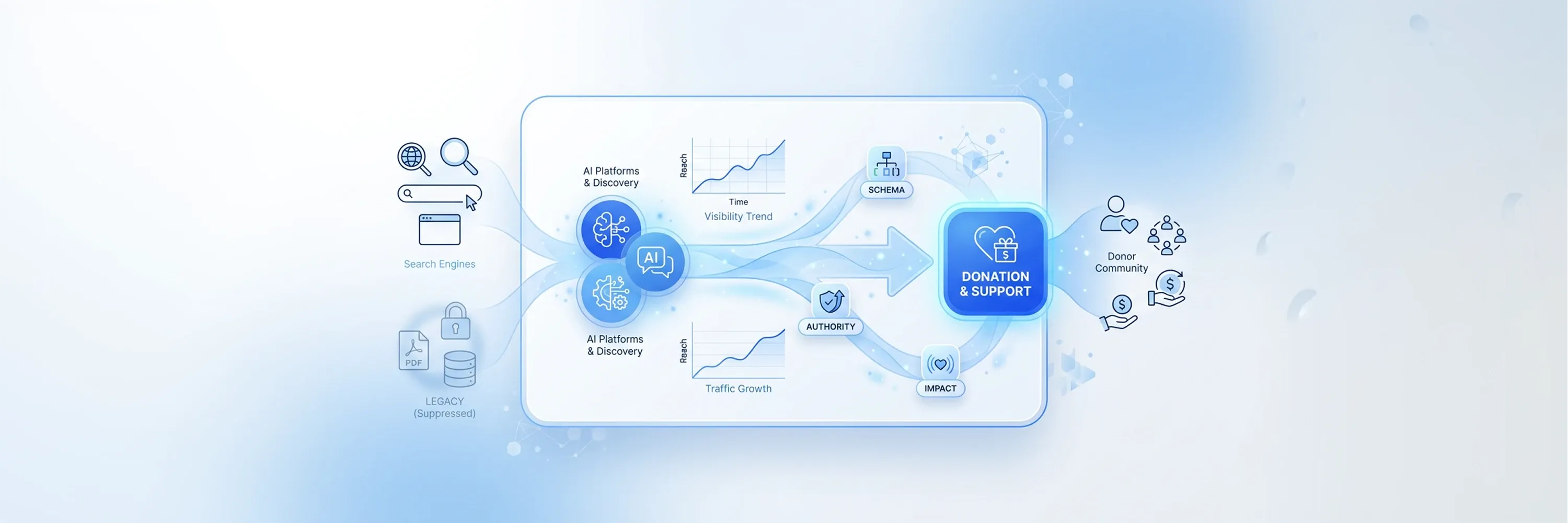
Charity discovery has fundamentally changed because artificial intelligence answers donor questions before they ever click a link. For years, organizations relied on traditional keyword strategies to drive website traffic, collect donations, and recruit volunteers. When a supporter searched for a cause, they clicked through standard search engine results and explored the organization's website directly. Today, AI-generated summaries provide immediate answers, and this significantly reduces the need for users to visit external pages. Consequently, major information-based organizations experienced a 33% year-over-year traffic reduction.
This drop in informational search traffic leaves many groups disconnected from their audience. When potential donors cannot find a mission, organizations lose the funding they need to operate essential programs. A new approach that goes beyond basic keywords closes this visibility gap. Organizations need to implement a cohesive seo charity strategy that integrates Generative Engine Optimization and maps donor goals. Organizations restructure their digital footprint to ensure that both human readers and machine algorithms recognize their credibility. The following sections explain how to combine technical optimization with transparent impact measurement to secure visibility and funding online.
SEO Charity Strategies for Answer Engines
Organizations secure visibility online when they adapt to modern search engines. Search engines no longer just provide links, and they generate direct answers instead. Artificial intelligence platforms compile information from across the web to answer user queries immediately. This shift changes search behaviors and causes drops in traditional website traffic. Users read the artificial intelligence summary and leave the search page without ever clicking a link.
According to recent data, AI Overviews now appear in 58% of queries. This number represents a sharp increase from just 12% in 2024. Furthermore, half of consumers now use artificial intelligence search tools to find information. These machine learning models extract facts and data directly from source websites. Consequently, organizations see a decline in organic visits to their informational pages.
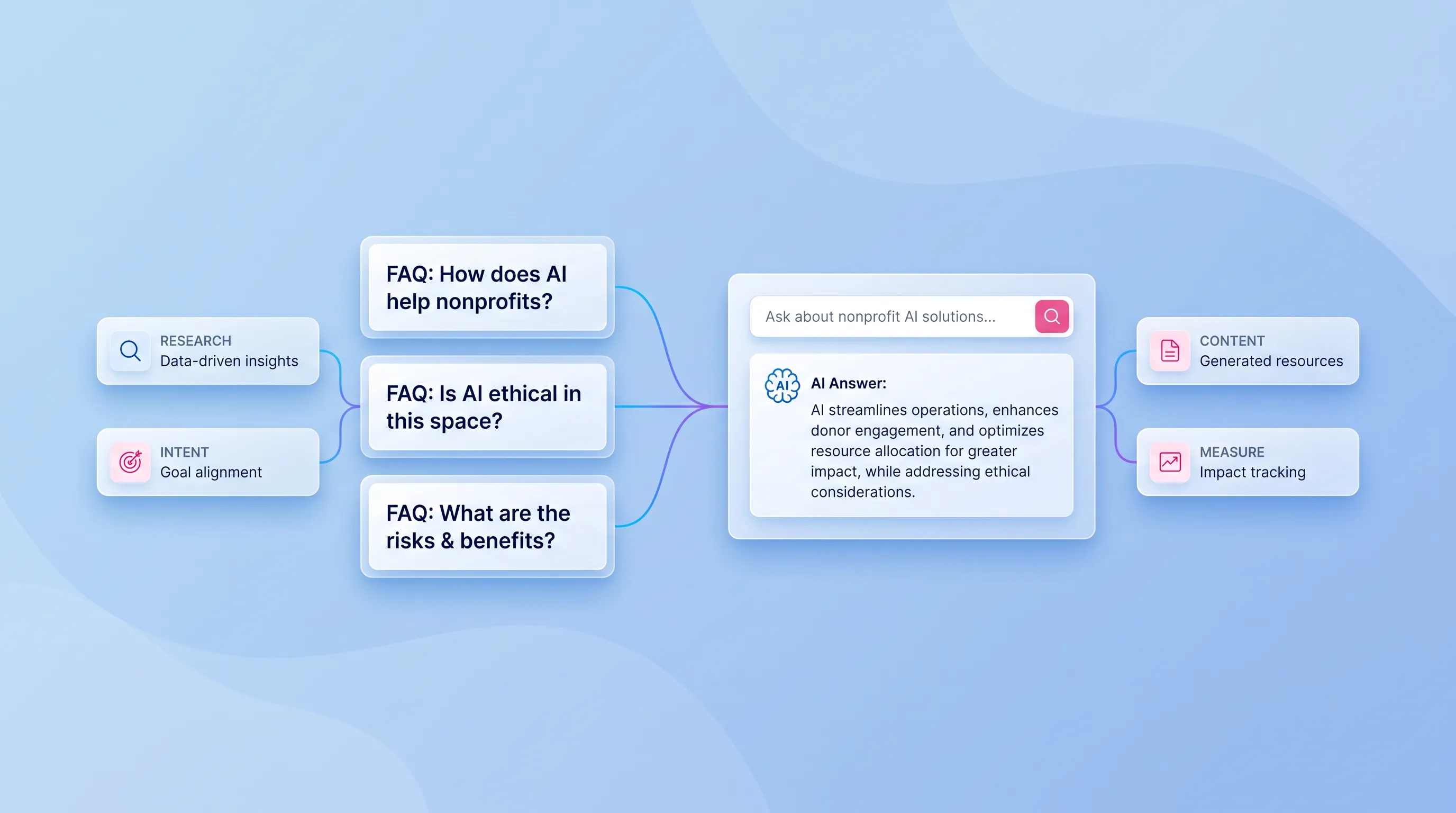
If organizations want to maintain charity search visibility, they must optimize for artificial intelligence citations instead of traditional blue links. Answer engines prioritize websites that structure their content clearly and answer specific questions directly. Artificial intelligence algorithms favor authoritative platforms that present data with confidence. When an algorithm detects structured and accurate information, it cites that organization as a source in its generated response. This mechanism helps organizations reach the public with their mission. Organizations explore technical citation requirements to understand how they must restructure their content publishing to earn these citations.
Three-Tier Donor Intent Architecture

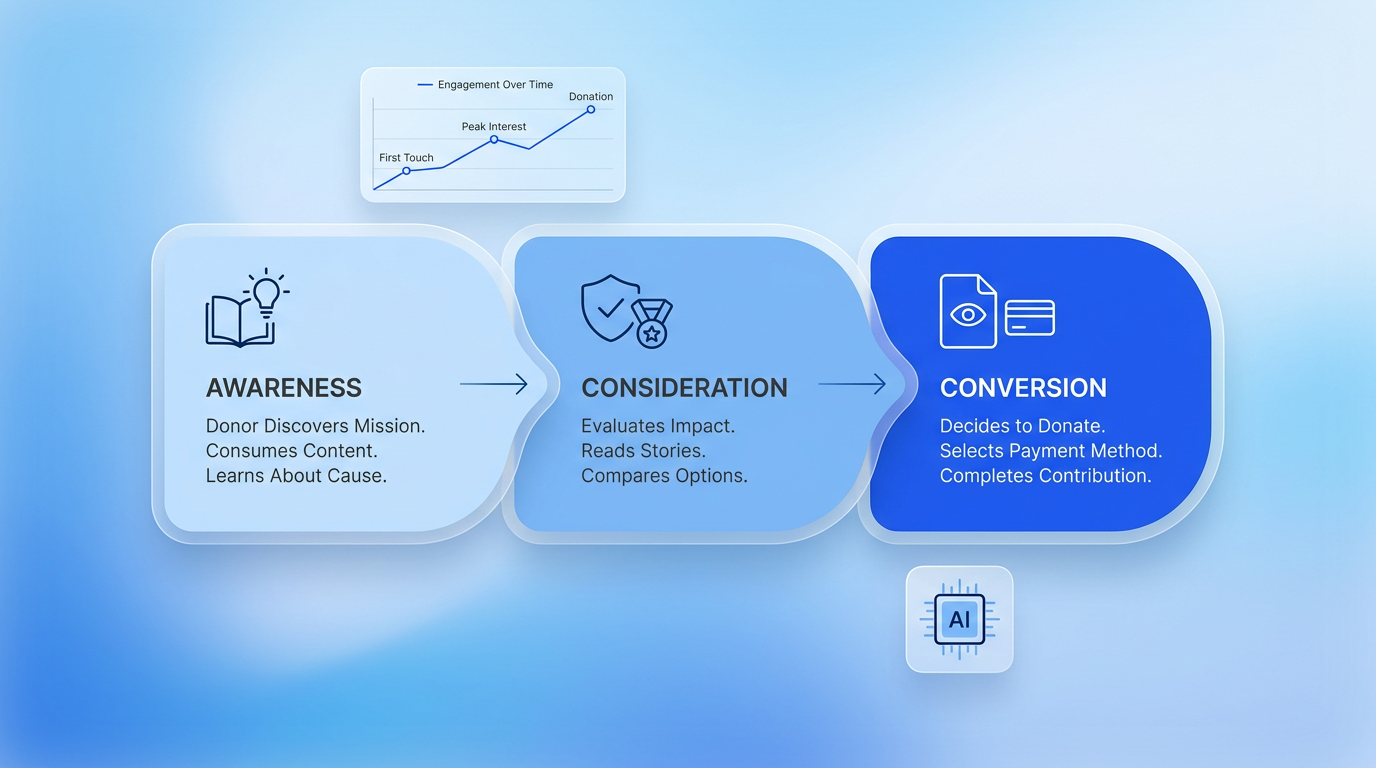
Organizations restructure their content publishing to match donor search behavior. This donor search behavior follows a predictable pattern that requires specific content at every stage. Organizations must structure their digital content to match what users need as they move through different phases of discovery. A successful donor intent SEO strategy categorizes these searches into three distinct stages, such as awareness, consideration, and conversion.
During the initial phase, people ask broad questions about social issues or global crises. They want to know that organizations exist to solve these problems. As they learn more, these same people transition into the consideration phase. Here, they evaluate nonprofits and compare different operational approaches. They look for detailed impact metrics and third-party ratings. Finally, supporters reach the conversion stage when they decide to make a financial contribution. At this point, they search for specific brand names or exact donation pages.
When organizations match content to these distinct phases, they improve overall search visibility. If a website only publishes donation forms, it misses the users who still research the broader cause. Conversely, if a website only publishes educational articles, it creates friction for those ready to give. Precise content architecture ensures that human readers and search algorithms find the right information at the exact right time.
Content Architecture for Awareness Stage
Organizations deliver information at the exact right time when they focus on the awareness stage first. The awareness stage begins when individuals first discover a social issue or humanitarian crisis. These users search for broad educational terms to understand the problem better. Today, artificial intelligence search engines typically answer these top-level queries directly on the results page.
Organizations must publish clear and factual content that explains the core issues to capture these early-stage users. Answer engines look for thorough definitions, historical context, and verified statistics. When an organization provides this foundational knowledge, artificial intelligence models cite them as authoritative sources. This citation improves online presence and introduces the brand to new audiences.
Organizations demonstrate the soundness of their mission when they answer fundamental questions without asking for immediate donations. Educational content builds initial rapport with the public. When platforms publish thorough guides about their cause, they establish themselves as subject matter experts. This early interaction lays the groundwork for deeper engagement as the user continues their research journey.
Donor Consideration Phase
Users continue their research journey and move into the consideration phase after they understand the broader issue. During this stage, people actively compare different organizations and evaluate their operational efficiency. They search for reviews, financial transparency reports, and specific impact metrics.
Third-party validation helps supporters during this comparison process. Independent watchdog groups and charity evaluators provide the safety that cautious donors require before they make financial commitments. When a website features prominent ratings from recognized evaluators, it signals credibility to human visitors and search algorithms. Conversely, organizations lose potential funding when they lack these trust signals. Recent behavioral research demonstrates that individuals are 32% less likely to donate to charities they view unfavorably during this comparison process.
An effective donor intent SEO strategy prioritizes transparent reporting and visible third-party endorsements. Organizations publish their impact data clearly and link to independent evaluations. This transparency helps users make informed decisions and separates effective nonprofits from less accountable groups.
High-Intent Conversions
Users make informed decisions and enter the final conversion stage when they decide exactly where they want to send their money. At this point, users execute specific, brand-focused searches to find donation portals. They bypass general educational content and look directly for secure contribution pages. Organizations must remove all technical friction from these high-intent pathways. Donation pages need fast loading times, clear payment options, and visible privacy policies that offer data protection. If a donor experiences a slow checkout process, they will not complete their transaction and will abandon their gift.
Early optimization for artificial intelligence platforms pays off significantly at this final step. A thorough content strategy that successfully guides users from awareness to conversion yields remarkable results. Recent industry data shows that users who click through artificial intelligence search results convert at a 23 times higher rate than users from traditional organic search. This increase proves that high charity search visibility in answer engines drives motivated supporters directly to the contribution page.
Authentic Authority Through E-E-A-T
Organizations build trust with search engines to drive motivated supporters to the contribution page. Search engines categorize nonprofit websites under the Your Money or Your Life designation because these platforms process financial transactions and address serious societal issues. Consequently, artificial intelligence models rigorously evaluate these websites for Experience, Expertise, Authoritativeness, and Trustworthiness. Algorithms demand strict editorial standards before they recommend an organization to potential supporters.
Many professionals previously relied on transactional link exchanges to manipulate search rankings. However, modern algorithms penalize these artificial schemes and instead reward authentic authority. Organizations build genuine credibility when they pursue mission-focused strategies rather than generic optimization tactics.
How Authority Partnerships Strengthen SEO for Nonprofits
Nonprofits improve their SEO charity performance when they secure citations from respected institutions. A successful authority campaign relies on several authentic strategies.
These efforts typically take shape through the following initiatives:
-
Organizations secure coverage from reputable news outlets through active public relations outreach.
-
They publish collaborative research papers with accredited universities or academic institutions.
-
They establish Corporate Social Responsibility partnerships with established businesses.
-
They write guest columns for recognized industry publications related to the specific cause.
These authentic connections prove to algorithms that an organization operates legitimately in the real world. When respected institutions link to a nonprofit's website, they transfer their algorithmic credibility to that organization. This digital endorsement builds the algorithmic trust necessary for high placement in answer engine summaries. Organizations that operate with strong conviction naturally attract these valuable institutional connections. Professionals explore digital authority partnerships to understand how these connections influence algorithmic evaluations. Ultimately, artificial intelligence models do not cite unknown organizations. They cite organizations that human experts already recognize and respect.
Impact Data for AI Extraction
Organizations earn respect from human experts and artificial intelligence models when they share accessible information. However, nonprofits often hide their most valuable impact data inside downloadable PDF files. Search algorithms struggle to read and extract information from these static documents. Artificial intelligence engines require structured data to understand content and provide direct answers. When organizations lock financial reports in PDFs, they force search algorithms to guess their impact. This technical mistake blocks machines from verifying their credibility to potential donors and harms charity search visibility.
Websites achieve measurable results when they add schema markup. For example, Excel achieved a 777% year-over-year click increase after they implemented this code on their web pages. Organizations extract their data from static documents to achieve similar results and improve seo charity performance.
The data formatting process involves four specific steps:
-
Organizations convert existing PDF reports into accessible HTML web pages.
-
Developers add Organization schema markup to define the core details of the nonprofit.
-
Web teams implement DonateAction schema to highlight specific contribution pathways.
-
Staff members update the impact metrics annually directly on the website.
Donors gain peace of mind because they can verify the financial health of the nonprofit without downloading unknown files. Organizations also prove the quality of their transparency to search engines when they publish data in HTML format. The AI models parse the schema markup and generate citations that appear in search summaries. Organizations study charity marketing tactics to understand how to implement the technology. Proper data formatting allows algorithms to read the information, and this directly influences how organizations measure their return on investment.
Visibility Measurement and Intent Gap
Organizations track conversions to measure their return on investment because high search rankings mean nothing if the website fails to convert visitors into donors. After artificial intelligence engines direct supporters to a website, the platform provides a simple experience. Organizations measure their return on investment when they track both AI citations and actual website conversions because this data reveals how effectively their digital presence generates actual funding. A strong SEO charity plan tracks how users interact with the donation portal.
Many organizations struggle with this final step. Recent data shows that average nonprofit donation pages convert at just 12% across devices. This low conversion rate occurs because websites introduce technical problems. When supporters feel inspired to give, they view the donation page as a refuge for their generosity. They want to complete the donation with precision. Researchers found that slow page load speeds, form friction, and weak trust signals stop donors mid-journey. A successful donor intent SEO strategy fixes these barriers.
Hidden donation forms frustrate users who want to support the cause. Charities lose money every time a frustrated user closes the browser. Slow mobile speeds force potential donors to abandon the page before the form loads, and this technical failure ruins the entire cultivation process. Developers audit donation pages to close this gap. They simplify payment options and display security badges prominently. Testing the mobile checkout process constantly bridges this intent gap. An effective NGO digital strategy improves the user experience. Organizations capture the funding they need when they remove technical barriers and align their website with donor expectations.
Conclusion
Organizations align their websites with donor expectations through a well-structured digital footprint. To summarize, this digital footprint ensures that both human donors and machine algorithms recognize and recommend the mission. Organizations must prioritize their SEO charity implementation because AI-driven search engines determine which causes receive public attention and funding. Maintaining a technically sound website builds the algorithmic trust needed to thrive in a zero-click environment. The future of charitable giving relies on machine-readable transparency, so organizations will continue to adapt their data architecture to meet these evolving standards. Auditing a digital presence and moving impact data out of hidden PDFs aligns this technical foundation. Organizations can review the nonprofit search visibility framework for further guidance on updating content accordingly.