Organize the brand
Map everything that carries a name in a charity brand strategy: the parent organization and each program. Note which names your stakeholders actually recognize, because recognition is an asset you shouldn't discard for the sake of tidiness.
Three structures cover most nonprofits. A branded house puts everything under the parent name with descriptive program labels, which concentrates recognition and cuts marketing cost. A house of brands lets programs stand alone, which suits organizations whose programs serve unrelated audiences. The endorsed model gives a program its own name plus a visible connection to the parent through the line "a program of."
The Cosmic design team, which works on brand architecture for nonprofits, argues that a sub-brand makes sense when your organization is telling a complicated story to multiple audiences under one name, or when a long institutional legacy overshadows newer program work. First Ascent Design flags the opposite case: if adding a brand means your audience needs a flowchart to understand what's what, don't add it.
Oxfam International faced this at scale. Its 14 affiliates had each developed a separate identity, and in 2010 the confederation moved to unite them, with a spokeswoman describing it not as a rebrand but as "a project to strengthen" the existing brand globally. Rachel Hayes, then senior director of communications at Oxfam America, called the approach "creating bookends," where affiliates dial messages up or down for local markets inside fixed boundaries.
Roll out the strategy
Approval is not implementation. Assign a single owner for the nonprofit brand strategy document and a named owner for each touchpoint you plan to change, with a date attached. Without named owners, the document goes into a shared drive and dies there.
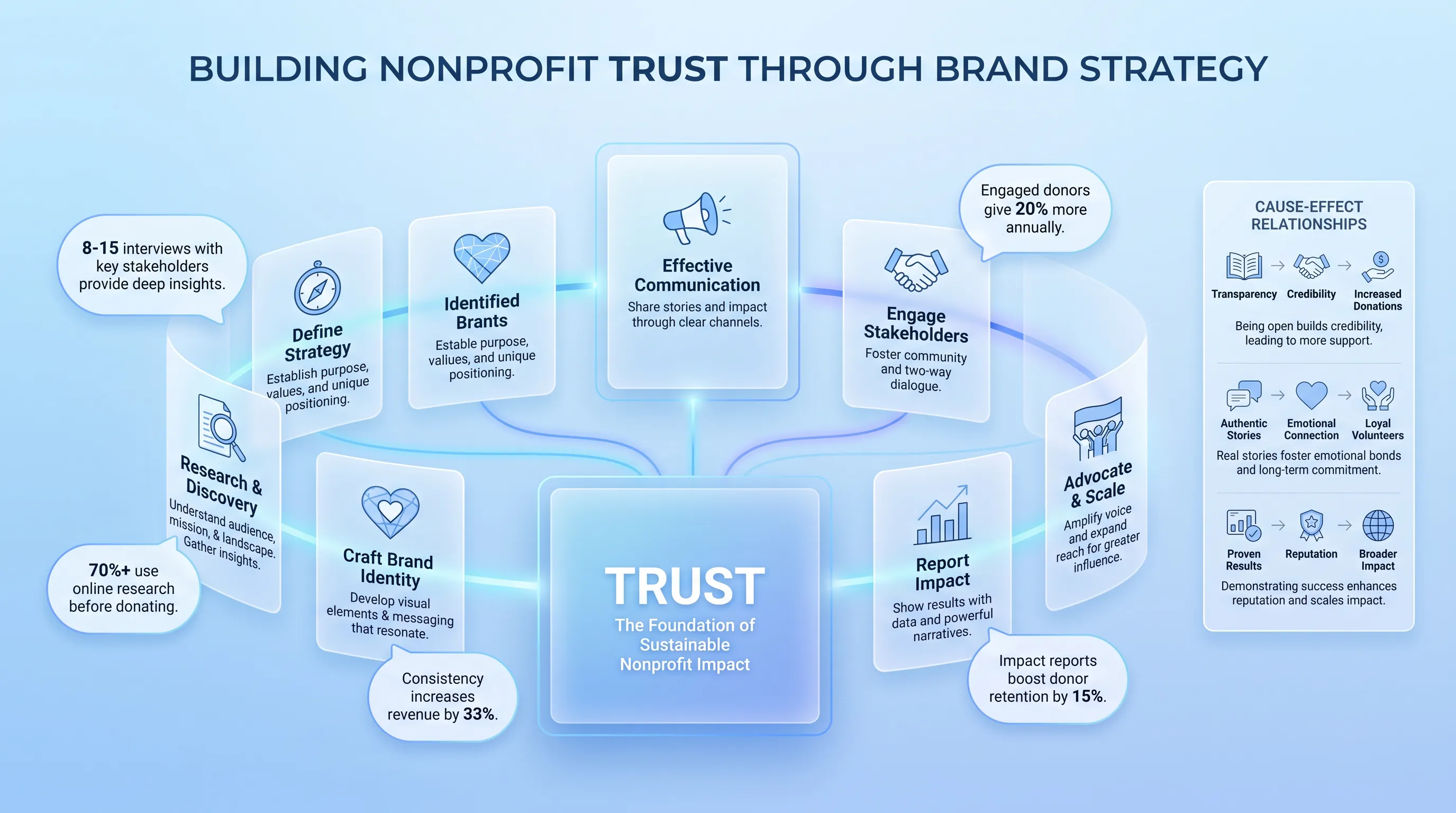
Then train people. Research published in Frontiers in Psychology on mission-driven branding found that brand-centered training and brand-oriented leadership together predict whether staff actually deliver the brand promise. Big Duck, which has run nonprofit rebrands since 1994, estimates it now spends roughly a third of project time managing internal buy-in, which it calls the secret ingredient of a successful rebrand.
Sequence the changes in phases rather than launching everything at once. Start with what your highest-priority audience touches first: the homepage and your primary appeal. Move to secondary materials in the following quarter.
Keep logos and color palettes out of this project. Those belong in brand guidelines, which come after the nonprofit brand strategy is approved and answer a different question: how do we execute consistently? Deciding on a color while you're still arguing about positioning guarantees you'll redo both.
Measure brand trust
Set a baseline before the rollout of your charity brand strategy, or you'll have nothing to compare against. Then repeat the same measures on a fixed schedule, annually for survey work and quarterly for behavioral data.
Track awareness in two forms. Unaided awareness asks people to name organizations working on your issue without prompting. Aided awareness gives them a list. The Wikimedia Foundation's brand health tracker shows why both matter: its aided awareness has run at 12% while unaided awareness sat at 2%, a gap that tells you something specific about how the name lives in memory.
Beyond awareness, watch message comprehension by asking a sample to describe what you do in their own words and scoring how close they land. Stakeholder confidence comes from a repeated trust question. On the behavioral side, donor retention is the sharpest signal you have, and the sector average was 42.9% in 2024 according to the Fundraising Effectiveness Project, a fifth consecutive annual decline. New donors retained at just 19.4%, repeat donors at 69.2%, which means retention by segment tells you far more than the blended number.
Two measures nonprofits underweight: referrals and internal adoption. Independent Sector found that 79% of people who volunteered with nonprofits said the experience made their view of the sector more favorable, so direct contact converts better than any campaign. For internal adoption, sample a month of staff-written communications and check them against your pillars.
Findings should change the nonprofit brand strategy. If comprehension stays flat while awareness climbs, your pillars are unclear rather than under-promoted. Revisit the strategy alongside your strategic planning cycle, which Big Duck recommends running every three to five years.
Use the strategy framework
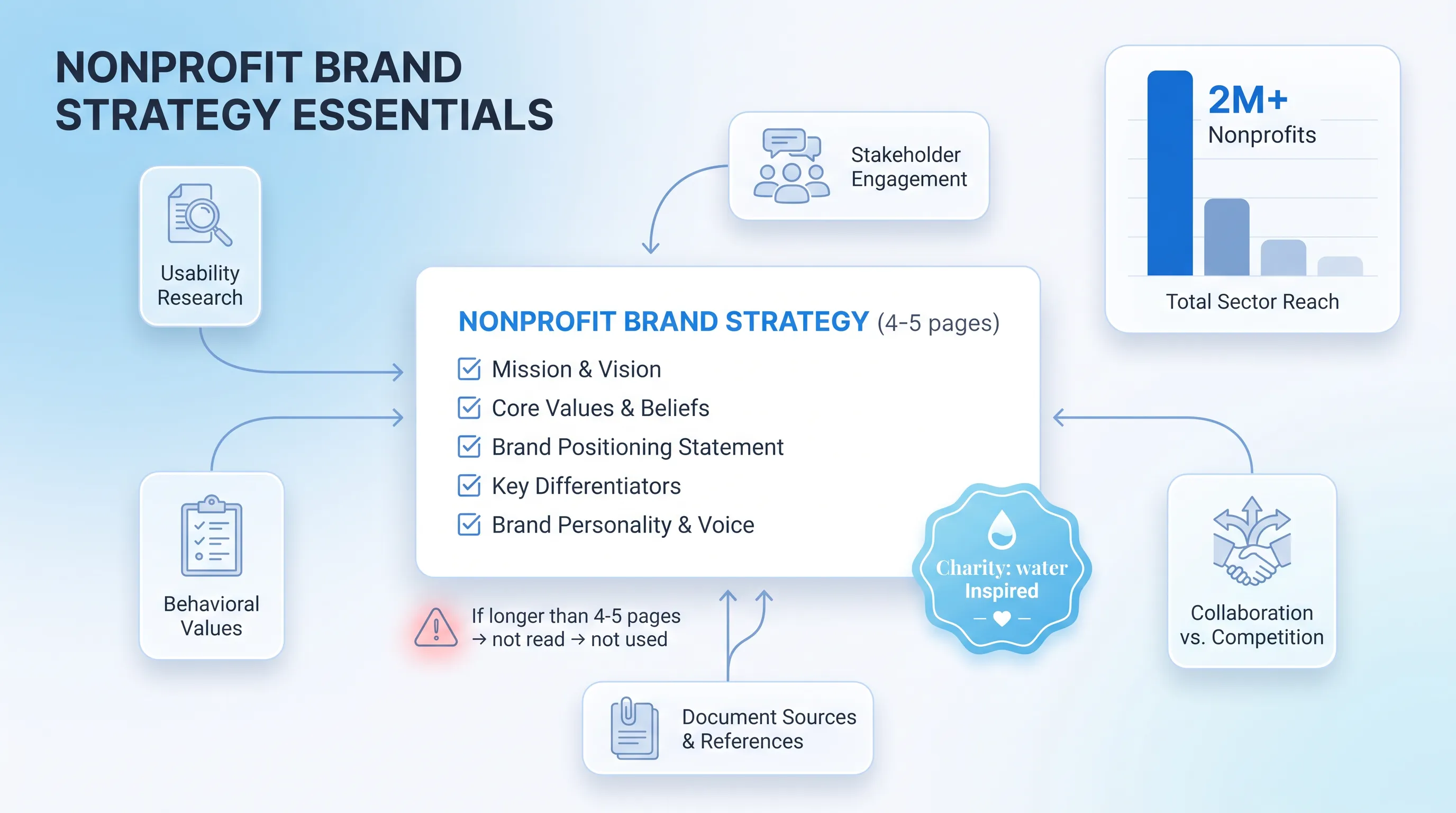
Turn all of it into one nonprofit brand strategy worksheet your team fills in and revisits.
Each row is a decision with a named owner, and the whole thing fits on a few pages:
-
Research findings: interview themes and survey results
-
Mission and values: one mission sentence plus each value written as an observable behavior
-
Audiences: ranked, with the primary conflict between them named
-
Positioning: your role in the cause area, and the two alternatives you're compared against
-
Differentiation: two or three differences, each with the evidence that supports it
-
Personality: four traits, each with a "we do" and "we avoid" line
-
Messaging pillars: three or four, with proof points attached and unsupported claims flagged
-
Architecture: your chosen model and the naming rule for any new program
-
Rollout: owners and dates for each priority touchpoint
-
Success measures: baseline figures with review dates
Fill in what you know and leave gaps visible. A charity brand strategy with three honest blanks is more useful than one padded with guesses, because the blanks tell you where to spend your research budget.
Get expert support
The hard part is rarely the writing. It's holding twenty conflicting stakeholder voices in one room and leaving with decisions your board will back and your staff will use. Snoika Foundation works with nonprofits and NGOs on visibility and content so teams can turn scattered input into messaging that gets found and cited. If your organization has outgrown inconsistent messaging, book a call and we'll map your next steps toward a nonprofit brand strategy your whole team can carry.