Preparing Nonprofit Pages for AI Citation Opportunities

Content authorArtem LozinskyPublished onReading time11 min read
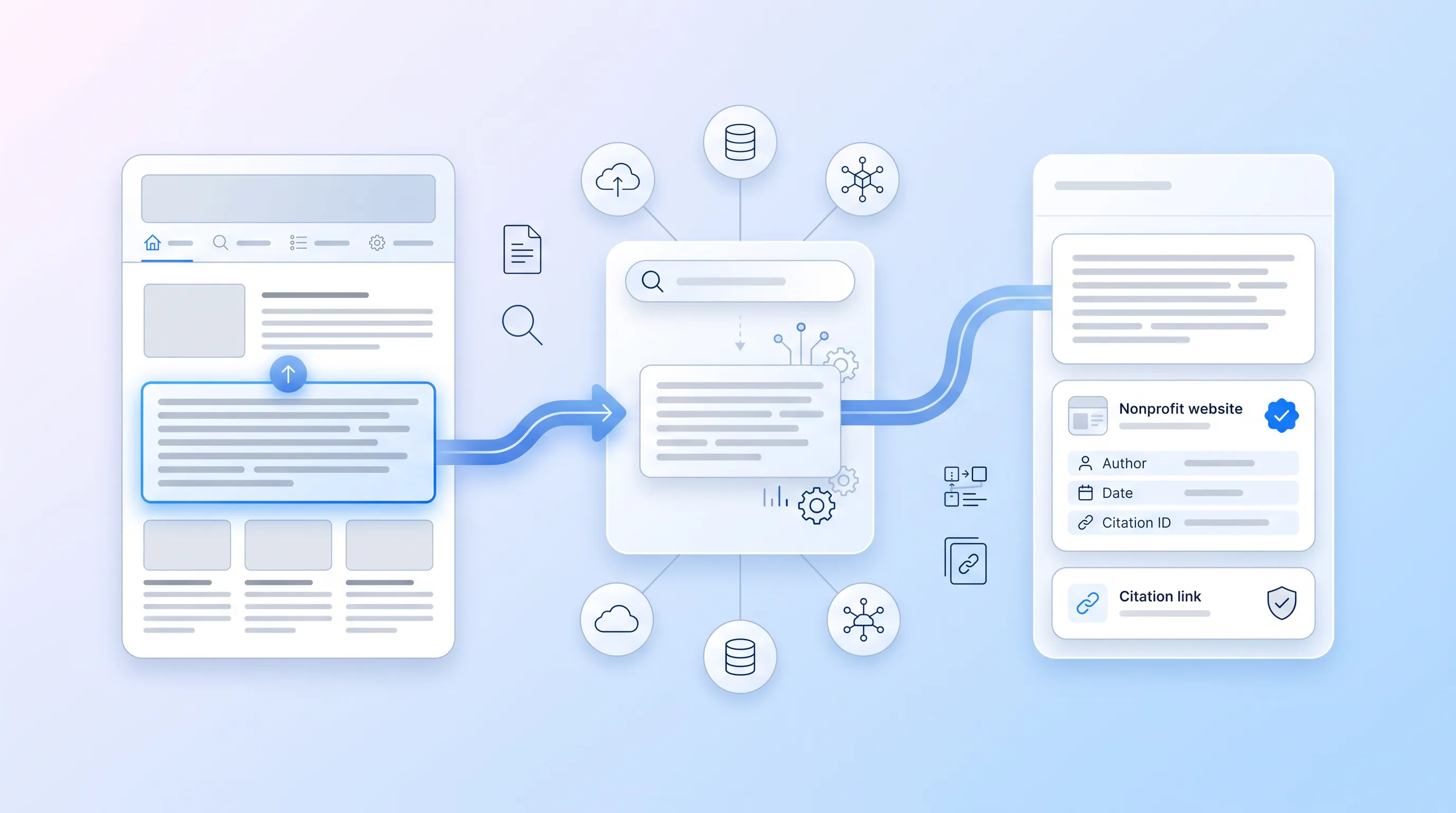
Minimalist illustration of a nonprofit web page with structured content flowing to an AI interface, emphasizing citation-ready architecture.

This article explains how to rebuild nonprofit web pages with citation-ready content architecture so that any short extract holds up on its own when an AI system pulls it out of context. It covers rewriting and a repeatable audit you can run with your existing editorial team.

Why extraction changed the rules

Most nonprofit sites were written for a reader who arrives at the top and scrolls down, which is exactly the reader that citation-ready content architecture no longer assumes. Assistants quote fragments. They lift 40 or 60 words out of the middle of a page and present that fragment as the answer.

The habit of reading in fragments isn't new. Nielsen Norman Group's early eyetracking work found that 79% of test users scanned any new page rather than reading it word by word. What's new is that a machine now does the scanning first, and the fragment it keeps is the only part of your work most people will ever see.

So the question is whether a random slice of it can survive on its own.

The 60-word standard

Here's the test. Take any 60 consecutive words from a published page and ask whether that block is still accurate and still traceable to a source. If you need the paragraph above it to know which country you're talking about, the extract fails.

Sixty words is roughly the length of what an assistant quotes before it moves on. The standard is a stress test applied after the writing is done, and it works because it forces you to notice every pronoun and every figure floating without a year.

Be honest about what this buys you. Passing the 60-word test improves your odds of being quoted, because it makes you cheap to verify and hard to misread, without guaranteeing selection. No standard does, and anyone promising placement in an AI answer is selling something. What you control is whether your high-confidence factual claims are the ones a system can use without risk.

Published is not citation-ready

A page without citation-ready content architecture can be edited and approved and still be useless to a system trying to extract a claim from it. The gap shows up in four places, and once you see them you'll find them on your own site within minutes.

  • Vague claims. "We've reached thousands of families across the region" gives a machine nothing to anchor. Which families and which region.

  • Buried answers. The direct response sits in paragraph six, under three paragraphs of mission framing.

  • Orphaned context. The country is named in the H1, then never again, so every extract below it is geographically homeless.

  • Weak sourcing. A number appears with no publisher and no date, which means nothing meets basic citation hygiene standards.

The cost of this is measurable. A Tow Center for Digital Journalism study at Columbia tested eight generative search tools against 1,600 queries and found they returned incorrect answers to more than 60% of them. The tools cited with confidence and got the attribution wrong. Klaudia Jaźwińska and Aisvarya Chandrasekar, who ran the tests, reported that the tools "were generally bad at declining to answer questions they couldn't answer accurately." Ambiguous source material feeds that behaviour.

Visibility matters too, because the fragment increasingly is the destination. Pew Research Center tracked real browsing of 900 US adults and found that users clicked a link in 8% of visits where an AI summary appeared, against 15% where it didn't. If you aren't inside the summary, you've largely lost the visit.

Prioritise high-value pages

Start with the pages that carry decisions: programme descriptions and anything connected to funding. These are the pages where a donor or a journalist forms a judgement about you.

Score each candidate across four dimensions and rank the list.

  1. Strategic value. How close is this page to money or policy influence?

  2. Factual authority. Do you hold primary data here that nobody else holds, such as your own field surveys or programme audits?

  3. Demand. Are people and systems already asking the question this page answers?

  4. Current weakness. How badly does it fail the 60-word test today?

Your first cohort should be ten pages. Pages built on original evidence deserve the front of the queue, because Google's own guidance for publishers asks whether content offers "original information, reporting, research" rather than restating what's available elsewhere. Most NGOs sit on exactly that kind of material and bury it in annual report PDFs.

Need help with your AI visibility?

Book a free consultation with our experts we'll help you determine exactly which services your organization needs.

Build citation-ready content architecture

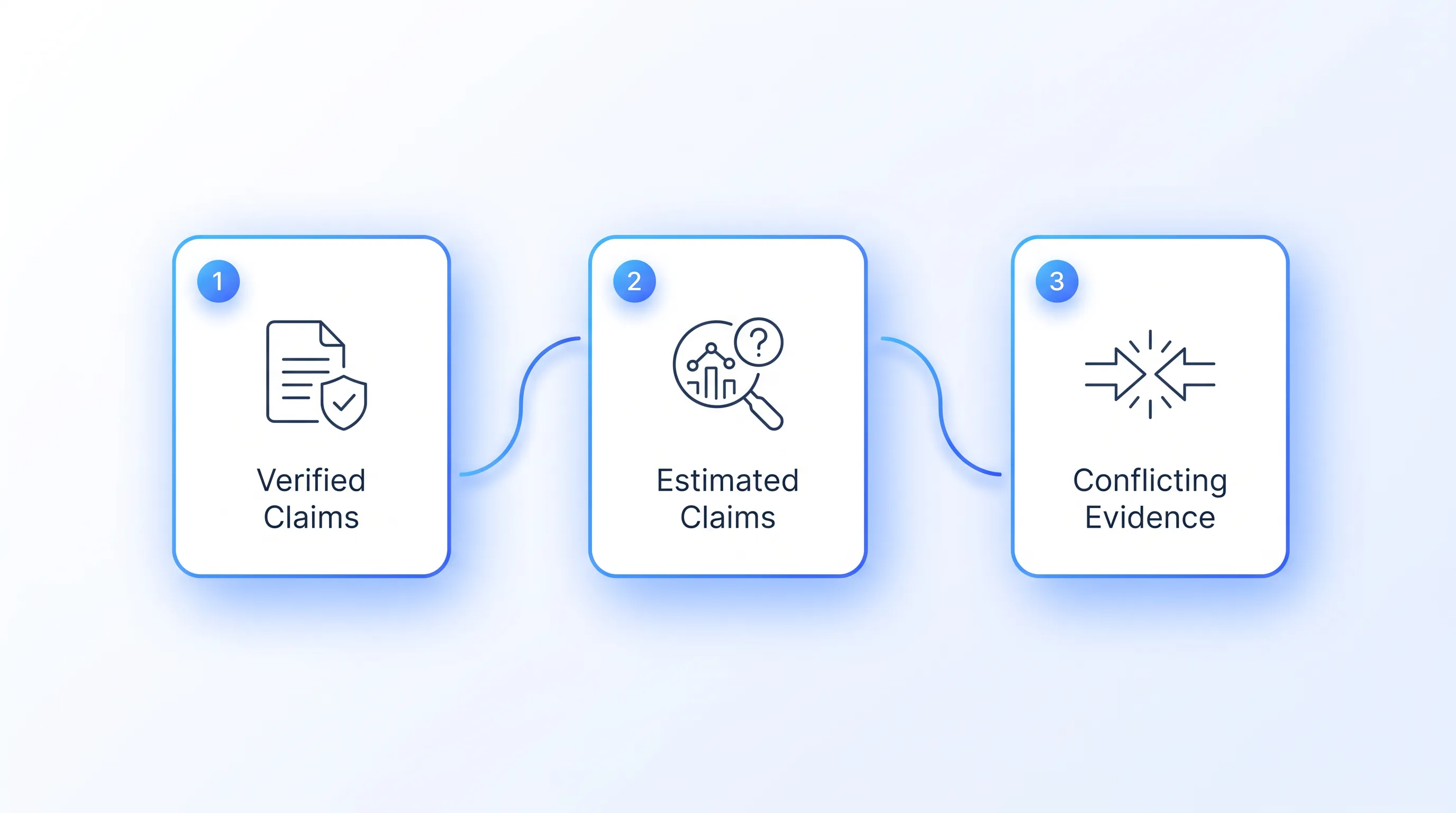
Three-step infographic redesign featuring polished floating UI cards with minimalist icons for Verified Claims, Estimated Claims, and Conflicting Evidence.

Rebuilding a page with citation-ready content architecture means cutting it into self-contained blocks. Each block answers one question completely and reads correctly whether it's first on the page or seventh. Think of it as writing a set of short, independently verifiable statements that happen to sit next to each other.

That's the whole discipline behind citation-ready content architecture. Not new design, not a plugin. A structural rule applied sentence by sentence, supported by the four practices below.

Lead with direct answers

Open every section with the answer, then explain it. The explanation is for the human who stays. The opening sentence is for everyone else and for the machine.

Before: "Through our longstanding commitment to community empowerment, we work tirelessly alongside partners to improve access to clean water across the region."

After: "Between 2021 and 2024, [Organisation] built 148 boreholes in Turkana County, Kenya, which served an estimated 62,000 people. Construction was funded by [Donor] and verified by district water officers in March 2024."

The second version is the one that survives extraction through citation-ready content architecture, and it took no more words to write.

Add context and qualifiers

Every extractable block needs its own coordinates. Name the organisation rather than writing "we". Name the programme and the country. Pronouns and phrases like "this initiative" or "as noted above" break the moment the surrounding copy disappears.

Scope matters as much as subject. "Child vaccination rates rose 12 percentage points" is a different statement from "child vaccination rates in the 14 villages covered by the programme rose 12 percentage points between January 2022 and December 2023." The second one is used because it can be checked. Compare how the World Health Organization writes its public figures: 263 million malaria cases in 2023 across 83 endemic countries. Number and year, in one line.

High-confidence factual claims

Separate what you know from what you believe. A verified count of distributed bed nets is a fact. A projection of lives saved is a model output. "We are the leading voice on displacement in East Africa" is neither, and it will never be quoted as anything but marketing.

Grade your sentences before publishing:

  • Verified: measured and documented from records you hold. State it plainly with its source.

  • Estimated: modelled or extrapolated. Say so and name the method.

  • Aspirational or interpretive: targets and opinions. Attribute them to a named person or to the organisation explicitly.

The evidence you attach should scale with the weight of the claim. A line about office locations needs nothing. A mortality reduction figure needs the study and the date. This is what separates high-confidence factual claims from everything else on the page, and it's the same logic behind Wikipedia's rule that material challenged or likely to be challenged needs an inline citation to a reliable published source.

Need help with your AI visibility?

Book a free consultation with our experts we'll help you determine exactly which services your organization needs.

Citation hygiene standards

Link each claim to the primary source. Name the publisher in the text. Give the date in the text, because a system extracting your sentence won't open your footnote.

Three situations cause most of the trouble, and each has a clean answer under working citation hygiene standards:

  • Internal research. Publish the methodology and the dataset, or at minimum a downloadable summary with sample size and collection period. Unpublished internal data is an assertion.

  • Updated figures. Replace the number and change the date stamp. Don't silently overwrite, because a system quoting your old figure needs a reason to re-crawl.

  • Conflicting evidence. State both and explain which you use and why. A page that acknowledges disagreement is more trustworthy than one that pretends there isn't any.

Keep the reference physically beside the claim it supports. References parked in a block at the bottom of the page detach the moment anything is extracted, which defeats the point of citation-ready content architecture.

Strengthen trust signals

Trust has to be visible on the page itself. Put a named author on substantial content, with a role and a reason that person is qualified to write it. Add the editorial owner and the publication date. Google's search quality rater guidelines, which define how human evaluators assess pages, state plainly that Trust is the most important member of the E-E-A-T family.

Organisational credentials carry real weight in the nonprofit sector because they're externally verified. Link your Form 990 filings if you're a US entity, plus your Charity Navigator rating. If you report aid data, publishing to the IATI Standard gives any checker a machine-readable record to compare against your claims.

Methodology transparency does the rest. One short section explaining how you collect and verify programme figures tells a reader more than any paragraph about commitment to excellence. Describe the method in ordinary language, the way UNICEF documents its child mortality estimates, with the technical detail available for anyone who wants it. Skip the claim that you're a trusted leader. Nobody has ever been cited for saying so.

Make sure the machines can reach the result. Check that your robots.txt doesn't block GPTBot and OAI-SearchBot or Google-Extended unless that's a deliberate policy decision taken with your leadership, and mark up pages with Organization and Article structured data so the authorship and dates you just added are readable as data.

Audit citation-ready content architecture

Testing is mechanical and fast. Open a revised page and copy 60 words from each of three starting points at random. Paste them into a blank document and judge each block against five questions.

  • Accuracy: is the statement true as it stands, with nothing load-bearing left behind?

  • Context: are organisation and place present or obvious?

  • Specificity: are there numbers, or only adjectives?

  • Source support: is the evidence named inside the extract?

  • Plain language: would someone outside your sector understand it on one read?

Score each extract. Pass means all five hold. Revise means one gap: a missing date or an orphan pronoun. Fail means the extract is unusable or, worse, misleading on its own, and a misleading extract is a correction waiting to happen.

One rule has no exceptions. Any interpretation presented as fact comes out or gets attributed. If an extract says a programme reduced school dropout rates and your evidence shows dropout rates fell during the programme period, that's a causal claim your data doesn't carry. Fix the wording. Auditing citation-ready content architecture this way catches those slips before a model repeats them at scale, which is the practical difference between high-confidence factual claims and claims that merely sound confident.

Make quality repeatable

A one-off rewrite decays within two budget cycles. Push the standard upstream into the places where content gets commissioned and approved, so nobody has to remember it. Add the 60-word test to your content brief template as a required field, with the question each section must answer written out before drafting starts.

Then build the approvals around it. A reviewer checks every figure against its primary source and signs off by name. Nothing publishes without a date and an author. The checklist is short enough to run in ten minutes, and it should include the same five audit questions you used on the first cohort, plus a pass on citation hygiene standards for any new external link.

Assign three standing owners and write their names in the workflow. One person owns factual verification for each content area. One owns link maintenance and runs a quarterly broken-link and dead-source sweep. One owns the review calendar, because statistics pages need re-checking the month new data lands, not whenever somebody notices. Citation-ready content architecture survives staff turnover only when those duties sit in job descriptions, and it's what keeps your high-confidence factual claims from quietly aging into wrong ones.

Work with Snoika Foundation

The work is unglamorous and it compounds. Rewrite ten pages properly, then make the standard routine. Snoika Foundation works with NGOs on exactly this: citation-ready content architecture and editorial workflows that hold up under scrutiny and keep holding up after launch. If your published work is credible but not yet built for extraction, book a call with our team to review your site and plan the implementation of citation-ready content architecture.
Need help with your AI visibility?

Book a free consultation with our experts we'll help you determine exactly which services your organization needs.

Create a dated correction or update record rather than overwriting the old claim without explanation. Keep the original publication date, identify the revised figure, state why it changed, and link the new primary source. This preserves an audit trail for readers and systems using citation-ready content architecture.

Yes. Move the report’s key findings, definitions, dates, and methods into HTML sections, then retain the PDF as a downloadable record. HTML gives extracts readable context, while the original file preserves page-level detail for verification. Check that the PDF has selectable text and a stable URL.

Publish an estimate when the number comes from modelling, sampling, forecasting, or incomplete records. Label it in the same sentence, name the method and coverage period, and include a range when the method produces one. Don’t present an estimate as a measured count.

No. Structured data helps machines read authorship, dates, and page type, but it doesn’t prove a programme result. Put the publisher, source date, and evidence beside the relevant claim in visible text. Treat schema as supporting metadata, not a substitute for citation hygiene.

Snoika Foundation can help assess priority pages, review extractable claims, and set up an editorial workflow for ongoing checks. The client supplies source records and approves factual wording. A nonprofit can book a call to define the review scope, evidence needed, and staff responsibilities.

Book a Demo

Book a time that works best for you

You Might Also Like

Discover more insights and articles

A modern digital interface panel with a stylized browser window, surrounded by geometric trust icons on a soft blue gradient background.

Trust-First Copy Framework for AI Search Results

This article explains how to write educational content that holds up when an AI system summarises it and hands a condensed answer to someone who never visits your page. It sets out a four-layer trust-first content framework for sourcing and framing that content, plus a review sequence and the indicators worth measuring.

A modern SaaS dashboard design featuring a blue-focused color palette with clean lines, smooth gradients, and interconnected elements.

Prioritization Framework: Which Content to Fix First

This article sets out a scoring method for deciding which webpages to repair or retire when you have hundreds of URLs and a handful of hours each week. It covers evidence gathering and how to check the results in Google Analytics 4.

A polished SaaS dashboard with floating FAQ cards and a central AI search interface, set against a soft blue gradient background.

GEO-Focused FAQ Strategy for Nonprofits

This article explains how to apply NGO FAQ optimization to build an FAQ programme that answers the questions your stakeholders actually ask, in a form search engines and AI assistants can quote accurately. It covers research and clustering, then writing and schema. It also covers auditing and the measures worth reporting to your board.

Infographic with a glassmorphism style, featuring a 9-step process in three rows, with elegant blue-and-white icons and flowing connections.

How to Build AI-Ready Program Pages That Convert

This article explains how to rebuild a programme page as an AI-ready program page structure so that a prospective participant and a language model can work out in seconds what you do and whether it applies to them. It walks through a nine-block architecture and a publishing workflow you can run with a small team.