Cluster questions by intent
A single page with sixty questions on it is a filing cabinet. Clustering turns your raw list into a content plan you can staff, and it's where most NGO FAQ optimization either becomes manageable or collapses under its own weight. Group first by who is asking and what they're trying to finish, then by programme and location.
The discipline is to let clusters live on the page that already has the context. An eligibility question belongs next to the service description. Question intent clustering gives you that assignment rule, and the two sections below show how to apply it and then check the output against the way AI systems actually read a page.
Question intent clustering
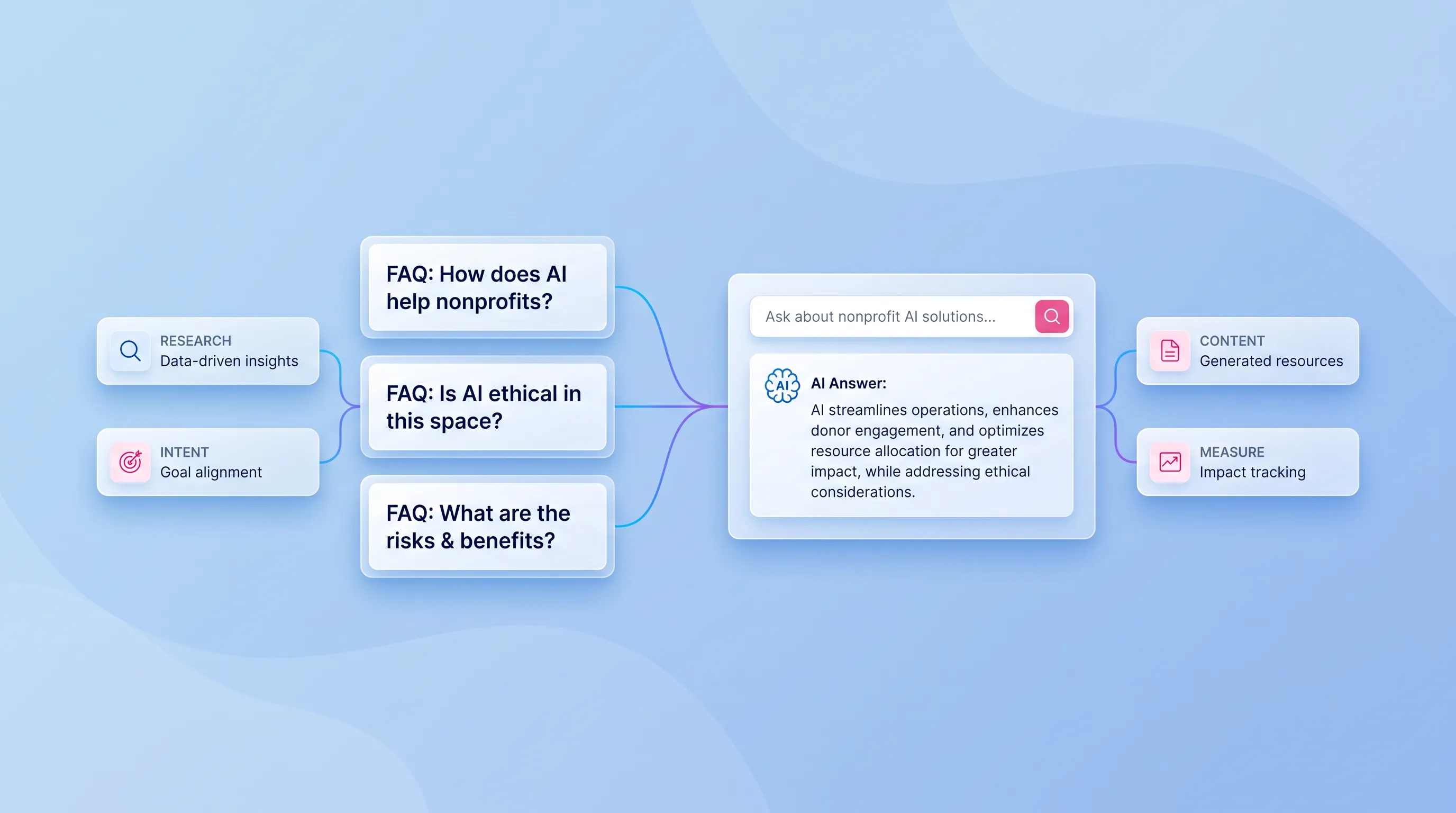
Question intent clustering separates what someone wants from what they typed. Five buckets cover most of what an NGO receives. Informational questions ask what something is. Navigational ones ask where to find a document or an office. Eligibility questions ask whether this applies to me. Action questions ask how to start. Trust questions ask why anyone should believe you.
Each bucket points to a different owner and a different page. Eligibility and action questions belong to programme staff and sit on service pages, because they need the criteria and the form in the same place. Trust questions belong with finance and governance, next to the audited accounts.
Done properly, question intent clustering also tells you what not to write. If two questions resolve to the same action with the same conditions, they're one answer with two phrasings.
AI answer mapping
AI answer mapping is the second pass. For each cluster, write out the conversational prompts a person would type into an assistant, then list the facts a correct response has to contain: the named entity and the date the rule took effect, along with the geography it covers and the caveat that keeps it honest.
This step exists because generative systems are confidently wrong about sources. The Tow Center for Digital Journalism at Columbia tested eight AI search tools across 1,600 queries and found they cited sources incorrectly in over 60% of cases, with Perplexity at 37% and Grok 3 at 94%. If the facts about your eligibility criteria aren't stated plainly on a crawlable page, the model fills the gap with something else. An AI visibility report can help identify where that happens.
AI answer mapping is also where you decide what an answer must never say. A model summarising your refugee legal aid page should not imply you handle asylum appeals if you don't. Write the caveat into the visible answer, because that's the only version the system can quote. Treat the output of AI answer mapping as a checklist your programme lead signs off.
Write authoritative answers
Lead with the answer. One or two sentences that resolve the question together with the context that qualifies it, then the evidence and the single next step you want the person to take. Anything longer than about 80 words stops working as a quotable unit and starts working as an essay.
Plain language is a precision tool. GOV.UK writes for a reading age of 9, on the reasoning that by that age people recognise roughly 5,000 common words by shape, and adults read those faster than anything learned since. The W3C makes the same point formally in success criterion 3.1.5 of WCAG 2.2.
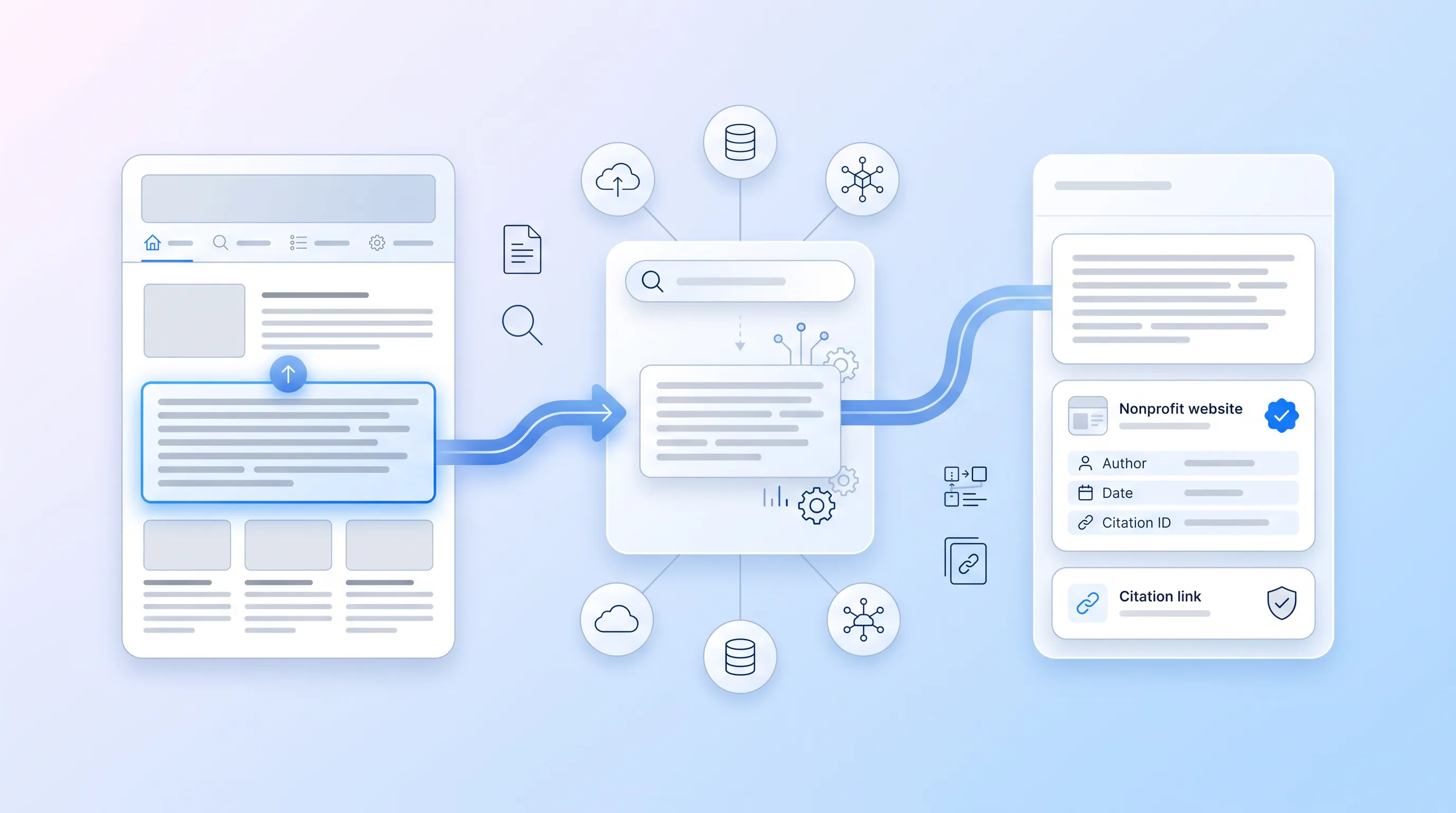
Attribution earns you citations. The Princeton-led GEO study by Pranjal Aggarwal and colleagues tested nine content tactics and found that adding citations and statistics produced a relative improvement of 30 to 40% on how much of a generated answer a source contributes. Name your evidence. "Our 2025 programme evaluation" beats "research shows" every time, and it's the format your AI answer mapping notes already specify.
High-stakes claims need a named reviewer and a date. Anything touching legal status or medical guidance gets verified by the programme expert before publication, and the page says when that happened.