How to Build AI-Ready Program Pages That Convert

Content authorSnoika FoundationPublished onReading time11 min read
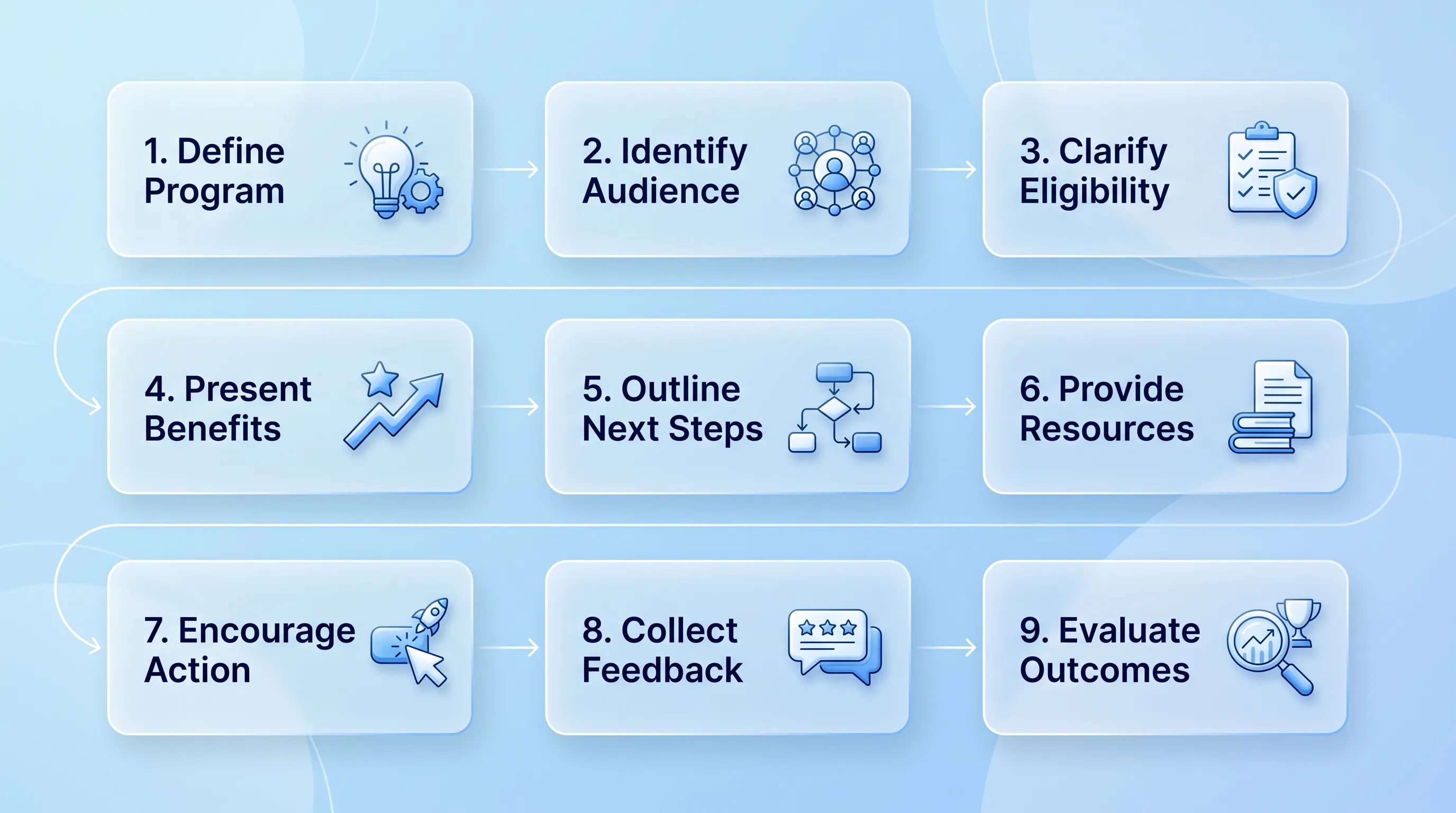
Infographic with a glassmorphism style, featuring a 9-step process in three rows, with elegant blue-and-white icons and flowing connections.

This article explains how to rebuild a programme page as an AI-ready program page structure so that a prospective participant and a language model can work out in seconds what you do and whether it applies to them. It walks through a nine-block architecture and a publishing workflow you can run with a small team.

Why brochure pages fail

Most programme pages fail for the same reason. They were written to impress a board, not to inform a reader, and an AI-ready program page structure starts from the opposite instinct. Vague mission language gives nobody a way in. "Empowering communities through holistic capacity building" tells a mother in Kisumu nothing about whether her daughter qualifies, and it gives a retrieval system nothing to quote.

The second failure is organisation-first narrative. Pages open with the founding story and bury eligibility below the fold, which matters because Jakob Nielsen's research found users read at most 28% of the words on an average visit. The third is unsupported claims. Sprawling, encyclopedic nonprofit pages that assert impact without a source or a date leave both people and machines with nothing to verify.

Set page intent

Before you write a word, name one primary audience and one action you want them to take. A page that tries to convert a participant and a corporate partner at once converts neither of them well. Gerry McGovern's top task research on the Norwegian Cancer Society found that symptoms and treatment ranked at the top of what people wanted, while donation-related tasks ranked at the very bottom. The society cut its site from 4,000 to 1,000 pages, and donations rose.

"Your first job is to help [prospects] do what they came to your website to do as quickly and easily as possible," McGovern told Salesforce. Secondary audiences get a short, clearly labelled pathway near the end, one line and one link each.

An AI-ready program page structure holds that hierarchy visibly. Eligibility sits above the fold when the primary audience is a participant, and partnership terms sit above the fold when it's a delivery partner. What you refuse to do is flatten the page into one of those encyclopedic nonprofit pages where every audience gets equal weight and nobody gets a clear answer.

AI-ready program page structure

Nine blocks each do one job and each is labelled so it can be read alone or as part of the whole. The reason for the modularity is practical. SparkToro's citation position study found that 44.2% of AI citations pull from content in the first 30% of a page, which means a self-contained answer near the top earns far more than a buried one.

Modular doesn't mean disconnected. The blocks run in a fixed order because they form one argument from need to proof. That's problem-action-proof sequencing, and it's the spine of the whole page.

The nine blocks of an AI-ready program page structure run from a definitional answer to a next action. Each has a labelled heading. None repeats another.

Definitional answer

Open with two or three sentences that say what the programme is and whom it serves. Go straight to the definition. If someone reads only this block, they can decide whether to keep reading.

Write it as a standalone definition. "The Nyanza Girls' Re-entry Programme helps girls aged 12 to 17 in Kisumu County, Kenya, return to formal secondary school after pregnancy-related dropout" does more work than a paragraph about vision. This is where an AI-ready program page structure earns its keep, because retrieval systems lift exactly this kind of self-contained sentence.

Sourced problem

Define the need with current evidence and link every important number to where it came from. UNESCO's Global Education Monitoring Report puts 273 million children and youth out of school as of 2024, with the out-of-school rate at 36% in low-income countries against 3% in high-income ones. That's a claim anyone can check in ten seconds.

Then narrow to your operating context. National or global figures establish the category, but the reason your programme exists is usually local. Cite the district survey or the ministry statistic, and say when it was collected.

Intervention mechanism

Explain what the programme does and why those activities move the problem you just described. Internal vocabulary kills this block. If your team says "wraparound accompaniment," write out what that means: a caseworker visits each household monthly and negotiates with the school on re-admission.

The causal link needs to be explicit. Say which barrier each activity removes. A reader who can't reconstruct your logic will assume you haven't examined it either.
Need help with your AI visibility?

Book a free consultation with our experts we'll help you determine exactly which services your organization needs.

Problem-action-proof sequencing

The order matters more than most teams expect. When a page presents activities first and evidence last, both a human reader and a retrieval system have to fill gaps, and filling gaps is where misrepresentation starts. Problem-action-proof sequencing removes the guesswork by making each block answer the question the previous block raised.

A 2025 cross-engine study audited 1,702 citations across Brave Summary and Google AI Overviews, and the operational takeaway was blunt: machines need a source they can retrieve and quote without inventing missing context. Sequencing is how you supply that context. Nothing on the page should require the reader to hold a claim in suspense.

Participant pathway

This block answers the questions that decide whether someone acts, including who's eligible and what the applicant does next. Name the steps in order and give a realistic timeline for each.

Costs deserve particular honesty. If the programme is free but participants need to reach a centre 14 kilometres away, say so and say whether transport is covered. Accessibility belongs here too, because only 26% of nonprofits have websites designed for people with visual and hearing impairments. An AI-ready program page structure treats that gap as a content problem.

Delivery model

Name your delivery partners and your geographic scope. Say who employs the frontline staff and which organisation holds legal responsibility for participant welfare. Vagueness here reads as evasion to funders who've seen it before.

Safeguarding practices belong on the page, not buried in a policy PDF nobody opens. State which code you follow and how a participant raises a complaint. Operational specificity is a credibility signal that no amount of adjectives can replace.

Outcomes and evidence

Separate the outputs you counted from the outcomes you measured. Give dates for every figure. If 412 girls enrolled in 2024 and 287 completed the school year, publish both numbers and the ratio between them.

Say how you measured. A pre-post comparison is not a randomised evaluation, and the difference matters to anyone assessing your claim. J-PAL's work explains why randomised designs produce a rigorous and unbiased estimate of causal impact, which is precisely the standard most programme pages quietly imply without meeting. Publish the limitation and you gain more trust than you lose.

Human impact

One participant story, properly contextualised, does something the aggregate numbers can't. It shows what the intervention feels like from inside. Keep it short and tie it to the outcomes block.

Consent is not optional. The Dóchas Guide to Ethical Communications commits signatories to obtaining informed consent from the contributor before a story is researched or footage taken, free from any pressure or false expectation of benefit. Record whether the person wants to be named and explain how they can withdraw it.

Clear next action

Match the action to the intent you set at the start. A participant needs an application link or a phone number, not a donate button. Give the primary audience one obvious action and the secondary audiences one line each.

Make the mechanics concrete:

  • State what happens after submission and how long a response takes.

  • Name a real person or team who receives the enquiry, with a monitored address.

  • Offer an offline route, because in 2024 mobile devices accounted for 53% of nonprofit website visits and not every applicant will finish a long form on a phone.

An AI-ready program page structure ends with an action a specific person can take today.

Need help with your AI visibility?

Book a free consultation with our experts we'll help you determine exactly which services your organization needs.

Add authority signals

Put a name on the page. Google's own summary of its rater guidelines says raters review the information available about the website and its creator, because it should be clear who is responsible for the website and who created the content. A named programme lead with a title and a reviewed-on date does more for trust than any design refresh.

Add the credentials that already exist and cost you nothing to display. Villanova University and University of Wisconsin-Milwaukee researchers compared nonprofits with and without a transparency seal and found the seal holders averaged 53% more in contributions the following year. Registration numbers and audited accounts work the same way.

This is where the temptation to write encyclopedic nonprofit pages returns, so resist it. An AI-ready program page structure that covers your history and your entire portfolio dilutes the one programme it was meant to explain. Encyclopedic nonprofit pages compete with Wikipedia on breadth, which is a losing position, and Pew Research found that Wikipedia and YouTube already dominate as the most-cited sources in AI summaries.

Focused, substantiated coverage wins instead. Link outward to the studies you cite and inward to the related resources a reader wants next. Every link you add is a claim you're willing to have checked.

Make content machine-readable

Start with the things you control in the content management system. Descriptive headings that name their block and alt text on every image. Those alone address the most common failures, since the WebAIM Million found low contrast text on 79.1% of home pages and missing image alt text on 55.5%.

Then the technical layer, which needs developer support:

  • Semantic HyperText Markup Language (HTML) so headings and lists carry meaning.

  • Schema.org markup in JavaScript Object Notation for Linked Data (JSON-LD) that matches the visible text exactly, because Google requires that markup accurately represents page content.

  • Crawlability checks covering robots.txt and any JavaScript rendering that hides text from crawlers.

Skip the speculative work. Google's guidance states that there's no special schema.org markup for AI features. Google also asks site owners to make sure important content is available in textual form, which is the whole job in one line. The machine-readable layer of an AI-ready program page structure supports the AI-ready program page structure.

Build the page

Run it as a project with a named owner and a deadline, otherwise it becomes a rolling edit that never ships.

Here's the workflow:

  1. Audit what's live. Paste the current page into a document and mark every sentence as a fact, a claim, or filler. Most brochure pages are two-thirds filler.

  2. Gather evidence. Pull the monitoring data and the most recent evaluation. Flag anything you can't source.

  3. Draft the nine blocks in order and keep problem-action-proof sequencing throughout. Draft the definitional answer last, once you know what the page actually says.

  4. Route it for programme approval. The delivery team checks eligibility and safeguarding, and finance checks cost claims.

  5. Publish with a visible author and a reviewed-on date.

  6. Assign an update owner with a calendar reminder. Content updated within the last 90 days receives a 3.2x citation multiplier compared with older content, according to ConvertMate's analysis of 80 million citations.

Approval is where most rewrites die, so bring the delivery team in at step two rather than step four. Their objection is almost always that a claim overstates the work, and they're almost always right. Resist the pull back toward encyclopedic nonprofit pages during review, when every department asks for one more paragraph about itself.

Measure and improve

Track qualified conversions. An application from someone who meets the eligibility criteria is worth more than fifty who don't, and the difference shows up in your intake team's workload before it shows up in analytics. Scroll depth on the pathway and evidence blocks tells you which parts people actually reach.

Watch AI citations separately from search rankings. Google rankings still predict AI Overview citations, but BrightEdge measured pairwise overlap between engines' top cited sources at just 16% to 59%, so a win on one surface won't carry to another. Candid's analysis found AI-driven traffic made up 2% of nonprofit website volume between January and October 2025, a 1000% increase year over year, and those visitors stayed more than 70% longer than other visitors. Small base, steep curve.

Then use what you learn. Log the questions that reach your inbox, because each one is a gap in the page. If three people a week ask whether siblings can enrol together, that belongs in the pathway block, and the AI-ready program page structure gives you an obvious place to put it without disturbing problem-action-proof sequencing.

Get expert support

You can now take one brochure page apart and rebuild it as nine labelled blocks of an AI-ready program page structure. That's a week of focused work for a page that will carry applicants and funders for years.

Snoika Foundation works with NGOs and nonprofits to make their content visible and cited in AI search engines like ChatGPT and Perplexity. If you want help planning or implementing an AI-ready program page structure, book a call with our team.

Need help with your AI visibility?

Book a free consultation with our experts we'll help you determine exactly which services your organization needs.

Include the programme name, location, participant group, and main result or service. A title such as “School re-entry support for girls aged 12 to 17 in Kisumu” gives readers and search systems useful context before they read the page.

Review it at least every 90 days and whenever eligibility, funding, safeguarding procedures, or results change. Assign one owner to check dates, links, contact details, and evidence so outdated information doesn't remain published.

You can, but participants should remain the primary audience if applications are the main goal. Put eligibility and application steps first, then add a short, clearly labelled route to funding information rather than giving both audiences equal space.

Structured data can help search systems interpret a page, but it doesn't guarantee AI citations. Use semantic HTML and matching JSON-LD, while keeping the important information visible as text because markup must accurately represent the page.

Snoika Foundation helps NGOs and nonprofits plan and implement an AI-ready program page structure. Before requesting support, gather the current page, eligibility rules, monitoring data, evaluation reports, and the contact details for the programme owner.

Book a Demo

Book a time that works best for you

You Might Also Like

Discover more insights and articles

Modern infographic with soft blue gradient background, featuring four circular glassmorphism cards connected by subtle lines and icons.

Nonprofit Call to Action Examples for Donations, Volunteers, and Advocacy

This article is a working swipe file of nonprofit call to action examples you can adapt for donations and volunteer recruitment. It covers copy formulas and a simple testing method so you can replace vague asks with ones that actually get completed.

Modern B2B technology infographic with frosted-glass cards, soft blue gradient, and elegant connections, centered on "Brand Guidelines.

Nonprofit Brand Identity: How to Build a Consistent System Beyond the Logo

This article explains how to build a nonprofit brand identity that survives contact with reality: twelve staff members and no in-house design team. It covers the visual and verbal systems behind that consistency, plus the templates and governance that keep the whole thing alive after launch.

Flat design infographic comparing two donation website types: 'Visit-to-Donation Rate' on the left and 'Start-to-Completion Rate' on the right, with arrows i…

Donation Page Conversion Rate: Formula, Benchmarks, and Diagnostics

This article explains how to calculate and benchmark a donation page conversion rate without mixing up denominators. It walks through two formulas with worked numbers and a repeatable diagnostic sequence you can run before you change anything on the page.

A minimalistic vector diagram showing interconnected digital processes with a cool blue gradient background and no title.

Nonprofit Color Palette: How to Choose Accessible Brand Colors

This article explains how a small communications team can pick and test brand colors without a designer on staff. It covers strategic criteria and the documentation that keeps charity brand colors consistent once volunteers and vendors start using them.