Multilingual AI Visibility Roadmap for International Missions

Content authorArtem LozinskyPublished onReading time12 min read
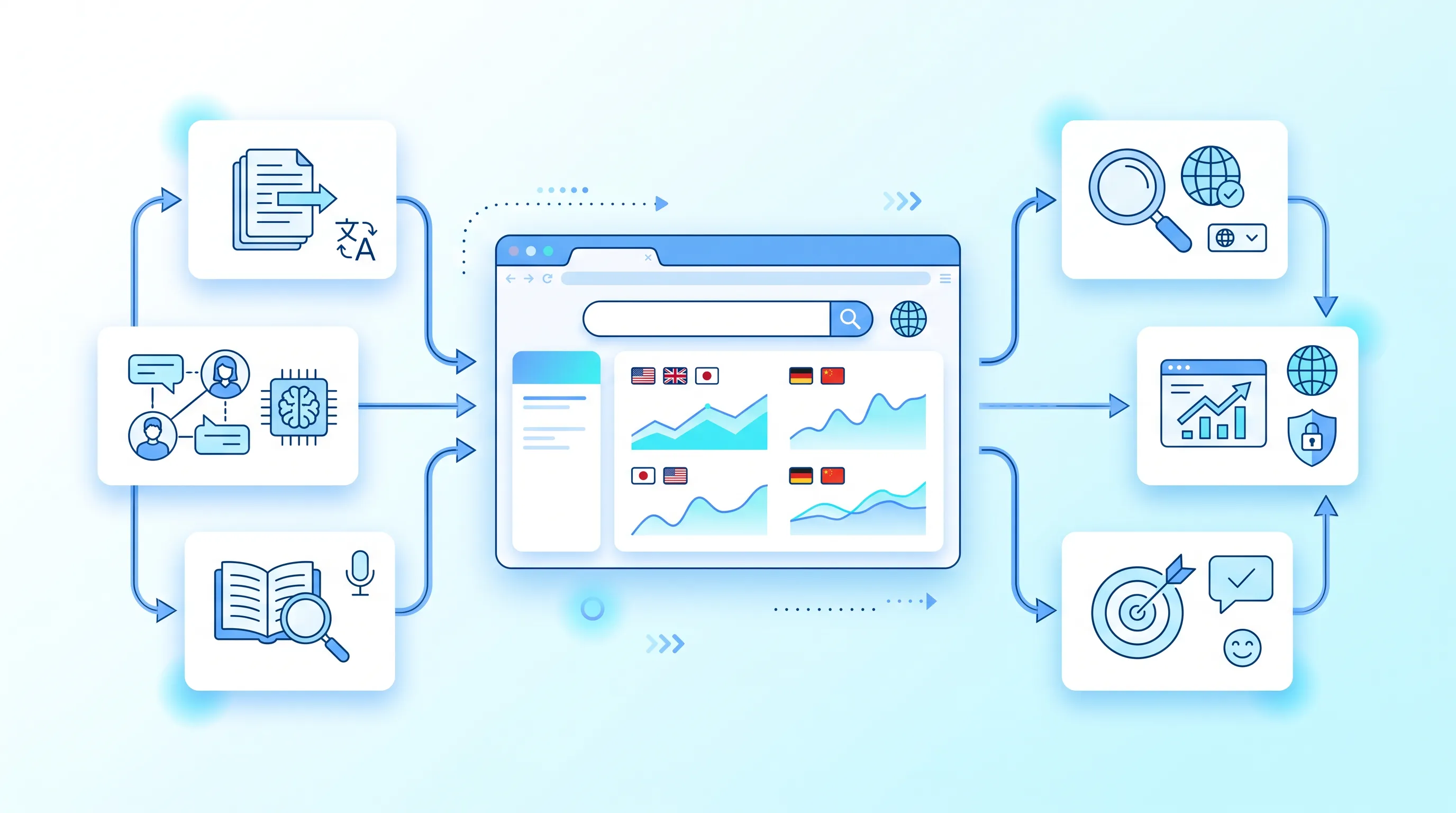
A modern infographic featuring a central web browser window with a multilingual AI dashboard, surrounded by blue line icons on rounded cards.

This article sets out a prioritized way to decide which languages your organization publishes in and what a complete reader journey looks like in each one. It covers language scoring and localization briefs, then hreflang structure and review gates, along with measurement by language and geography.

Why partial translation fails

A translated homepage with untranslated pages behind it is the most common shape of multilingual AI visibility failure in the nonprofit sector. The welcome text reads in Swahili or Arabic, then the eligibility page and the application form switch back to English. Anyone who got that far has already been told the organization speaks their language, and then told it doesn't.

That break costs more than access. It costs trust, because a reader who hits an English form assumes the program wasn't built for them. It costs action, because the enquiry never arrives. And it costs machine-readable proof, since an answer engine asked a question in Portuguese has nothing complete to summarize. Partial translation produces a partial record of what you do.

Prioritize languages

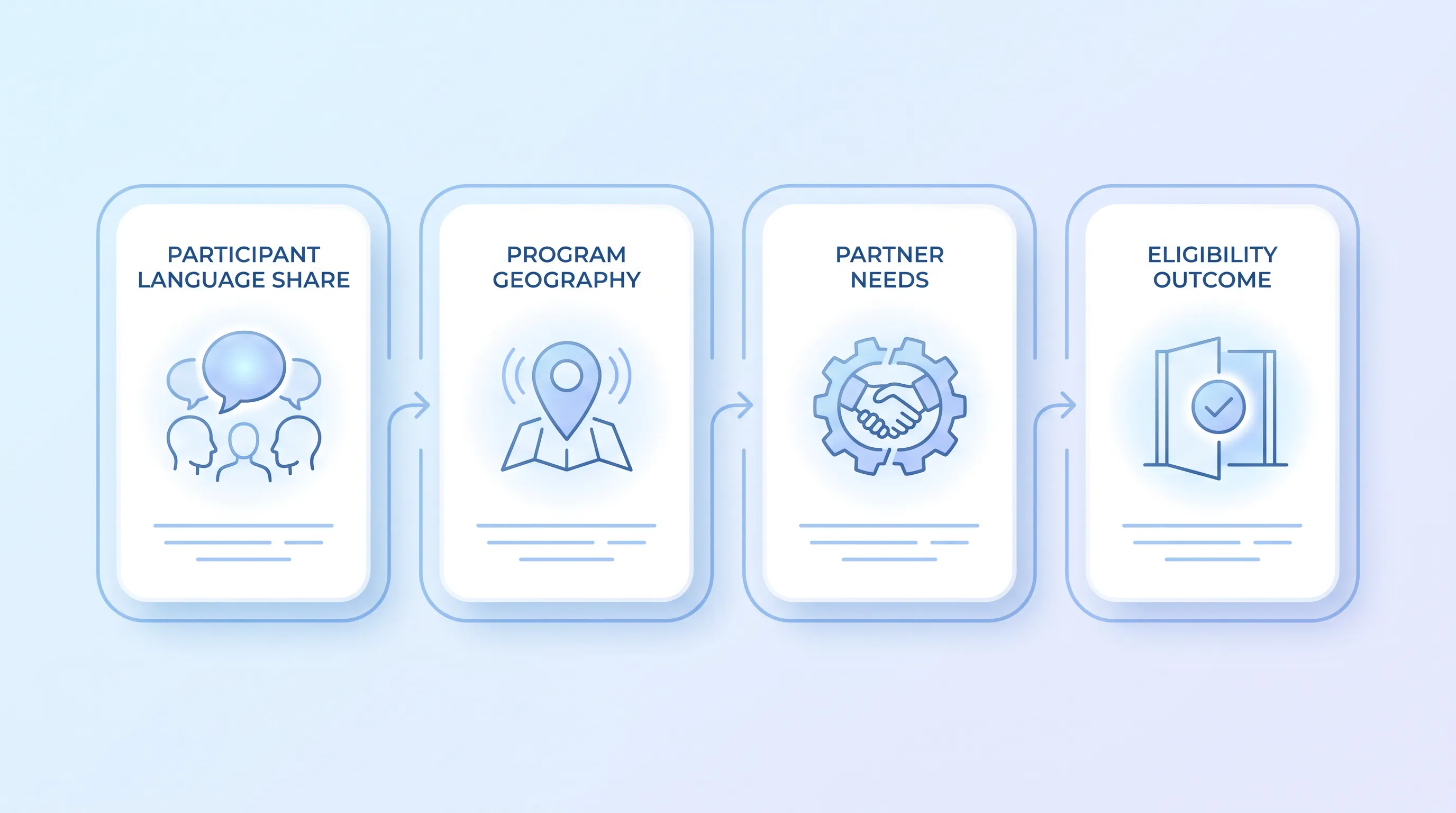
Infographic panels in soft blue shades illustrate language priorities for program eligibility, arranged linearly with smooth edges and ambient lighting.

Global speaker counts are the wrong deciding shortcut. Mandarin and Hindi top every popularity list, but if your programs run in Niger and northern Nigeria, those numbers tell you nothing about who needs your eligibility page. Score candidate languages against your actual operation instead, using a matrix your leadership can discuss and challenge.

  • People served: Share of current participants whose first language this is. (Highest weight)

  • Programme geography: Countries where you hold active operations or offices. (High weight)

  • Partner and donor need: Institutional funders and ministries requiring local-language documents. (High weight)

  • Inbound enquiries: Messages, calls, and forms already arriving in this language. (High weight)

  • Search demand: Query volume for your programme topic in-country. (Medium weight)

  • Accessibility obligation: Legal or grant-condition duties to publish in the language. (Medium to binding weight)

  • Reviewer availability: A named, qualified person who can approve copy. (Gate, not a score)

  • Maintenance capacity: Hours available per quarter to keep it current. (Gate, not a score)

The last two rows decide more than the first six. A language with strong demand and no reviewer is a language you cannot publish responsibly. Consumer research points the same direction on the demand side, where CSA Research's 2020 survey of 8,709 consumers in 29 countries found 40% would never use a site in another language at all. AI visibility starts with a shortlist you can defend, the basis of multilingual AI visibility.

Research local questions

Literal keyword translation reproduces your internal vocabulary in a new alphabet. What you need is the phrasing people already use when they're worried and looking for help. Your local staff and your existing inbound enquiries give you that, and market-specific query research is done in-country.

Ask field teams what callers say in the first ten seconds, then compare that to what your English page calls the same thing. The gap between "cash assistance" and the phrase a household actually types is where search intent by language lives. CLEAR Global found that in frontline Ukraine response materials, English-source documents translated without plain-language editing produced errors and misinterpretations, which is the same failure in a higher-stakes format.

Search intent by language

Take one programme topic, maternal health support, and put it in two places. In Jordan, the Arabic page needs eligibility by residency and registration status near the top, because the first question is whether a non-citizen qualifies at all, and the desired action is booking an appointment. In Kenya, the Swahili page leads with clinic locations and costs, because eligibility is less contested and the action is showing up on the right day.

Same programme with two different page orders and two different vocabularies for "registration." That's search intent by language expressed as structure. If both pages are translations of the same English outline, one of them is answering a question nobody asked.

International mission localization

Before anyone writes, fill in a brief. International mission localization works for multilingual AI visibility when the writer and the reviewer agree on the facts and the risk before the first sentence exists.

  • Audience and locale: who reads this, in which country, with what status or entitlement

  • Purpose and action: the one thing the reader should do next, written as a verb

  • Terminology: approved local terms for programme names, legal status, and currency, with the forms you reject

  • Cultural and legal context: conditions that differ from the source country, including anything that changes who qualifies

  • Evidence requirement: which figures must appear, and the approved source for each

  • Risk level and reviewer: what harm a wrong sentence causes, and the named person qualified to sign it off

Reuse the same brief for every language. International mission localization becomes repeatable when the template is fixed and only the content inside it changes.

Need help with your AI visibility?

Book a free consultation with our experts we'll help you determine exactly which services your organization needs.

Choose one complete journey

One language done completely beats six done halfway. A complete journey is four connected pages that run from the programme overview and the evidence behind it through the eligibility detail to the contact or application path. Every link inside that chain must stay in the reader's language, which includes the form labels and the confirmation message.

Supporting documents follow a different rule. A 60-page evaluation report needs a reviewed local-language summary that states the method and the finding, with the sample noted and the full document linked and labelled in its original language. Translate the report in full when funders require it or when it carries commitments people will act on. Multilingual AI visibility depends on that summary existing as a real page.

Compare localization approachesLocal staff translationLocal staff translation

Local staff translation

  • Factual risk: Moderate; increases with technical content

  • Best suited for: Short service pages and community notices

  • Terminology control: Strong when a glossary exists

  • Reviewer need: Second reader for legal or medical claims

  • Maintenance: Competes with staff programme work

Professional translation

  • Factual risk: Low for accuracy, but local nuance may be missed

  • Best suited for: Legal, medical, and funder-facing documents

  • Terminology control: Strong with a supplied glossary

  • Reviewer need: Local reviewer for context

  • Maintenance: Vendor turnaround time for each change

AI-assisted draft plus qualified review

  • Factual risk: High without review; acceptable with qualified review

  • Best suited for: High-volume drafting of low-risk explanatory copy

  • Terminology control: Weak unless the glossary is enforced in the prompt

  • Reviewer need: Mandatory named reviewer

  • Maintenance: Fast drafting, but review time increases with volume

The third row is where most teams get hurt. Google's John Mueller put the standard plainly: if auto-translation quality is low, "a human native in those languages reviews" and fixes the output before it goes live. The accuracy gap behind that advice is measurable, with top models scoring 12 to 29 points lower in non-English languages according to The Economist, and a 2025 evaluation of GPT-4o and Llama across 19 Indic languages found minimal gains for low-resource languages even as model size grew. International mission localization that skips the review step inherits those errors at scale and harms multilingual AI visibility.

Build dependable foundations

Contradictions between language versions come from a missing source of truth. Hold one approved facts sheet that records the programme name and eligibility criteria along with dates and figures, with the citation behind each number. Every language version draws from it, and local teams stay free to choose their own order and wording.

Two artefacts keep that process consistent: a glossary and a change log.
Glossary

Programme name

  • English source: Safe Water Start

  • Approved target: Local rendering

  • Do not use: Transliterations, abbreviations

  • Approved by: Country lead

Eligibility term

  • English source: Registered household

  • Approved target: Local rendering

  • Do not use: Informal synonyms

  • Approved by: Legal reviewer

Figure

  • English source: 12,400 people reached, 2025

  • Approved target: Same numeral format

  • Do not use: Rounded estimates

  • Approved by: M&E lead

Change log: Date and source page changed: 14 March, /programmes/water. What changed: Eligibility age lowered from 18 to 16. Languages affected: French, Arabic. Reviewer and sign-off date: Named reviewer, 19 March. Status: Published / pending / withdrawn.

Multilingual AI visibility rests on this layer, because contradictory numbers across language versions teach every system reading your site that your figures are unreliable.

Need help with your AI visibility?

Book a free consultation with our experts we'll help you determine exactly which services your organization needs.

Structure language versions

Give each locale its own URL. Google's guidance on using different URLs per language is explicit about not switching content by cookie or browser setting, and it warns that Googlebot crawls from the United States without an Accept-Language header, so dynamic swapping hides your work. MSF runs its global site at msf.org with a visible language selector and separate country sites for its offices across 40-plus countries, which is the pattern to copy: language choice in the header, never a forced redirect.

Decide early whether you're targeting a language or a region. French for readers anywhere is "fr". French for Canada specifically is "fr-CA", and you only add the region code when the page content actually differs by country. Google supports ISO 639-1 language codes with optional ISO 3166-1 Alpha 2 region codes, and every page in a set must reference itself and all its alternates.

Canonicals need the same discipline. Point each language version's canonical at itself, never at the English original, because a canonical pointing elsewhere overrides the hreflang relationship you just built. Verify the current syntax and supported codes against Google's live documentation before you ship, since the details change and stale blog posts outnumber accurate ones. Multilingual AI visibility collapses quietly when a single template pushes every canonical back to the source language. Technical SEO supports this foundation.

Multilingual AI visibility roadmap

Run this as a sequenced release with named owners and gates, because a sitewide translation project stalls at 40% complete.

  1. Score the shortlist and confirm reviewers (communications director, two weeks)

  2. Lock the approved facts sheet and glossary (programme lead plus M&E, one week)

  3. Draft the four-page journey against the brief (writer or vendor)

  4. Qualified review and sign-off (named local reviewer, gate: no sign-off, no publish)

  5. Technical build with locale URLs and hreflang (web owner)

  6. Pre-launch checks across links, forms, and claims (web owner, gate)

  7. Measure for one quarter before approving a second language (communications director)

Assess demand and capacity

Score every candidate language against the matrix, then strike any language without a named reviewer and quarterly maintenance hours. Confirm the reviewer in writing, with their qualification recorded against the risk level of the content. Pick one opportunity where demand and capacity line up with search intent by language.

Prepare and localize

Finalize the source facts before anyone writes, because changing a figure mid-build means re-reviewing every page it touched. Complete the full journey and apply the brief and glossary to each page. Send the whole set to the reviewer together so inconsistencies surface in one pass. International mission localization fails most often at this step, when a form or a confirmation email gets left in the source language, which breaks multilingual AI visibility.

Test and expand

Before launch, check that every internal link stays inside the locale and that forms submit and confirm in the right language. Confirm that page titles and meta descriptions are localized and that the language switcher is visible on mobile. Every claim must match the approved facts sheet. Then stop. Expand to a second language only when the first produces enquiries you can handle and you still have review hours left over.

Own every update

An update with no owner becomes a contradiction within a quarter.

  • Eligibility criteria change: Source-page owner: Programme lead. Language reviewer: Named local reviewer. Deadline: 5 working days. Escalation: Country director. Action: Update all versions or unpublish the affected section.

  • Annual figures published: Source-page owner: M&E lead. Language reviewer: Named local reviewer. Deadline: 10 working days. Escalation: Communications director. Action: Update glossary figure row, then all versions.

  • Contact or office change: Source-page owner: Operations. Language reviewer: Named local reviewer. Deadline: 2 working days. Escalation: Country director. Action: Update journey endpoint and confirmation copy.

  • Legal or status wording change: Source-page owner: Legal. Language reviewer: Qualified legal reviewer. Deadline: Before publication. Escalation: General counsel. Action: Hold publication until sign-off.

Unpublishing is a legitimate action. A section withdrawn while it's being corrected beats a section that quietly contradicts your English page for six months. International mission localization is an ongoing obligation attached to named people responsible for multilingual AI visibility.

Measure languages separately

Aggregate traffic hides everything that matters here. Split your reporting by language and geography, and track useful visits and relevant enquiries for each. Completed key actions and search appearances follow the same split. Google Search Console's performance report filters by country, and since October 2026 it supports combined traffic for multiple countries, which makes regional grouping possible without spreadsheet work.

AI answers need their own log, because multilingual AI visibility in one language tells you nothing about another. Weglot's analysis of 1.3 million AI citations found untranslated Spanish sites earned 431% more AI Overview citations for Spanish queries than English ones, and that translated sites gained across both. Record each check by question and language with the platform and date attached, and re-run the same questions monthly. Visibility reports can support this measurement.

Keep the measurement honest about who you're reaching. GSMA reports that 63% of people in Africa covered by mobile broadband still don't use mobile internet, so your page data describes the connected portion of your audience and nothing more. Multilingual AI visibility is one channel inside a wider communication plan, and search intent by language is measured.

Choose the first expansion

Pick the language where people you serve are already asking and a qualified reviewer has said yes, with hours on your team to maintain four connected pages for a year. Build that journey completely and measure it for a quarter. Expand only when the numbers and the capacity both hold.

Snoika Foundation works with NGOs and public institutions on exactly this problem, from language scoring through review workflows and measurement. Book a call with our team to plan your first complete journey and build multilingual AI visibility your organization can sustain.
Need help with your AI visibility?

Book a free consultation with our experts we'll help you determine exactly which services your organization needs.

Pause or unpublish the affected section until the approved facts sheet is corrected. Record the change, identify every language version it affects, and assign the named reviewer a deadline. Republish only after each version matches the new rule and the change log records the sign-off.

A language is ready when a qualified reviewer, maintenance time, and a complete reader journey are confirmed. Check the programme, evidence, eligibility, and contact or application pages together. Test links, forms, confirmation messages, claims, titles, and mobile language switching before publication.

AI can produce a draft for low-risk explanatory content, but a qualified human must review it before publication. Medical, legal, eligibility, and funder-facing content needs closer review because errors can change who qualifies or what action a reader takes. Keep the reviewer’s name and approval record.

Separate reporting shows whether a language reaches the intended audience and produces relevant actions in that location. Track useful visits, enquiries, completed actions, search appearances, and AI citations by language and geography. This prevents strong results in one market from hiding weak or missing performance elsewhere and supports multilingual AI visibility.

Snoika Foundation helps NGOs and public institutions plan language scoring, review workflows, technical setup, and measurement. Your team can book a call to discuss a first complete journey, provided you have a named reviewer and enough capacity to maintain the pages after launch.

Book a Demo

Book a time that works best for you

You Might Also Like

Discover more insights and articles

A diagram of an editorial calendar workflow in blue shades, featuring interconnected icons and labeled steps in a modern, clean style.

AI-Powered Editorial Calendar for Continuous Visibility

This article explains how a small communications team can plan publishing and maintenance in one spreadsheet that follows documented reader demand instead of the awareness-day treadmill. It covers inputs and prioritisation. A worked four-week example and the review questions worth asking at month end follow.

Modern infographic illustrating a central browser interface for nonprofit competitive intelligence, surrounded by symbolic blue icons and connectors.

Competitive Visibility Monitoring for Mission Organizations

This article explains how to check whether your organisation shows up, and shows up accurately, in search results and AI-generated answers about your cause. It covers a question registry and a coding method two reviewers can reproduce, plus a share calculation with defined denominators that shows the point at which paid software earns its cost.

Modern infographic depicting an advocacy content strategy with a central browser window, user group icons, and a soft blue gradient background.

Advocacy Content SEO for Policy and Public Education

This article sets out a practical framework for planning and measuring policy pages so that facts and organisational positions stay separate on the page. It covers question mapping and evidence ranking through an outcome worksheet for ethical evidence publishing built around one clearly fictional proposal.

A modern infographic featuring a central browser panel surrounded by geometric icons representing data flow, set against a soft blue gradient.

Wikidata and Wikipedia for Nonprofits: Making Your Organization Machine-Readable

This article explains how to check what public records say about your organisation across Wikipedia and Wikidata, and how to improve them without breaking community rules. It covers eligibility testing and the limits of what any of this work can promise.