Competitive Visibility Monitoring for Mission Organizations

Content authorArtem LozinskyPublished onReading time12 min read
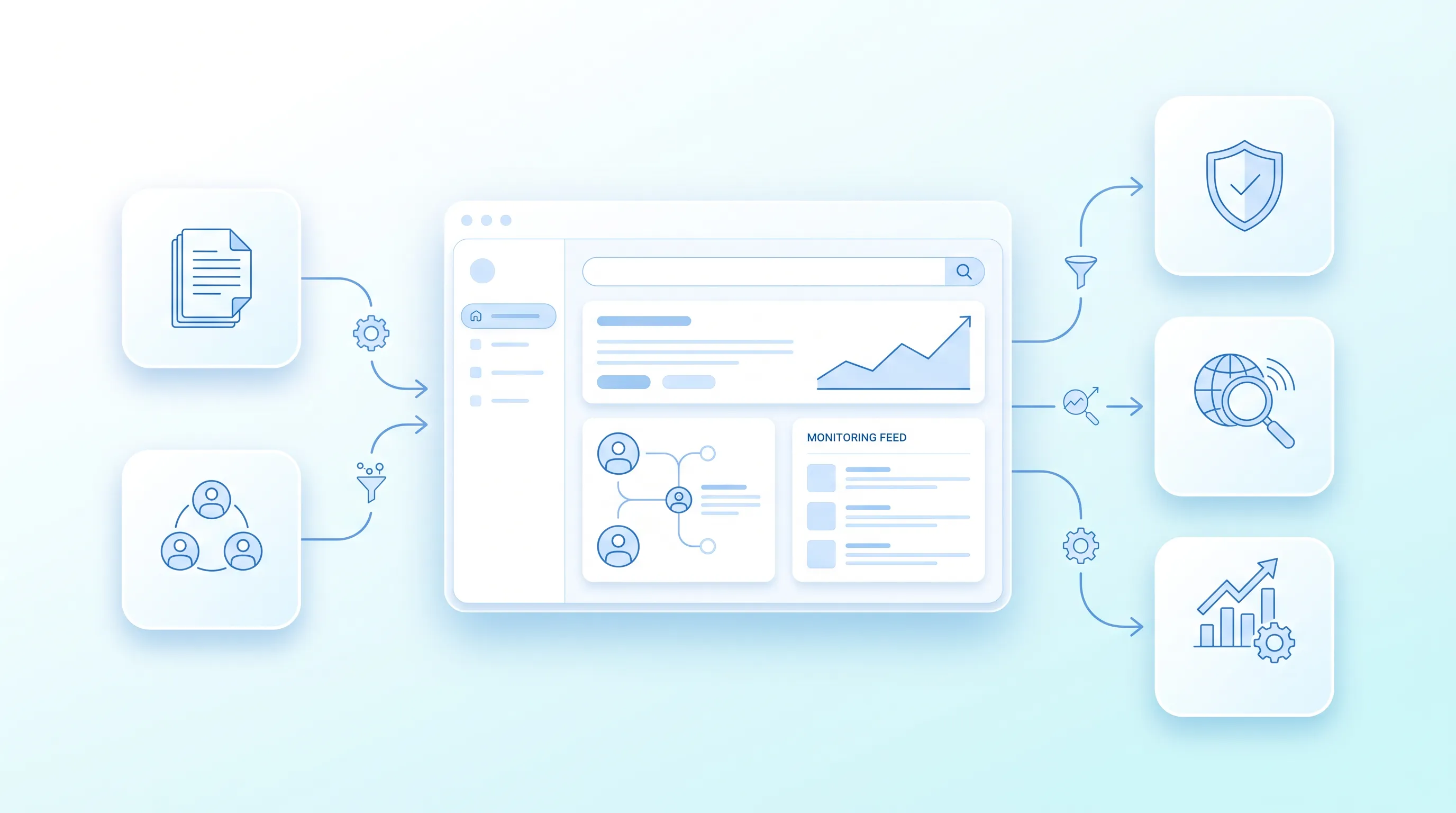
Modern infographic illustrating a central browser interface for nonprofit competitive intelligence, surrounded by symbolic blue icons and connectors.

This article explains how to check whether your organisation shows up, and shows up accurately, in search results and AI-generated answers about your cause. It covers a question registry and a coding method two reviewers can reproduce, plus a share calculation with defined denominators that shows the point at which paid software earns its cost.

Set the monitoring decision

Nonprofit competitive intelligence starts with an uncomfortable question that most communications directors ask quietly: when a potential volunteer asks an AI assistant about our issue, do we appear at all? And if we do, is the description right?

That uncertainty is reasonable. Pew Research Center found that 18% of 68,879 real Google searches by 900 US adults in March 2025 produced an AI summary, and that share rose to 53% for searches of ten words or more. Longer, question-shaped searches are exactly how people look for help.

Before you measure anything, name the decision the measurement will inform:

  • Correcting identity information that's wrong, such as a merged entity, an old service area or a defunct programme name

  • Clarifying a page so it answers the question people actually ask

  • Publishing evidence you hold but have never put on the public web

  • Approaching a partner whose page already carries the authority your answer needs

If none of these is on the table, don't build the dashboard. A nonprofit competitive intelligence monitoring file nobody acts on costs staff hours and produces a number your board will ask about every quarter.

Build the question registry

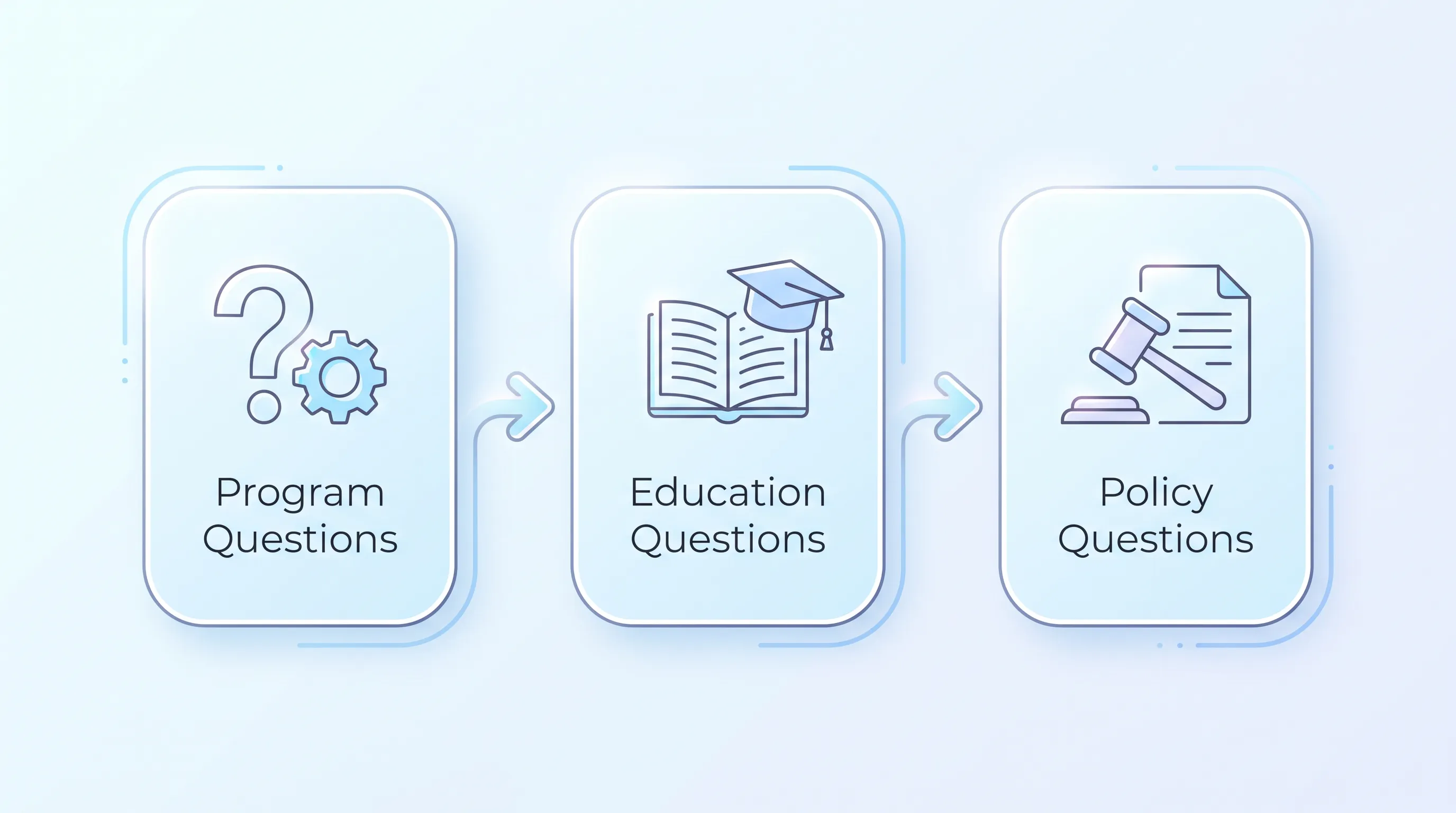
Infographic panels with rounded rectangles on a soft blue gradient, featuring icons and questions about mission organizations, in a minimalist style.

The registry is one row per question, and it's the asset that outlasts every tool you'll ever buy. Record the audience you're imagining and the intent behind the question, with the exact wording and the country or city setting used when you ran it. Change the wording later and you've started a new measurement, so log additions with a date rather than editing in place. A stable question registry also makes later reporting easier to reproduce.

Cover the full range of what people ask about a mission organisation. Programme questions ("where can I get free legal advice on eviction in Manchester"). Education questions about the condition or issue itself. Policy questions a journalist would ask. Volunteering and partnership questions belong in there too, because each pulls a different set of organisations into the answer.

Here's the trap. If half your registry contains your own name, your apparent visibility will look excellent and mean nothing. Branded questions measure whether a model knows who you are. Unbranded questions measure whether anyone finds you without already knowing you exist, and that's the harder result. Keep branded questions under a quarter of the sample and report the two groups separately, because nonprofit competitive intelligence collapses the moment the denominator flatters you.

Choose relevant comparison sources

Comparison in nonprofit competitive intelligence is about understanding who occupies the answer space you want, and those occupants differ question by question. Group them into service providers who do similar frontline work and public institutions such as councils or health bodies.

Match the group to the question. A local housing advice query pulls in the council and two neighbourhood charities. A policy query pulls in a think tank and a national broadsheet. Benchmarking every single question against the largest international organisation in your field produces a flat, discouraging report that tells you nothing you can act on this quarter.

There's a practical reason to include publishers and institutions rather than only charities. Peec AI's analysis of 30 million cited sources across ChatGPT and Google's AI surfaces found Reddit and YouTube leading the citation counts, with Wikipedia and Forbes close behind. The organisations named in an answer and the pages the answer leans on are frequently not the same thing.

Need help with your AI visibility?

Book a free consultation with our experts we'll help you determine exactly which services your organization needs.

Code each answer consistently

Save each answer and then code it using clearly defined classification criteria. The goal is to ensure that two independent reviewers reach the same classification when assessing the same answer.

Track the following five fields:

  • Organisation mention: Is your organisation named in the answer using its legal name, trading name or a recognisable short form?

  • Website link: Does the answer link directly to a page on your own domain?

  • Third-party citation: Does the citation list include an external source describing your organisation or its work?

  • Description accuracy: Do the claims about your services, location and current status match your published facts?

  • Answer relevance: Does the answer address the question and could it be sent to a service user without editing? Each field should have a clear yes/no classification rule to avoid subjective interpretation.

Finally, test the coding process with two independent reviewers and calculate inter-rater agreement. Published content-analysis guidance considers a chance-corrected agreement score of 0.61–0.80 substantial, while McHugh recommends 0.80 as the working minimum when decisions are based on the data.

Keep these separate. A mention without a link and a link without an accurate description each point to different work. Accuracy deserves the strictest definition, because Columbia's Tow Center for Digital Journalism ran 1,600 queries across eight AI search tools and found that they failed more than 60% of the time to attribute a source correctly. Error rates ranged from 37% for Perplexity to 94% for Grok 3, so a single platform's behaviour won't predict the others. Good nonprofit competitive intelligence treats "mentioned" and "described correctly" as two different results. This is also why AI visibility depends on more than a simple mention count.

Calculate visibility share

Two numbers do most of the work. Mention rate is the count of answers naming your organisation divided by the count of answers you collected in that sample. For visibility share tracking, visibility share is your mentions divided by the total mentions of every organisation observed across the same answers, where each organisation is counted once per answer.

Take an illustrative run of 40 answers on one engine and one country setting. Your organisation appears in 10, so your mention rate is 25%. Across those 40 answers, the coders also recorded 18 mentions of a national service provider and 14 of a university centre, plus 6 of the local authority. Total observed organisation mentions: 48. Your visibility share is 10 divided by 48, or 21%.

Both figures describe that sample and nothing else. Swap three questions and add Perplexity, and the share moves without anything changing in the world. Visibility share tracking is a description of a chosen measurement, which is why the registry and the engine list belong in every report alongside the percentage.

Nor is the sample stable on repeat. A review in the Journal of General Internal Medicine found that when identical prompts were submitted five times, some models changed their final recommendation up to 40% of the time. Run each question more than once and record the runs. Visibility share tracking built on a single pass will show you movement that's only noise.

Compare monitoring approaches

Judge any approach on whether another person can reproduce the run and whether the raw answer is retained as evidence. Check which languages it handles and how much review time it consumes, along with how transparently it reports its own method and what it costs over a year. Price is the easiest to compare and the least informative.

One warning before the options. A tool can automate collection and export. It can't repair a question registry full of branded queries and vague wording. Weak questions produce confident, meaningless charts faster when you pay for them.

Manual AI SERP watch

A manual AI SERP watch is one person who works through the registry in a browser on a fixed schedule and saves what comes back. This is enough when your registry holds 20 to 40 questions in one language, and when the decision in front of you is a factual correction rather than a trend claim.

Save a full-page screenshot or PDF and the raw answer text for every run, along with the citation list and the date with the engine and location used. Without the saved answer you can't settle a disagreement between reviewers six weeks later.

The limits arrive quickly. Workload rises with every question and engine, and consistency drifts once more than one person runs the checks. Given that more than 80% of surveyed nonprofits put between one and four staff on marketing or communications, a manual AI SERP watch for nonprofit competitive intelligence has a hard ceiling measured in hours.

Need help with your AI visibility?

Book a free consultation with our experts we'll help you determine exactly which services your organization needs.

Spreadsheet-supported review

The spreadsheet version keeps the human judgement and removes the arithmetic errors. The registry sits in one sheet with a stable question identifier. Coding fields use dropdowns rather than free text, so "yes" always looks like "yes". Formulas compute mention rate and share from the coded rows instead of from someone's recollection.

This suits a team of two reviewers who handle 50 to 150 questions across two or three engines and double-code roughly a fifth of rows to check agreement. It's where most nonprofit competitive intelligence should live for the first year, because the cost is staff time you already spend and the method is fully visible to whoever asks.

Add a notes column for anything the coding fields can't capture, such as a dated claim or a confusion with a similarly named charity. Those notes become the evidence behind your corrections. A disciplined AI SERP watch run this way beats an expensive nonprofit competitive intelligence tool that nobody opens.

Specialist monitoring platforms

Platforms automate the collection and repeat the sample daily. Published entry pricing in 2026 runs from $29 a month for 15 prompts on Otterly.ai's Lite tier through $95 a month for 50 prompts on Peec AI's Starter plan, with extra engines charged as add-ons. Scale comes from prompts multiplied by models multiplied by frequency, so the bill grows faster than the registry does.

Verify four things before you report a platform's score to anyone. Ask for the written denominator, because an audit of nine platforms on 10 September 2026 found three vendors publishing contradictory definitions of their own visibility metric, where a score of 50 can mean half of all answers or half of the answers that named any organisation. Ask whether raw answers are retained and exportable. Ask how many runs sit behind a daily figure. And ask whether the competitor set is one you define, since a closed list you built yourself improves the moment you remove someone from it.

Platform visibility share tracking is useful when the registry is already stable and the reporting burden is the bottleneck. It's a poor first purchase. Specialist monitoring platforms can help once the underlying method for nonprofit competitive intelligence is sound.

Turn findings into actions

Evidence without an owner decays into a slide. Build a decision log with one row per finding, and close each row with a dated follow-up check rather than an assumption that the fix landed.

  • The saved evidence, with engine, date and question identifier

  • What the finding is, in one sentence a trustee would understand

  • Named owner and the priority you've assigned

  • The action taken and the date of the re-check

Sort findings by type. A factual correction, such as a wrong service area or a programme you closed in 2023, goes straight to whoever controls your website and your Candid profile, which feeds the data behind more than 200 philanthropic websites and applications. Missing methodology is a different job: if answers describe your impact claims vaguely, the fix is publishing the method behind the number. Page improvements belong with content staff, and source context belongs with whoever manages media relationships.

Technical investigation deserves its own lane. Work out whether the pages you expect to be cited are reachable and current before you conclude that a model dislikes you. And separate material errors from routine variation, because an organisation dropping out of two answers one week isn't evidence of anything. Nonprofit competitive intelligence earns its keep when it changes a page.

Set a defensible cadence

Run a baseline across the full registry, with repeats, and treat it as the reference everything else compares against. After that, re-run on a quarterly schedule and additionally after a reorganisation or renaming on your side. Re-run after a substantial content release and after a known platform update.

Keep the questions stable between runs. Document additions with the date they entered the registry and report them separately until they have a baseline of their own. Platform behaviour shifts underneath you regardless: Semrush's three-month study tracked Wikipedia falling from appearing in roughly 55% of ChatGPT responses to under 20% in September 2025, while its share on AI Mode and Perplexity held steady. A drop in your own numbers across that window would have told you almost nothing about your content.

Say so in the report. An AI SERP watch in nonprofit competitive intelligence describes a sample of answers on named engines in a named week, and visibility share tracking inherits every limitation of that sample. Writing the caveat into the template protects the credibility of the next finding, the one where you're right and something genuinely needs fixing.

The scale behind all this is worth holding in mind. ChatGPT reached 800 million weekly active users by October 2025, and Blue State's November 2025 analysis cited by Candid found nonprofit organic search traffic down 35% in a year while AI-referred traffic rose more than 1,000%. Klaudia Jaźwińska and Aisvarya Chandrasekar, the Tow Center researchers behind the citation study, put the mechanism plainly: "generative search tools parse and repackage information themselves, cutting off traffic flow to original sources."

Pilot nonprofit competitive intelligence

Pick one decision. Build 25 questions around it and run them twice. Code the answers and see whether the evidence changes what you do. Then ask whether a wider registry would have changed anything else. Most organisations find the first pilot pays for itself in corrections.

Snoika Foundation is a Tallinn-based team that helps nonprofits and public institutions become visible and correctly cited in ChatGPT and Google. We run free AI visibility audits for mission organisations. Book a call with us and we'll scope a pilot in nonprofit competitive intelligence around the decision you're facing now.
Need help with your AI visibility?

Book a free consultation with our experts we'll help you determine exactly which services your organization needs.

Repeat each question at least twice and record every result separately. Identical prompts can produce different recommendations, so one pass can mistake normal variation for a trend. Keep the engine, location, wording and date with each run, then compare results only after reviewing the full set.

Treat the mention and the missing link as separate findings. Check whether the cited page describes your work accurately, then improve the page you control and review the answer again. A third-party citation can show that information exists while exposing a problem with ownership, accessibility or source selection.

Keep them separate in every report. Branded questions test whether an AI system recognises your organisation, while unbranded questions test whether people can find you without knowing your name. Combining them lets branded results raise the total and hides whether your organisation reaches new audiences.

A paid platform makes sense after your registry, coding rules and competitor set are stable, and staff time has become the main reporting constraint. Before paying, confirm the denominator, raw-answer export, run count and competitor controls. If those checks fail, a spreadsheet provides clearer evidence at lower cost.

Snoika Foundation can help scope a pilot around one decision, such as correcting inaccurate identity information or testing whether a service page answers user questions. A pilot can use 25 questions, repeated runs and reviewer coding before wider monitoring. You can book a call to define the registry and review method.

Book a Demo

Book a time that works best for you

You Might Also Like

Discover more insights and articles

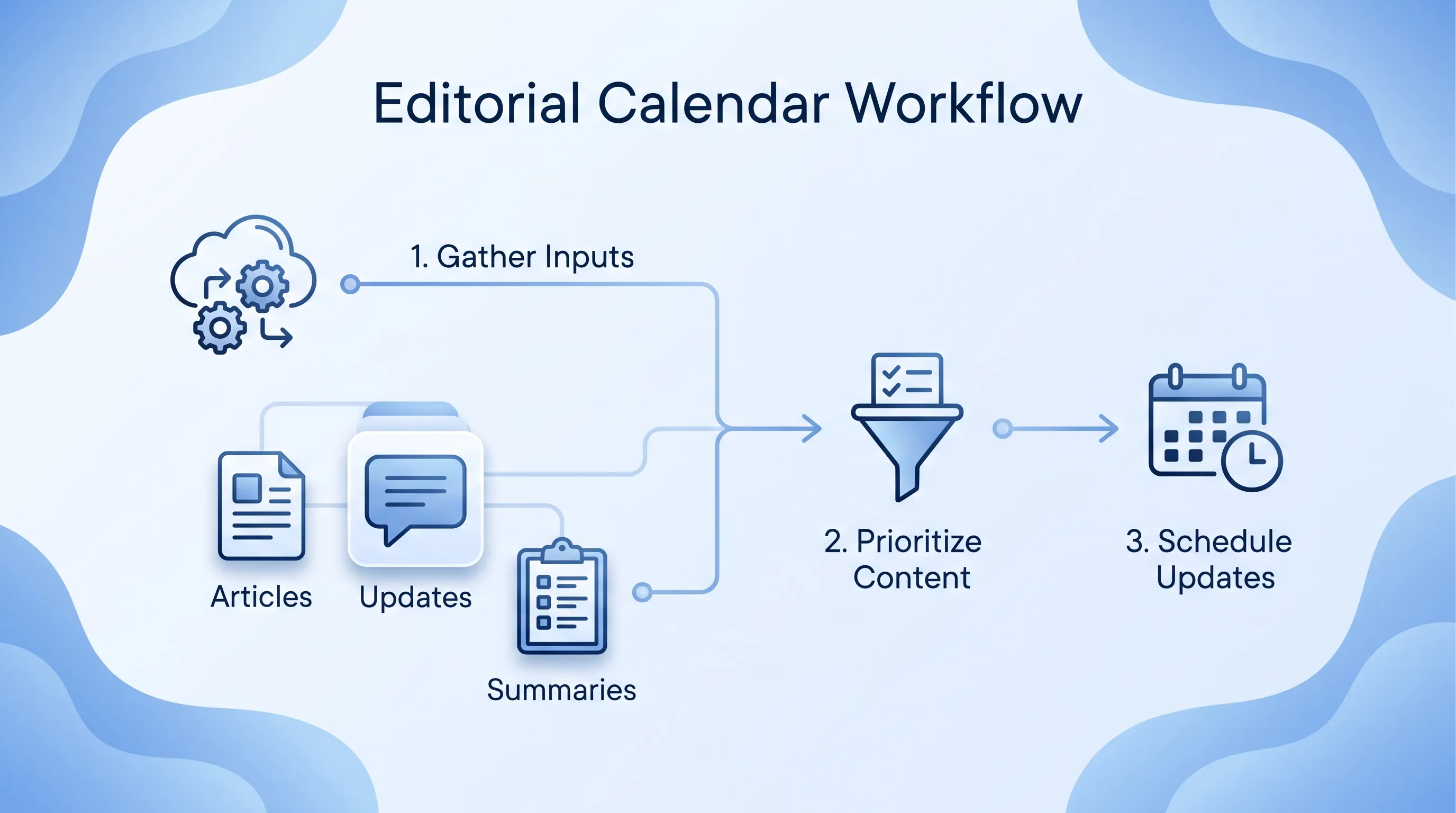
A diagram of an editorial calendar workflow in blue shades, featuring interconnected icons and labeled steps in a modern, clean style.

AI-Powered Editorial Calendar for Continuous Visibility

This article explains how a small communications team can plan publishing and maintenance in one spreadsheet that follows documented reader demand instead of the awareness-day treadmill. It covers inputs and prioritisation. A worked four-week example and the review questions worth asking at month end follow.

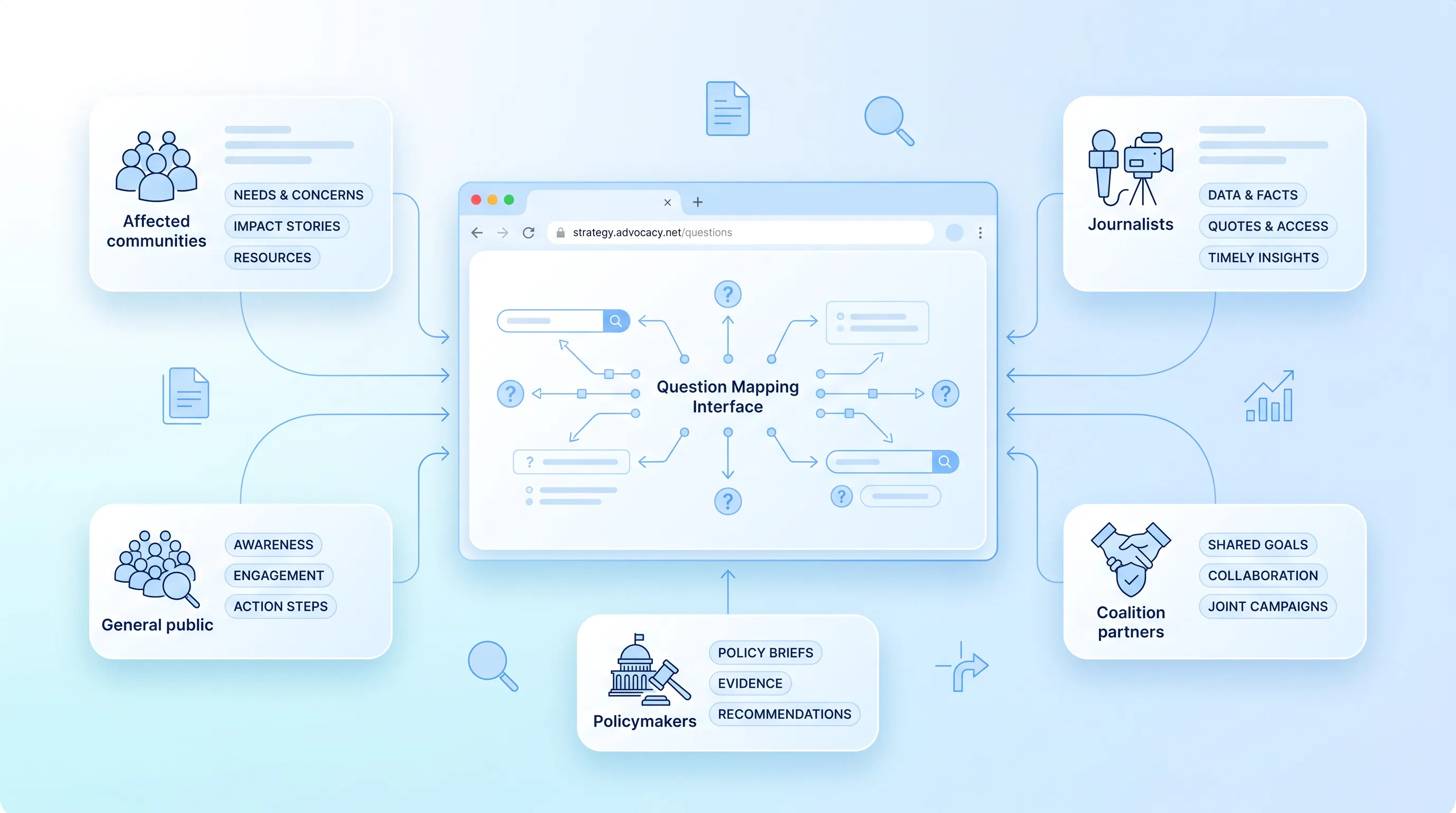
Modern infographic depicting an advocacy content strategy with a central browser window, user group icons, and a soft blue gradient background.

Advocacy Content SEO for Policy and Public Education

This article sets out a practical framework for planning and measuring policy pages so that facts and organisational positions stay separate on the page. It covers question mapping and evidence ranking through an outcome worksheet for ethical evidence publishing built around one clearly fictional proposal.

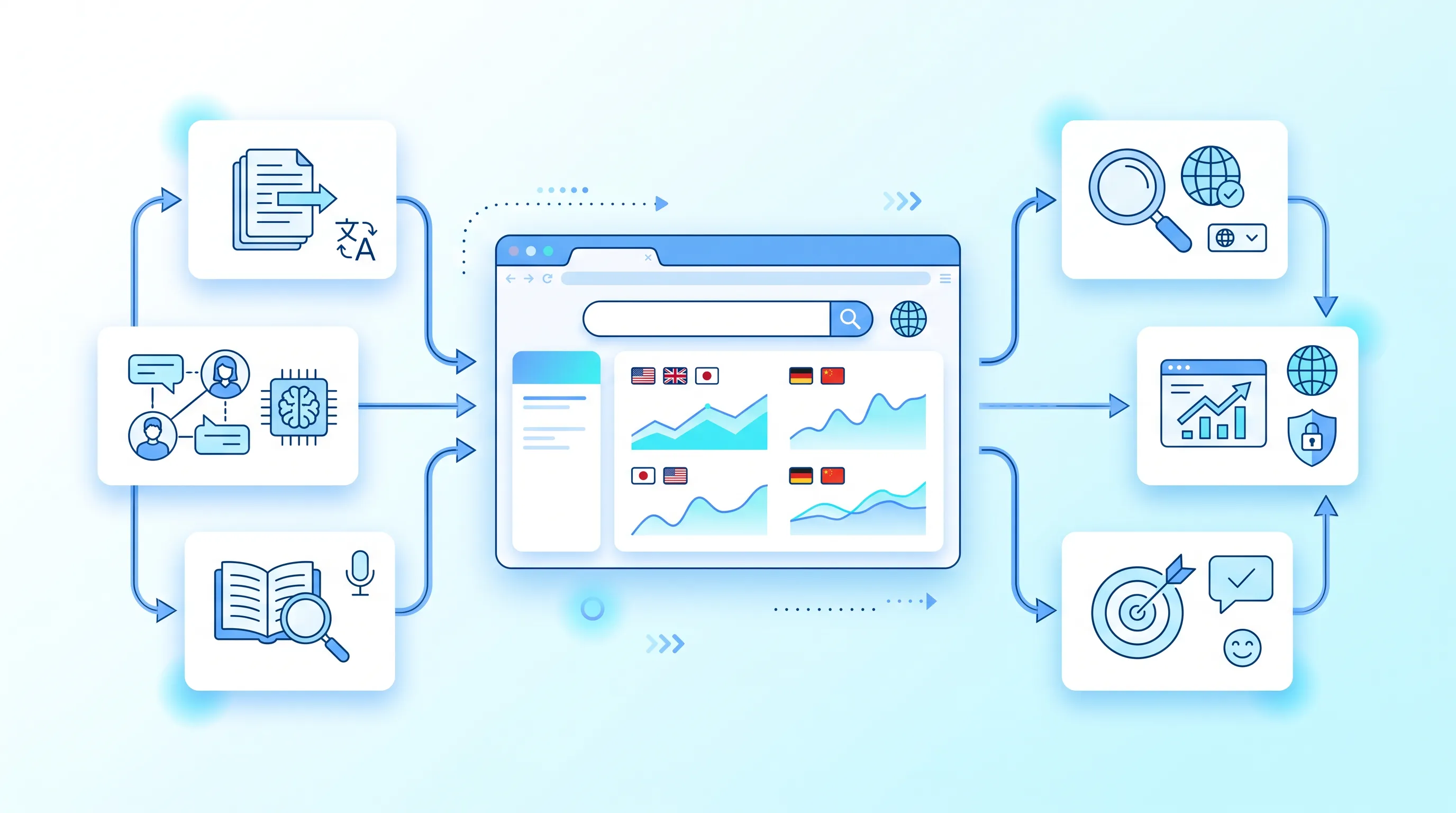
A modern infographic featuring a central web browser window with a multilingual AI dashboard, surrounded by blue line icons on rounded cards.

Multilingual AI Visibility Roadmap for International Missions

This article sets out a prioritized way to decide which languages your organization publishes in and what a complete reader journey looks like in each one. It covers language scoring and localization briefs, then hreflang structure and review gates, along with measurement by language and geography.

A modern infographic featuring a central browser panel surrounded by geometric icons representing data flow, set against a soft blue gradient.

Wikidata and Wikipedia for Nonprofits: Making Your Organization Machine-Readable

This article explains how to check what public records say about your organisation across Wikipedia and Wikidata, and how to improve them without breaking community rules. It covers eligibility testing and the limits of what any of this work can promise.