Advocacy Content SEO for Policy and Public Education

Content authorArtem LozinskyPublished onReading time14 min read
Modern infographic depicting an advocacy content strategy with a central browser window, user group icons, and a soft blue gradient background.

This article sets out a practical framework for planning and measuring policy pages so that facts and organisational positions stay separate on the page. It covers question mapping and evidence ranking through an outcome worksheet for ethical evidence publishing built around one clearly fictional proposal.

The page that answers everything except the question

Most policy pages fail at the same point: an advocacy content strategy that blends what is known with what is hoped, which leaves the reader unable to tell which is which. The traffic looks fine. The bounce rate looks fine. And the person who came to find out whether a proposal would change their rent leaves without an answer.

That gap matters more now than it did three years ago. Pew Research Center tracked 900 US adults through 68,879 Google searches in March 2025 and found that users clicked a traditional result in 8% of visits when an AI summary appeared, against 15% when it did not. Fewer visits, higher stakes per visit. The page has to earn its one reading.

Start with reader questions

A person searching the name of a proposed levy at 11pm wants to know one thing: does this cost me money, and when. They are looking for a definition and a rule that applies to their street.

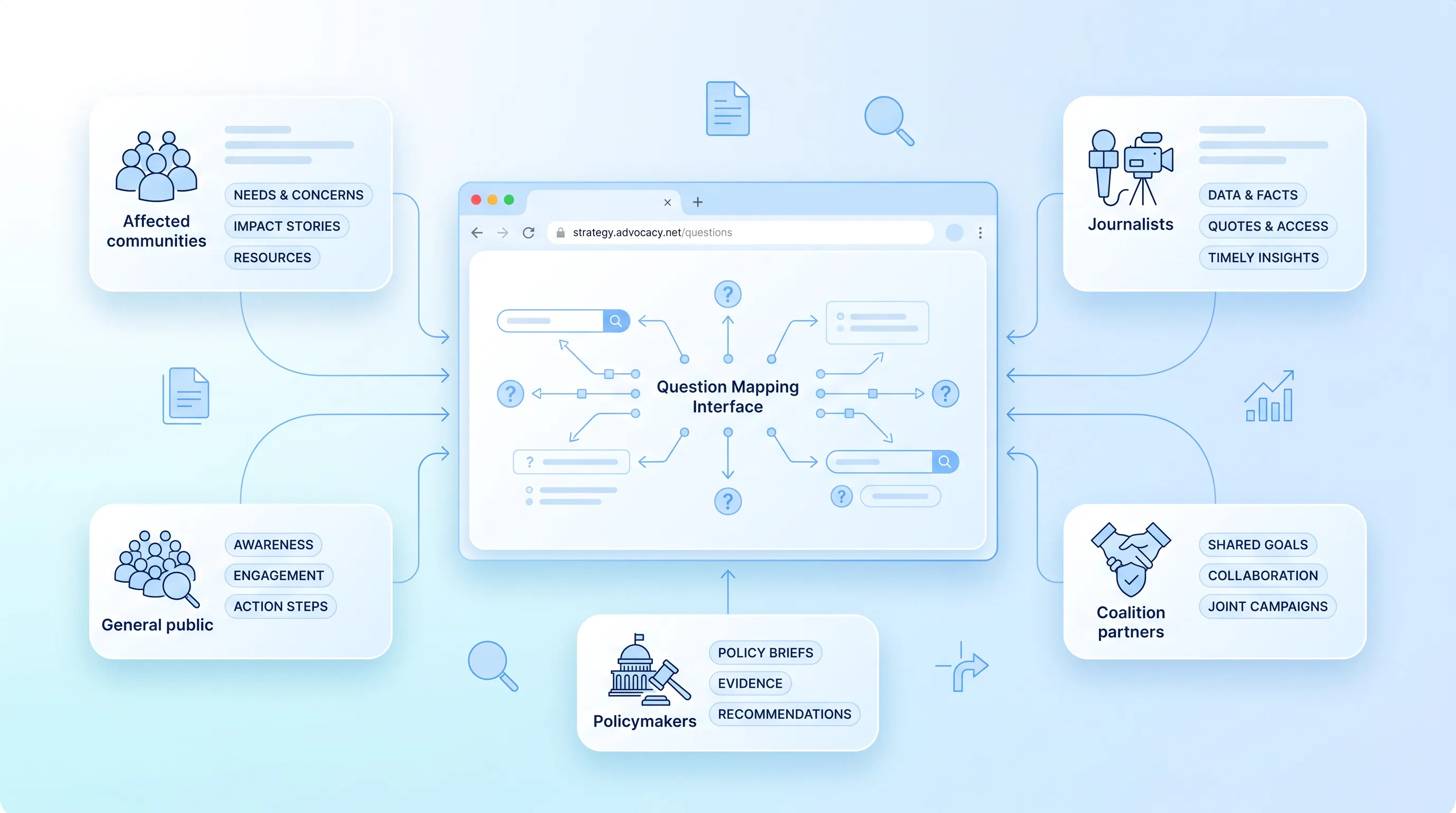
Five groups arrive at the same page with different questions, and a useful advocacy content strategy separates them before a word gets written:

  • Affected communities want to know what changes for them and whether they qualify for anything.

  • The general public wants the plain definition of the thing and who decides it.

  • Journalists want the source document and the status of the proposal.

  • Policymakers and their staff want the evidence base and the specific amendment being asked for.

  • Coalition partners want your position stated clearly enough to align or diverge from.

Serve all five on one page and you serve none of them. The affected resident scrolls past the evidence synthesis written for a select committee adviser. The adviser skims past the explainer written for someone who has never heard of the bill. Separate pages, separate jobs.

Advocacy content strategy foundations

Linear infographic panel on a soft blue gradient, featuring a rounded card with a line icon for organized information and connecting arrows.

Public education and persuasion are both legitimate. Mixing them silently on the same page is not. The Charity Commission's campaigning and political activity guidance is explicit that charities in England and Wales can campaign for changes in law and policy in support of their purposes, which means the problem was never whether to take a position. It's whether the reader can see where the facts stop and the position starts.

The fix is labelling, and it's duller than it sounds. Every claim on a policy page belongs to one of five categories, and each needs a different verbal signal:

  1. Factual background: what the document says, what the current rule is, what date it takes effect.

  2. Research findings: what a named study measured, in what population, when.

  3. Contested interpretation: where credible analysts read the same evidence differently.

  4. Uncertainty: what nobody knows yet, including you.

  5. Your recommendation: what your organisation asks for and why.

An advocacy content strategy built this way does something counterintuitive. By admitting that categories three and four exist, it makes category five more persuasive, because a reader who catches you overstating one claim discounts all the others.

Map questions to pages

Take a fictional proposal, invented for this article: the Northbridge Clean Air Levy, a charge on commercial vehicles entering a city centre, published as a draft and open for consultation. Nothing about it is real. Everything about how you'd map it is.

Assign one primary question and one purpose to each page, then write the question at the top of the brief before anything else. Duplication happens when two pages try to answer "what is the levy," and the result is two mediocre pages competing with each other in search. A disciplined advocacy content strategy treats the question as the unit of planning.

Policy education SEO map

Five pages cover the Northbridge example without overlap. Each gets a search question and a next step that the reader can actually take.

The overview page answers "what is the Northbridge Clean Air Levy" for the general public in 600 words of plain prose and sends readers to the terminology guide or the explainer. The terminology guide answers "what does chargeable vehicle mean" for anyone reading the draft text as a definition list with the clause number beside each term. The evidence summary answers "does a vehicle levy reduce emissions" for journalists and advisers as a structured synthesis with certainty ratings attached. The practical explainer answers "do I have to pay the Northbridge levy" for affected drivers and small operators and ends with the consultation link. The action page answers "how do I respond to the consultation" and states eligibility and the deadline.

Good advocacy content strategy is this boring on purpose. One question, one page.

Need help with your AI visibility?

Book a free consultation with our experts we'll help you determine exactly which services your organization needs.

Choose each page format

Format follows the job. Neutral education fits the overview and terminology pages, where any trace of your position contaminates the usefulness of the definition. Evidence synthesis fits the summary page, where your work is to represent a body of research honestly rather than to select from it. Explicit persuasion belongs on the action page and in a clearly headed position section elsewhere.

Accessibility is not negotiable in any of the three. The UK Government Digital Service tells writers to aim for a reading age of 9, even for specialist audiences, and the US Plain Writing Act of 2010 puts the same obligation on federal agencies for documents the public needs to use. The case is not abstract. The 2023 PIAAC survey found 28% of US adults scoring at Level 1 or below in literacy, up from 19% in 2017.

Whatever the format, the organisation's position has to be visible from the page itself. An advocacy content strategy that hides the ask under a neutral tone is just harder to audit.

Rank evidence carefully

Not all sources carry the same weight, and your page should say so rather than presenting a council press release and a peer-reviewed cohort study in the same voice. Build a hierarchy and apply it consistently: official documents and adopted law first, then original research. Testimony from affected communities answers a different question and should never be treated as a substitute for measurement.

Status and date do most of the work. A proposal is not a consultation, and a consultation is not adopted law. Give each a status line and a date. The UK Statistics Authority's Code of Practice organises everything around trustworthiness, quality and value, which is a useful frame for ethical evidence publishing because it puts the source's own reliability on the page rather than leaving the reader to infer it.

Ethical evidence publishing checklist

Before anything goes live, someone who did not write the page runs this review:

  • Is every number traceable to a named source with a publication date, and does the linked source actually contain that number?

  • Does each claim state what kind of claim it is, and is contested evidence shown as contested?

  • Are proposal and adopted law each labelled by status, with the date checked this month?

  • Is evidence from affected communities presented as experience rather than as a measured effect, and was it gathered with consent?

  • Is the organisation's position labelled as a position wherever it appears?

Three things are prohibited outright in ethical evidence publishing, and a review that catches nothing else should still catch these. Do not invent testimony or composite quotes. Do not characterise public opinion without a poll you can cite that includes its sample and fieldwork dates. Do not promise a result from any action a reader takes.

Explain uncertainty responsibly

An observation and a forecast are different objects. "Vehicle traffic in the zone fell 12% in the year after the charge" is one. "The levy will cut emissions by a fifth" is the other. Put them in the same paragraph without a signal and the reader reasonably assumes both are measured.

The IPCC solved this with calibrated language. In its guidance note for authors, saying an outcome is "likely" means ~66% to 100% probability, and confidence in a finding is rated separately from that probability. The GRADE system used by Cochrane and the World Health Organization does something similar and rates a body of evidence as high, moderate, low or very low certainty. You need their habit of stating the strength of a claim beside the claim.

State material limitations in the same breath as the finding. If the study measured one city over 18 months, say so. Where credible analysts disagree, represent the disagreement and say which reading your organisation finds stronger and why. False balance is its own failure, so an advocacy content strategy that gives equal weight to a single contrarian paper and a settled body of work is inaccurate.

Ed Humpherson, head of the UK's Office for Statistics Regulation, described the most common problem his team intervenes on: "a statement is made and it's not possible for a citizen to make intelligent sense of what's been said because there's no sources, there's no context. It's just a kind of naked number."

Need help with your AI visibility?

Book a free consultation with our experts we'll help you determine exactly which services your organization needs.

Build a fictional explainer

Here is the shape of one complete page for the Northbridge levy, written for the operator of two vans. It opens with the current situation in two sentences, then the proposed change with the clause reference and the draft date. Affected groups come next, defined by who pays and who is exempt.

Then the evidence, with its limits attached, followed by a short section headed "What we don't know yet" covering the questions the draft leaves open. The organisation's position appears under its own heading, labelled as a position, with the single amendment being asked for. The page ends with next steps that match the reader's actual eligibility. An advocacy content strategy that follows this order gives the reader everything they need before it asks for anything.

Show claims in context

A sample paragraph, from the fictional explainer:

"Between 2019 and 2022, average weekday commercial traffic in the Riverside zone fell by 12%, measured by the council's roadside counters and published in its 2023 transport review. The council's draft projects a further 9% reduction under the proposed levy by 2030. That second figure is a model output. It assumes fleet replacement rates continue at the 2022 pace, which the council's own appendix flags as uncertain."

Three sentences of observation and one of forecast. This is what ethical evidence publishing looks like at paragraph level, and it costs about forty extra words.

Add responsible actions

Actions have prerequisites, and burying them is how organisations waste people's time. UK parliamentary petitions get a government response at 10,000 signatures and are considered for debate at 100,000, but only British citizens and UK residents can sign. European Commission consultations on the Have Your Say portal run for 12 weeks. US federal comment periods run 30 to 60 days from publication in the Federal Register, and late comments need not be considered.

So state eligibility and location restrictions before the button. Verify every deadline on the day you publish and again at each review, because an expired consultation link is the fastest way to lose a reader's trust. Good advocacy content strategy keeps the explanation fully usable for someone who cannot or will not participate, which is most of the people who read it.

Measure advocacy content strategy

Traffic tells you a page was found. It says nothing about whether anyone understood it. Campaign wins tell you even less, since policy outcomes depend on elections and a dozen actors you don't control, and claiming credit for them from a web page is a category error.

Measure four things instead. Check whether people can find the page and whether they understand it. Check whether they engage with the evidence and whether the people who act were eligible to act.

Complete the worksheet

For each of the five indicator groups, record an indicator and a data source. Set a baseline and a target. Add a review date and a named owner. Discovery is impressions on the five mapped questions in Search Console, owned by the digital lead. Comprehension needs qualitative testing, and Jakob Nielsen's finding that five participants surface 85% of usability problems applies here. Ask five people to read the explainer and tell you, in their words, who pays the levy.

Evidence use is scroll depth and click-through on cited sources. Trust signals include returning visits and direct mentions by journalists or officials who found the page useful enough to link. Qualified actions means consultation responses or contacts from people who met the stated eligibility. Google's own guidance on first-hand expertise points the same direction as this worksheet, which is convenient, since clarity for readers and clarity for crawlers are no longer separate projects in advocacy content strategy.

Review a fictional result

Say the Northbridge overview page gets 4,000 impressions and 180 visits in its first quarter, while comprehension testing shows three of five participants cannot say who pays. Cited sources are clicked on 2% of sessions. The traffic looks like success and the page has failed.

The response is a rewrite. Move the eligibility statement above the evidence and retest with five new people. Weak evidence engagement points at a different fix: source links buried in long paragraphs where nobody finds them. Neither result says anything about whether the levy passed, and ethical evidence publishing means not pretending otherwise in your board report.

Assign reviews and updates

Three reviews, three different people. The policy lead checks that the status and the stated position match what the organisation actually agreed. A subject specialist checks the evidence and its limits. An editor checks that a reader who has never heard of the proposal can follow the page end to end.

Health and legal claims need a named reviewer with the relevant qualification, and the review date should appear on the page. Electoral law adds its own trigger: under the Elections Act 2022, campaigners spending more than £10,000 on public-facing activities likely to promote a party or candidate face registration requirements. An advocacy content strategy without a legal check before an election period is a liability dressed as a publishing plan.

Keep an update log with four triggers. Record when the proposal changed or new evidence landed, and when a deadline passed or the page became historical. Historical pages stay up with a dated banner explaining what happened and when. Between 2017 and 2019, UK e-petitions produced 8,154 opened petitions and 74 Westminster Hall debates, which is a reminder of how much published campaign material quietly goes stale.

Improve one priority page

Pick the page that gets the most traffic and do four things this week. Mark every claim with its category. Add a status line and a date to every source. Move the position statement under its own heading. Check that each stated action lists eligibility and an in-date deadline, then test the result on five people who have never read it. That single pass will teach you more about your advocacy content strategy than another quarter of analytics.

Snoika Foundation works with NGOs and public institutions to make their content visible and cited in AI search engines like ChatGPT and Perplexity, alongside traditional search. If your policy pages attract readers but your team is unsure whether those readers leave informed, book a call with us to review your advocacy content strategy.
Need help with your AI visibility?

Book a free consultation with our experts we'll help you determine exactly which services your organization needs.

Check the source title, publisher, date, and quoted figure against a current official copy before replacing the link. Record the new URL in the update log, keep the original citation details, and note any change in the source. If the claim can’t be verified, remove or qualify it until verification is complete.

Give readers the page without coaching, then ask them to explain the proposal in their own words. Ask who is affected, what is confirmed, and what remains uncertain. Record their answers and the points where they hesitate. Rewrite those sections, then test a different group to check whether comprehension improved.

You can add FAQPage structured data when the questions and answers appear visibly on the page. It can help search systems interpret the content, but it doesn’t guarantee enhanced results or higher rankings. Keep each answer complete, accurate, and useful to readers even if search engines show no special feature.

An archived version preserves what readers could see when a proposal, consultation, or rule was current. Add a clear date and explain what changed afterward. Keep outdated instructions from appearing active, while retaining the page as a record for journalists, researchers, and people checking past statements.

Choose the plain question that matches the page’s main job and the reader’s likely wording. Use one primary phrase, then cover close variations naturally in headings and copy. An advocacy content strategy should match search intent to a clear answer. Snoika Foundation can review that alignment, and readers can book a call for an external assessment.

Book a Demo

Book a time that works best for you

You Might Also Like

Discover more insights and articles

A diagram of an editorial calendar workflow in blue shades, featuring interconnected icons and labeled steps in a modern, clean style.

AI-Powered Editorial Calendar for Continuous Visibility

This article explains how a small communications team can plan publishing and maintenance in one spreadsheet that follows documented reader demand instead of the awareness-day treadmill. It covers inputs and prioritisation. A worked four-week example and the review questions worth asking at month end follow.

Modern infographic illustrating a central browser interface for nonprofit competitive intelligence, surrounded by symbolic blue icons and connectors.

Competitive Visibility Monitoring for Mission Organizations

This article explains how to check whether your organisation shows up, and shows up accurately, in search results and AI-generated answers about your cause. It covers a question registry and a coding method two reviewers can reproduce, plus a share calculation with defined denominators that shows the point at which paid software earns its cost.

A modern infographic featuring a central web browser window with a multilingual AI dashboard, surrounded by blue line icons on rounded cards.

Multilingual AI Visibility Roadmap for International Missions

This article sets out a prioritized way to decide which languages your organization publishes in and what a complete reader journey looks like in each one. It covers language scoring and localization briefs, then hreflang structure and review gates, along with measurement by language and geography.

A modern infographic featuring a central browser panel surrounded by geometric icons representing data flow, set against a soft blue gradient.

Wikidata and Wikipedia for Nonprofits: Making Your Organization Machine-Readable

This article explains how to check what public records say about your organisation across Wikipedia and Wikidata, and how to improve them without breaking community rules. It covers eligibility testing and the limits of what any of this work can promise.