AI-Powered Editorial Calendar for Continuous Visibility

Content authorArtem LozinskyPublished onReading time11 min read
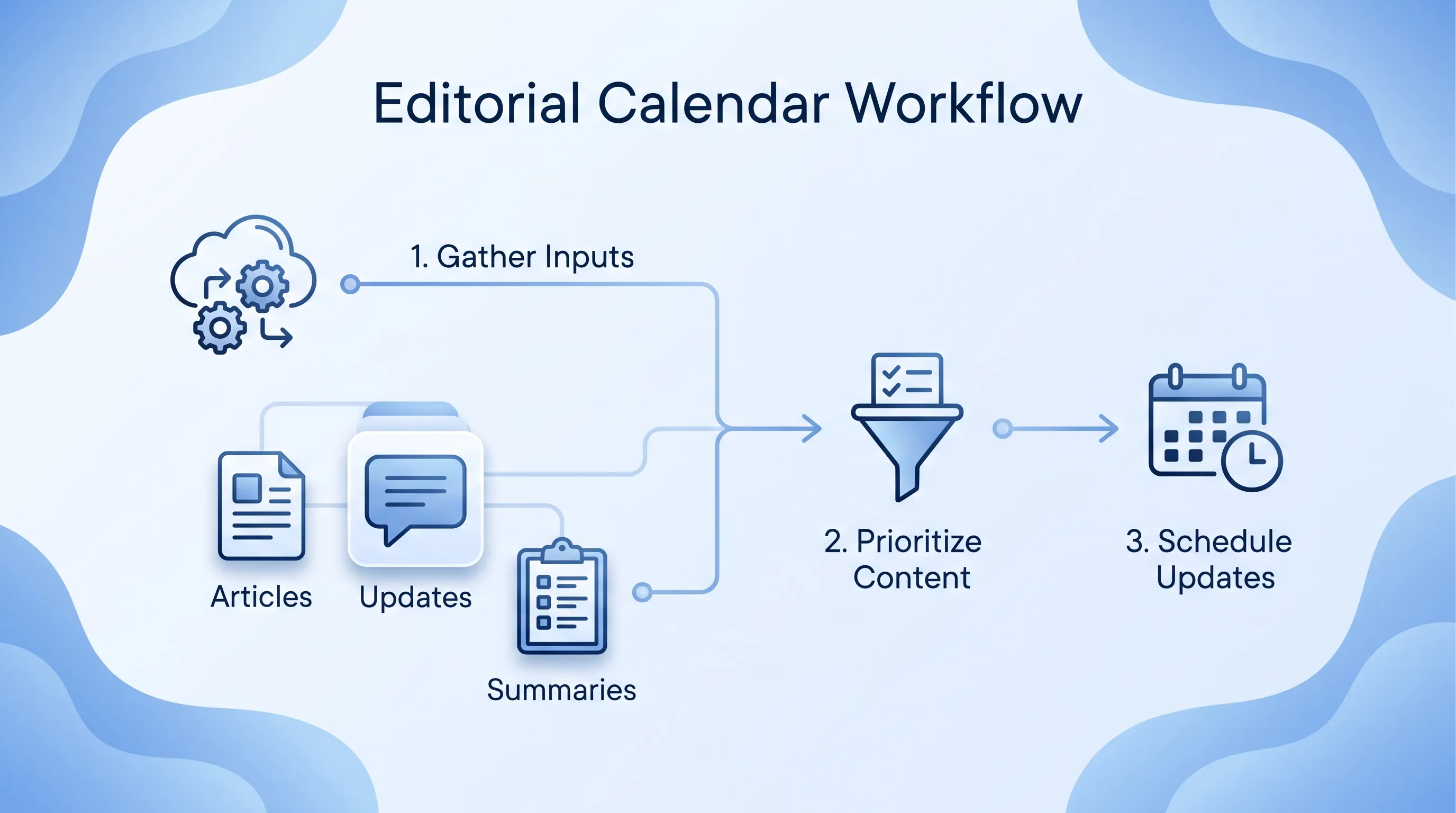
A diagram of an editorial calendar workflow in blue shades, featuring interconnected icons and labeled steps in a modern, clean style.

This article explains how a small communications team can plan publishing and maintenance in one spreadsheet that follows documented reader demand instead of the awareness-day treadmill. It covers inputs and prioritisation. A worked four-week example and the review questions worth asking at month end follow.

Why calendars fall short

An AI-first editorial calendar starts from a problem most communications plans never name: the campaign grid is full, and the questions people actually send you are answered nowhere on the site. Awareness days get three posts. The eligibility page nobody has touched since 2023 gets none.

That mismatch is expensive. Only 13.9% of content marketers said their blog delivers strong results in Orbit Media's 2026 survey of 1,042 respondents, the lowest reading in thirteen years of the study. Volume didn't save them, and it won't save you.

Sustainable visibility comes from content that is useful and current, which is why a supportable nonprofit publishing cadence beats a frequency target invented in a planning meeting. The question is which questions you can answer properly with the evidence and review time you actually have.

Build an AI-first editorial calendar

A calm digital interface features a checklist for an AI-first editorial calendar, with light blue icons on smooth card-like surfaces.

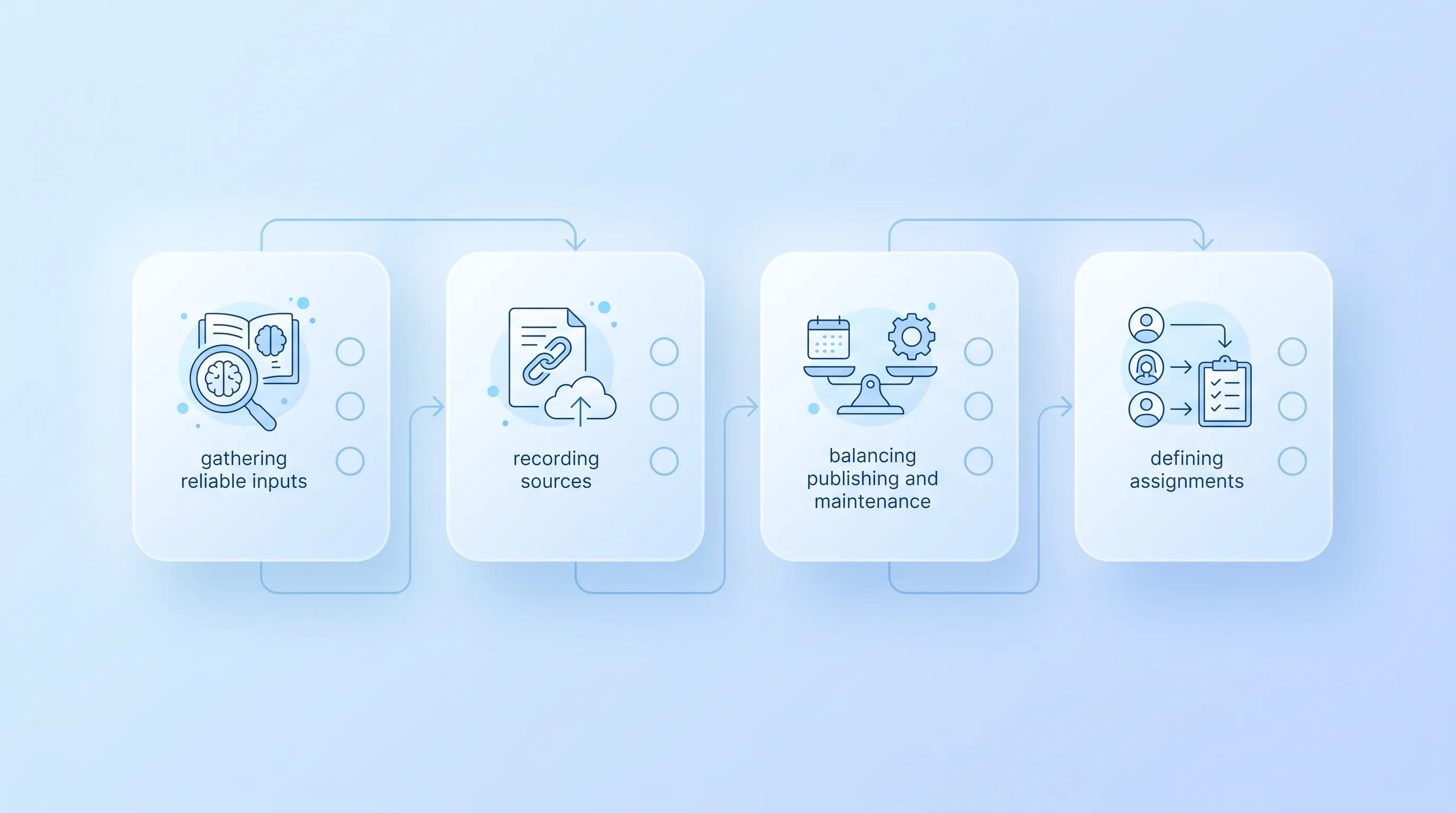
A lean team needs a short, honest list of what people ask and a record of where each item came from. It needs assignments small enough to finish. The work moves from documented demand to a dated commitment in three steps.

Treat the AI-first editorial calendar as an editorial operations roadmap. A wishlist collects topics. A roadmap carries owners and dated evidence, which is the difference between a plan that survives contact with February and one that quietly dissolves.

Gather reliable inputs

Pull from the places where demand already exists. Enquiry inboxes and helpline logs. Search queries in Google Search Console and questions raised at programme visits. The policy change your advocacy lead flagged last week and findings from the evaluation that finished in November. An AI-first editorial calendar is only as good as this list, so collect it before you open any AI tool.

Record the source next to every idea. Date and channel. This single column is what stops a plausible-sounding suggestion from a language model being filed alongside a question twelve people actually asked, and the distinction matters more than it sounds: the Tow Center for Digital Journalism found AI search tools returned incorrect answers to more than 60% of 1,600 citation queries, with Grok 3 wrong 94% of the time. Confident output is not evidence of demand.

Balance publishing and maintenance

Your AI-first editorial calendar should hold more than articles. Summaries of published research and updates to programme pages. Factual corrections and consolidation of three overlapping posts into one. Retirement of pages describing schemes that closed. The UK Government Digital Service draws a line in its guidance on when to retire content, which says guidance should be updated rather than withdrawn, and that expired schemes and policy papers that are no longer current belong in the withdrawal pile.

Maintenance also performs. HubSpot's historical optimisation programme raised monthly organic search views on updated posts by an average of 106%, and Orbit Media's data shows bloggers who update old articles are twice as likely to report strong results. When your programme page already ranks for the question and simply states last year's figures, an evidence-rich update answers the reader better than a second article on the same subject.

One caution. Google's own documentation warns against changing the date of pages to make them seem fresh when the content hasn't substantially changed. Real updates and real dates, in a nonprofit publishing cadence that leaves room for both.

Need help with your AI visibility?

Book a free consultation with our experts we'll help you determine exactly which services your organization needs.

Define every assignment

A topic is not an assignment. Before anything gets a date, write down:

  • The audience and the exact question they ask, in their words

  • Intent (find out, decide, apply, comply) and the outcome a reader should be able to reach afterwards

  • The evidence pack: which report, dataset or interview supports each claim

  • Owner, reviewer, and the dependency that could block it

Set the publication target last. If your programme director is the only person who can sign off medical guidance and she's in the field until the 18th, the piece publishes after the 18th. Capacity in the AI-first editorial calendar is set by reviewers.

Prioritise the roadmap

Score each candidate on mission relevance and strength of documented audience need. Evidence readiness and timeliness sit with effort on the same scale. Keep the scale small, one to three, because a ten-point scale invites argument it can't settle. The AI-first editorial calendar then sorts itself, and the arguments you do have become arguments about mission rather than preference.

Evidence readiness deserves more weight than it gets. A high-need question with no approved source behind it isn't ready, and pretending otherwise is how teams end up publishing something vague and then quietly removing it. Park it and name what's missing. Revisit next month.

Urgent factual corrections skip the scoring entirely. If a page states the wrong deadline or the wrong eligibility threshold, it gets fixed this week. The wrong contact route gets the same treatment. Every editorial operations roadmap needs that bypass written into it, or the scoring system becomes a reason to delay the thing that most damages trust.

Use AI with limits

AI earns its place in the planning stage. Used on material you already have, it saves hours. Used as a source, it invents things. The 92.4% of content marketers now using AI for blogging in Orbit Media's 2026 data are not, in that same dataset, reporting better results, which tells you where the value sits and where it doesn't.

Four prompts worth keeping, each run against pasted inputs from your own records:

  1. "Here are 40 enquiries from our inbox. Group them into themes and tell me how many enquiries sit in each. Do not add questions that aren't in this list."

  2. "Here are the URLs and summaries of nine published pages. Identify overlaps and tell me which pairs could be consolidated."

  3. "Using only the attached evaluation report, outline a 900-word update to this page. Mark any claim the report does not support."

  4. "Convert this decision note into a brief with audience, question, evidence source, owner and reviewer."

The prohibitions matter as much as the prompts. No invented programme developments and no invented findings. No invented demand and no claims about which expert is available to be quoted. Everything the model produces gets verified against the source pack by a human before it enters the AI-first editorial calendar, because fluency and accuracy are separate properties.

Create the spreadsheet

One sheet with eleven columns. Topic. Audience question. Intent. Format, meaning new article or page update. Evidence source with a link. Owner. Reviewer. Dependencies. Publication target. Status. Review date.

The review date column is the one teams skip and later regret. Set it when you publish, not when you remember, because AI assistants cite content that is 25.7% fresher on average than the pages ranking organically, across 17 million citations Ahrefs analysed. A page with no scheduled review becomes a page nobody owns.

Filter by status to run the week. Filter by review date to find the maintenance queue. That's the whole system, and an AI-first editorial calendar that fits on one tab is one your colleagues will actually open.

Need help with your AI visibility?

Book a free consultation with our experts we'll help you determine exactly which services your organization needs.

Set a nonprofit publishing cadence

Your pace is a calculation. Count the hours your team can give to writing. Then count the number of items your reviewer can read in a month and the number of pieces whose evidence is approved and sitting in a folder. The smallest of those three numbers is your nonprofit publishing cadence.

Most teams are working with less than they admit. Kivi Leroux Miller, founder of Nonprofit Marketing Guide, told Big Duck's podcast that communications teams are stalled, with only 17% of teams seeing growth in 2025 and 18% expecting it in 2026. Planning four strong pieces and publishing four beats planning twelve and publishing five with three of them thin.

Run monthly planning

Ninety minutes, same agenda every time:

  • New inputs since last month, with sources attached

  • Maintenance needs surfaced by review dates and by any correction raised during the month

  • Scoring and reprioritisation, including anything the editorial operations roadmap has carried for three months without moving

  • Assignments, dependencies and confirmed reviewer capacity

  • Distribution decisions and a named list of deferrals with the reason recorded

Record the deferrals. The 2026 Nonprofit Communications Trends Report found 34% of nonprofits have no system for managing communications requests from other departments, and a visible deferral list is the cheapest version of that system you can build.

Map four realistic weeks

Here's the template filled in for an invented organisation, the Riverbank Literacy Trust, with two part-time communications staff and one programme director who reviews everything. The numbers and names are fictional. The constraints are the ones small teams actually face.

Week one is the key page update. The "Who can join our tutoring programme" page lists 2024 eligibility criteria that changed in September. The communications lead rewrites it against the approved criteria document and the programme director reviews on Thursday. It publishes Friday with a review date six months out.

Week two is the evidence-led article that answers the question seventeen parents emailed last term: how long before a child's reading improves? It draws only on the Trust's own 2026 evaluation of 140 pupils. The draft lands Wednesday and review slips to Monday because the director is at a funders' meeting. The publication target moves with it.

Week three is the programme resource, a two-page guide volunteers can hand to families at enrolment. It reuses findings already approved in week two, which is why it takes four hours instead of two days. Dependencies here are design time.

Week four is review and deferral. Two older posts about a schools partnership that ended in 2025 get consolidated into one page with a note explaining the change. A planned article on reading and screen time is deferred because the only supporting data is a third-party study the team hasn't read in full, and that reason goes in the spreadsheet where next month's meeting will see it.

Plan useful distribution

Each published item should connect to something that already exists. Internal links from the programme page to the new article and a line in the next supporter newsletter. A paragraph in the briefing your programme staff send to partner schools. Distribution planned at the assignment stage costs minutes. Distribution invented afterwards costs an afternoon and doesn't happen.

Restraint pays here. M+R's 2026 Benchmarks study found nonprofits sent an average of 50 email messages per subscriber in 2025, with 31 of those being fundraising appeals, while 12% of subscribers unsubscribed. Pushing a repetitive version of the same finding into every channel adds to that fatigue without adding reach.

Reuse the approved finding. The evaluation figure that anchors your main piece can appear in a newsletter paragraph and a partner briefing with different framing for each, which is how 83% of nonprofits using email get value from a channel they already own.

Review calendar outcomes

Four questions at month end. Did the priority questions get answered? Did reviews happen when scheduled, or did they silently become rubber stamps? Are the key pages current? Can someone who read the resource now do the thing it was written to help them do?

Search and AI visibility belong in the review as signals. Pew Research Center found Google users clicked a traditional result in 8% of visits where an AI summary appeared, against 15% where none did. Andy Crestodina of Orbit Media put the consequence plainly in the 2026 survey write-up: "search traffic to articles that rank for information-intent phrases has been completely torched." Traffic alone will mislead you about whether the work was good.

So read the numbers against the plan. If the AI-first editorial calendar said you'd answer the eligibility question and you did, and enquiries about eligibility fall, that's a result the dashboard won't show you. An AI-first editorial calendar is judged by whether a real nonprofit publishing cadence held.

Rebuild next month

Open a blank sheet and delete the topic list. Replace it with four fully defined assignments, at least one of them maintenance, each with its evidence source and reviewer named before any date is set. That's a month you can finish.

Snoika Foundation works with NGOs and nonprofits on exactly this: content planning and publishing built so people and AI search engines can find and cite your mission. If you want help turning your current plan into a working AI-first editorial calendar, book a call with our team.
Need help with your AI visibility?

Book a free consultation with our experts we'll help you determine exactly which services your organization needs.

Park the topic and record the missing evidence as a specific task. Assign someone to locate an approved report, dataset, or interview, then review the item at the next planning meeting. Don’t set a publication date until a reviewer can verify the claims.

Track whether priority questions receive clear answers and whether related enquiries change after publication. Review page feedback, contact reasons, completion of intended actions, and correction requests alongside search data. This shows whether content helped people, even when fewer visitors clicked from search.

Yes. Use a format or status field to distinguish new articles, page updates, consolidations, and retirement work. Keep the evidence source, owner, reviewer, target date, and review date on every row so the same sheet supports publishing and content maintenance.

Change the target when the delay affects reviewer availability, evidence, or a required dependency. Record the reason in the status or notes field, then set a realistic replacement date. Don’t change a page’s displayed date unless its content received a substantial, documented update.

Yes. Snoika Foundation works with NGOs and nonprofits on content planning, evidence checks, and publishing workflows. If your team needs help turning existing enquiries and pages into defined assignments, you can book a call to discuss the current plan and its constraints.

Book a Demo

Book a time that works best for you

You Might Also Like

Discover more insights and articles

Modern infographic illustrating a central browser interface for nonprofit competitive intelligence, surrounded by symbolic blue icons and connectors.

Competitive Visibility Monitoring for Mission Organizations

This article explains how to check whether your organisation shows up, and shows up accurately, in search results and AI-generated answers about your cause. It covers a question registry and a coding method two reviewers can reproduce, plus a share calculation with defined denominators that shows the point at which paid software earns its cost.

Modern infographic depicting an advocacy content strategy with a central browser window, user group icons, and a soft blue gradient background.

Advocacy Content SEO for Policy and Public Education

This article sets out a practical framework for planning and measuring policy pages so that facts and organisational positions stay separate on the page. It covers question mapping and evidence ranking through an outcome worksheet for ethical evidence publishing built around one clearly fictional proposal.

A modern infographic featuring a central web browser window with a multilingual AI dashboard, surrounded by blue line icons on rounded cards.

Multilingual AI Visibility Roadmap for International Missions

This article sets out a prioritized way to decide which languages your organization publishes in and what a complete reader journey looks like in each one. It covers language scoring and localization briefs, then hreflang structure and review gates, along with measurement by language and geography.

A modern infographic featuring a central browser panel surrounded by geometric icons representing data flow, set against a soft blue gradient.

Wikidata and Wikipedia for Nonprofits: Making Your Organization Machine-Readable

This article explains how to check what public records say about your organisation across Wikipedia and Wikidata, and how to improve them without breaking community rules. It covers eligibility testing and the limits of what any of this work can promise.