Digital Marketing for Nonprofits: A Complete Growth Guide for Mission-Driven Organizations

Content authorArtem LozinskyPublished onReading time11 min read
Title:
Digital Marketing Nonprofits Need to Prioritize First

Meta description:
To manage the digital marketing nonprofits need, you must prioritize. Learn to use two main channels that increase your

This article is for the lean nonprofit team with one person responsible for the digital marketing nonprofits need, who feels pressure to be everywhere online at once. It makes the case for focus over coverage and walks through the two channels that most reliably move donations and sign-ups when your time and budget are tight.

Why focus beats doing everything

You run digital marketing nonprofits would normally hand to a full department, except the department is you, and the budget is whatever's left after the program work gets funded. The advice you keep finding assumes a team that doesn't exist. It tells you to post daily on six platforms and run paid campaigns before lunch, with funnels somehow part of the same morning. So you try until you fall behind, and you feel like you're failing at the one job that's supposed to bring in support.

Here's the thing. Trying to cover every channel is the single most common reason the digital marketing nonprofits are trying to run stalls. The accounts get created, then go quiet, and the silence reads worse than never having shown up. The fix is choosing fewer things and doing them on a schedule you can actually keep.

There's a sensible order to start in, and a mix that holds up month after month without burning you out. This article lays out that order. By the end, you'll have a starting point you can commit to this week and a routine that survives a busy season.

What lean teams get wrong

The trap is treating every platform as mandatory. Facebook feels required, so you make a page. Then Instagram, because that's where the photos go. Then LinkedIn for the funders and TikTok because someone on the board mentioned it, with X left in place because you've always had it. Five or six accounts and one person with no realistic way to feed them all.

What happens next is predictable. Posting gets irregular, then sporadic, then stops. Accounts sit abandoned with a last post from eight months ago. And because attention was sliced so thin, none of it produced a number you can point to. You spread the effort to look present everywhere and ended up looking absent everywhere.

The research on small organizations points digital marketing nonprofits the other way. The Bridgespan Group, which advises nonprofits on strategy, warns against spreading oneself too thin and notes that most nonprofits should concentrate on one or two funding categories for the bulk of their revenue. Leaders, they write, need to steer away from "well-intentioned diversions" such as "a new fundraising tactic that a board member is excited about." The same logic applies to your channels. Concentration wins because it's the only thing a small team can sustain.

The real cost is the gifts and sign-ups a focused approach would have caught. Every abandoned account is a supporter who tried to follow you and found nothing, or a donor who never got the second message that would've moved them. If you've already quietly let a couple of channels go dark, you didn't fail. You ran into the math, and the math was never on your side.

How to choose your channel mix

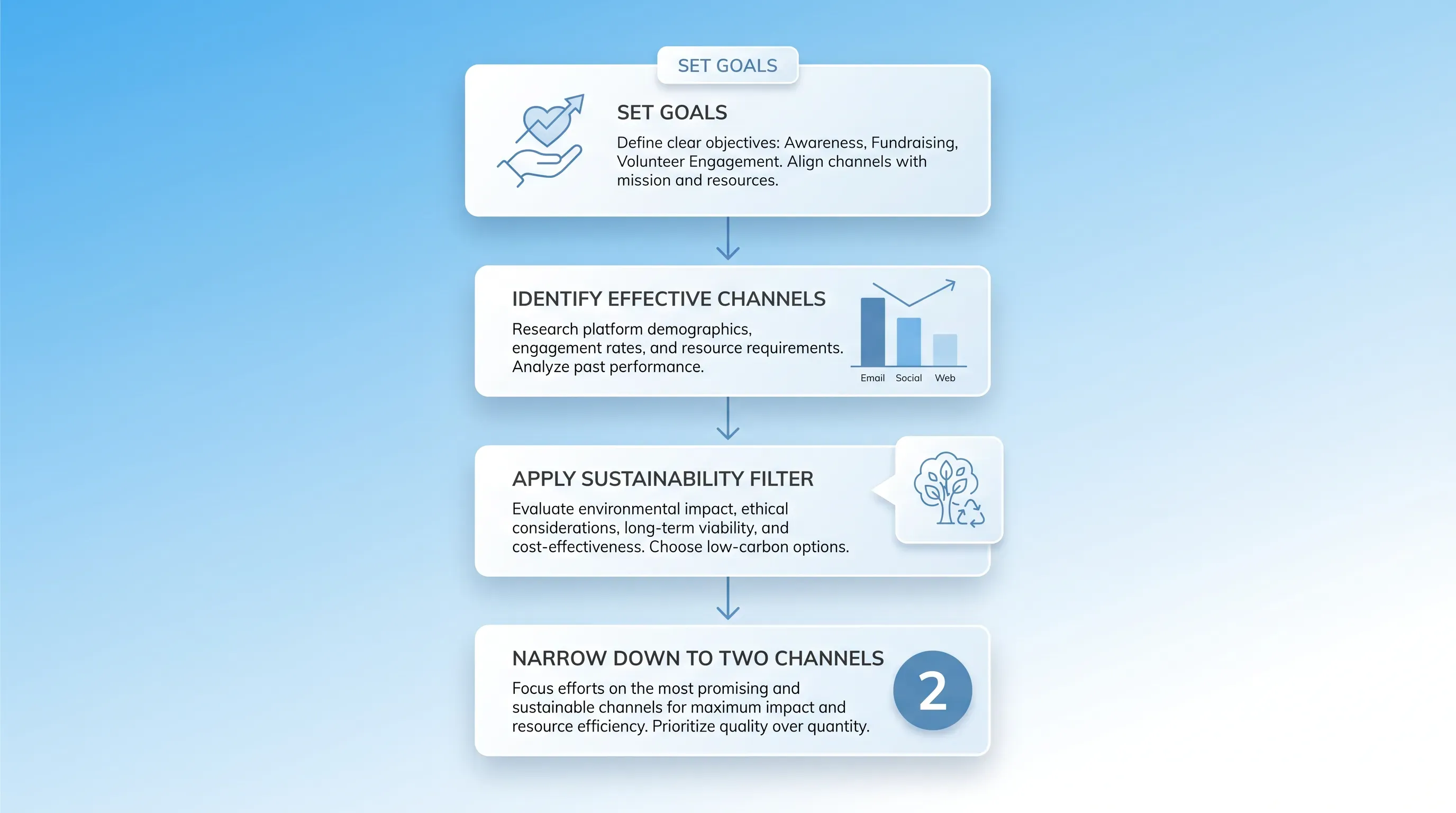
Calm vertical infographic illustrating nonprofit digital marketing channel selection with smooth white cards and a light blue gradient background.

Start from the goal. For most lean teams, the goals for digital marketing nonprofits can sustain are simple: bring in donations and grow a list of people who want to hear from you. Work backward from there. Which channels actually reach the people who'd give to you or sign up, and where do those people already spend time? You're looking for yours.

The second filter is harder and more honest. What can you keep up every single week, without heroics, in a normal week with a board meeting and a grant deadline? A channel you post to twice and abandon is worth less than no channel at all. The right mix is defined by what you can sustain.

Apply both filters and the field narrows fast. For most resource-strapped organizations, two channels carry the load. The next sections cover which two and how they feed each other so the whole thing runs as one routine.

Need help with your AI visibility?

Book a free consultation with our experts we'll help you determine exactly which services your organization needs.

Digital marketing nonprofits should start with

The foundation of a starting channel mix for digital marketing nonprofits can realistically run is two channels: email and social media, in that order. They rank first for the same set of reasons. Both are low cost or free to start. One you own outright and the other sits close to it. Both tie directly to donations and sign-ups, the goals that justify the work.

Picking up both at a basic level is achievable for a team of one. You're not building anything elaborate. A simple email rhythm and social media marketing for nonprofits on one or two platforms is the entire ask. Each channel is broken out below with what to do and what to expect from it.

Nonprofit email marketing first

Email comes first because supporters say it moves them more than anything else. In the Global Trends in Giving survey, 33% of donors named email as the channel that most inspires them to give, ahead of social media at 29% and websites at 17%. When you ask people what makes them act, they point to the inbox.

It also sits outside the reach of any platform's algorithm. Your list is yours. Nobody throttles how many of your supporters see your message or changes the rules overnight. That stability is the whole point of nonprofit email marketing, and it's why the channel keeps earning its place even as social feeds get noisier.

The returns hold up under scrutiny. Across the sector, nonprofit email marketing posts an average open rate of 28.59% and a 3.29% click rate, according to the Neon One Nonprofit Email Report. The 2025 M+R Benchmarks found organizations raised $54 for every 1,000 fundraising emails sent, up 4% from the year before. And the value of an address goes beyond the click: NextAfter reports that offline donor retention rises 29% when an organization simply has a supporter's email. Even small organizations punch above their weight with digital marketing nonprofits; they raise $6.15 per email contact against the sector average of $1.11.

You don't need much to begin. A free tool and a short list are enough. The starting routine for nonprofit email marketing has three pieces:

  • A welcome email that goes out the moment someone signs up. Welcome messages average around 80% open rates, far above a normal send, so it's the highest-attention message you'll ever send.

  • A regular newsletter on a cadence you can keep. Most nonprofits land on monthly, and 46% send theirs monthly, which is a fine place to start.

  • A small number of fundraising appeals tied to the calendar, like a year-end ask or a campaign moment.

That's the entire program at the start. Build the welcome first, then settle into a newsletter rhythm with appeals when the calendar calls for them.

Need help with your AI visibility?

Book a free consultation with our experts we'll help you determine exactly which services your organization needs.

Social media marketing for nonprofits second

Social comes second, and it still matters. It expands your reach beyond the people who already know you and feeds the email list that does the converting. The catch is in the word "borrows." Social media marketing for nonprofits runs on platforms you don't control, where an algorithm decides who sees you and the rules shift without warning. That's why it supports email.

Pick one or two platforms where your supporters actually are, and skip the rest without guilt. Facebook and Instagram dominate the sector for a reason: 93% of nonprofits have a Facebook page and 85% actively use Instagram, according to Kindsight. Among donors moved to give through social, 56% pointed to Facebook posts. Where you commit should come down to where your people spend their time.

What you post matters more than how polished it looks. Authentic stories and impact updates beat glossy production, and the numbers back it. Strat Labs reports that 70% of donors say they're more likely to give to a nonprofit that shares stories about its impact, and that people remember stories 22 times more than facts alone. A photo and a true story about one person you helped will travel further than a designed graphic with a slogan.

Staying consistent gets easier with free or discounted tools. Canva is free for eligible nonprofits and handles design without a designer. Buffer offers a 50% discount to nonprofits on every plan and lets you schedule a week of social media posts for nonprofits in one sitting. Set the right expectation for social media marketing for nonprofits, though. Its job here is awareness and list growth. Facebook's own giving tools made up only 0.2% of online revenue for nonprofits in 2024, which tells you where social belongs in the order.

How email and social work together

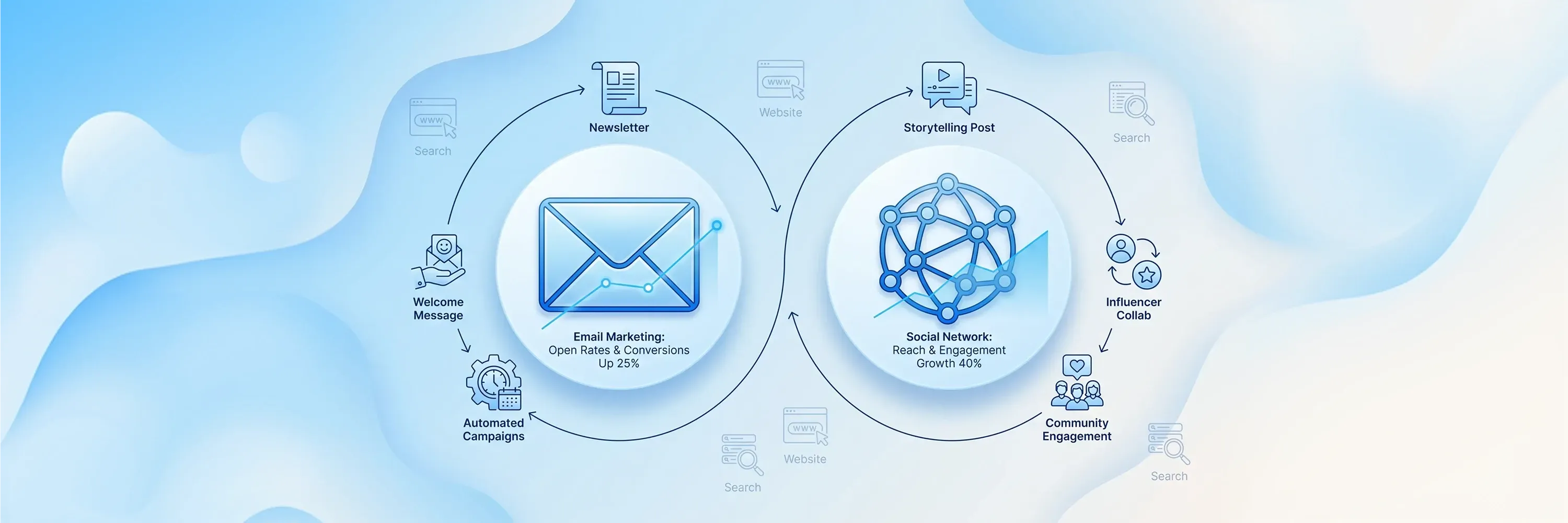
Treat these as one loop. Social media marketing for nonprofits grows awareness and captures email sign-ups at the top. Email takes those new supporters and turns them into donors and repeat givers at the bottom. Neither half does the whole job alone, which is exactly why this pairing for digital marketing nonprofits holds up for a small team.

The flow is easy to picture. You post a short story on Facebook or Instagram about someone your work reached, and the post links to a sign-up page. A supporter who clicks and joins your list gets the welcome email that morning while their interest is fresh. Weeks later, when your year-end appeal goes out, they're already on the list and already warm. The story did the recruiting and the email did the asking.

That hand-off is what makes a two-channel mix both sustainable and measurable. You can see sign-ups grow from social and see revenue grow from email, and you can tell which post or which appeal did the work. The 2025 M+R Benchmarks even quantify the connection: nonprofits hold an average of 527 Instagram followers for every 1,000 email addresses, a reminder that the two audiences overlap and reinforce each other. Run them as one system and each side makes the other worth more.

Measuring what actually matters

You need a handful of numbers tied to the goals that justify the work. Track these, and check them on a regular schedule:

  • Email open rate and click rate, against the 28.59% open and 3.29% click sector benchmarks, so you know whether your subject lines and content land.

  • Email list growth, because a list that isn't growing is a revenue ceiling slowly lowering on you.

  • Donations and volunteer sign-ups you can attribute to each channel, which is the only proof that any of this moved the mission.

Ignore the vanity numbers. Follower count feels like progress and connects to nothing, which is why nonprofit marketers on Reddit advise you to look beyond likes and track which posts actually drive donations and sign-ups. A page with 10,000 quiet followers loses to a list of 400 people who open and give.

The reporting you need is already built into the tools you're using. Your email platform shows opens and clicks on its dashboard, along with list growth. Facebook and Instagram report reach and link clicks for free. To connect a click to a sign-up, digital marketing nonprofits should add a UTM code to the links you share, a step only 22% of nonprofits take, which means doing it puts you ahead of most. Watch a few numbers consistently and you'll know what to keep and what to adjust.

Start small and stay consistent

Pick the two channels and build a routine you can keep; add more only after the basics are running on their own. A welcome email and a monthly newsletter can sit alongside a steady presence on one platform with a handful of appeals through the year. That's a complete program, and it beats an ambitious plan that collapses by month two.

Choose one action this week. Set up your nonprofit email marketing tool and write the welcome, or pick the single social platform where your people already are. Expand the mix later, once the foundation hums. When you're ready for help making digital marketing nonprofits can sustain reach further, Snoika Foundation works with mission-driven teams on visibility and content. Reach out for a consultation.
Need help with your AI visibility?

Book a free consultation with our experts we'll help you determine exactly which services your organization needs.

Clean your nonprofit email list at least twice a year. Remove addresses that bounce, fix obvious typos, and consider a re-engagement email for contacts who haven’t opened messages in 6 to 12 months. A cleaner list protects deliverability and gives you more accurate open and click data.

Add a third channel after your first two channels run on schedule for at least three months. Your email list should be growing, your social posts should send people to that list, and you should have time to review results. If the basics slip, wait before expanding.

Yes, you can reuse the same story if you adapt it for each channel. Social posts need a short version with a clear sign-up link. Email can include more context, a direct ask, and a next step. This keeps digital marketing nonprofits manageable without creating new content from scratch each time.

Ask them directly through a short survey, donation form question, or event sign-up form. You can also check your current referral data to see which platforms already send visitors to your site. Choose the channel with real supporter activity rather than the one that feels popular.

Get help when planning, content creation, or reporting takes time away from fundraising or program work. An outside partner can set up a workable system and train your team to maintain it. Snoika Foundation works with mission-driven organizations on visibility and content, and you can book a consultation if you need structured support.

Book a Demo

Book a time that works best for you

You Might Also Like

Discover more insights and articles

Infographic illustrating the transformation of nonprofits hiring a Google Ad Grants agency, featuring a curved arrow and metrics.

Why Nonprofits Need a Google Ad Grants Agency to Maximize Free Ad Spend

This article explains what it takes to turn a Google Ad Grant into real donations and awareness, and where in-house efforts stall. It walks through setup and compliance, then follows the path from targeting to tracking so you can decide whether charity Google Ads support fits your organization.

Infographic comparing four AI marketing automation tools for nonprofits, featuring a central white board with soft shadows and muted blue icons.

Best AI Marketing Automation Tools for Nonprofits and NGOs

This article compares AI marketing automation tools for lean nonprofit and NGO teams across the jobs that eat your week, especially email and segmentation, while the discussion also covers scheduling and the reporting demands that come with multilingual outreach. It weighs honest strengths and trade-offs, then closes with implementation steps sized for a one- or two-person team.

A spacious SaaS infographic featuring translucent cards, icons, and flow lines on a smooth blue gradient background.

AI Content Generator for Nonprofits: Scale Content Without Losing Authenticity

This article shows nonprofit communications staff how to use an AI content generator to publish more without flattening the mission-rooted voice that earns trust. It covers where the tools save time and how to keep human judgment in the loop across multilingual outreach and AI search.

Title:
How an AI SEO Content Generator Helps NGOs Rank in Google and AI Search Engines

Meta description:
With this AI SEO content generator guide, you will learn to write steady posts that rank your

How an AI SEO Content Generator Helps NGOs Rank in Google and AI Search Engines

This article explains how a small NGO communications team can use an AI SEO content generator to publish steady, well-structured content that performs in both Google and AI search engines. It walks through keyword research and a repeatable publishing workflow, with practical steps you can copy.