Social Media Marketing for Fundraising: Proven Campaign Ideas for Nonprofits

Content authorArtem LozinskyPublished onReading time12 min read
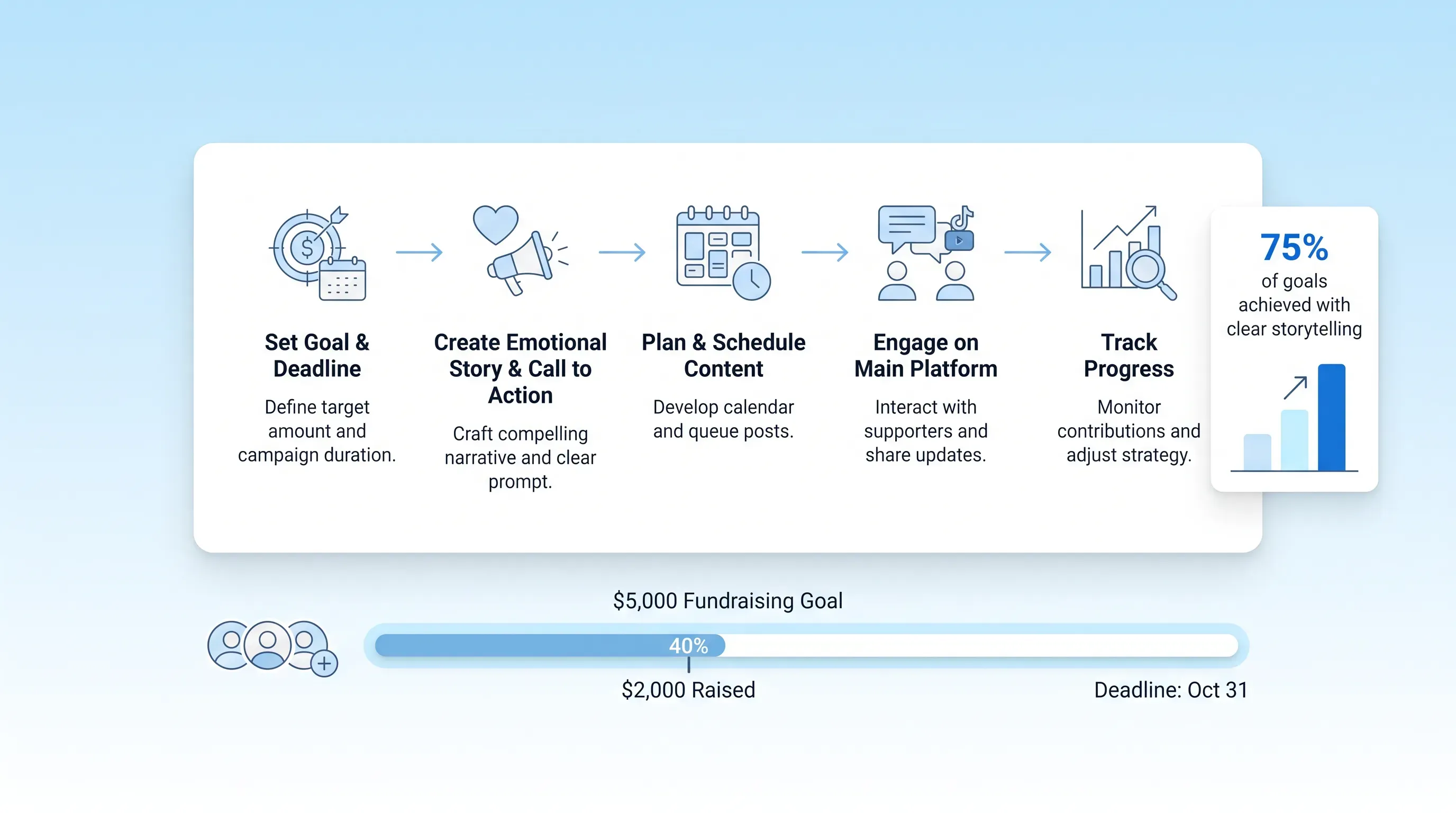
Calm modern infographic guiding users through steps of a social media fundraising campaign, featuring a central flow diagram and supporting elements.

This article shows you how to turn an existing social following into actual donations. It walks through donor psychology and campaign structure, then shows you how to prove which posts raised money.

Why your posts aren't raising money

You post consistently. People like posts and sometimes share them. But when you check the donation dashboard, the numbers barely move, which is the exact frustration that pushes most people toward social media marketing for fundraising in the first place. The gap you're feeling is real, and it has a name. Donor engagement on social media and giving are two different actions that live in two different parts of a person's day. A like costs nothing and takes half a second. A donation asks someone to stop scrolling and use a card to give money. Those aren't the same decision, so a feed full of likes tells you almost nothing about whether anyone will give.

The fix isn't posting more often. Volume without direction burns out a small team and trains your audience to keep scrolling. What moves money is a campaign built around one purpose, with a goal and a deadline that give people a reason to act now instead of later. A repeatable structure for social media marketing for fundraising lets you run a campaign on the single platform where your supporters already spend their time. That's what the rest of this guide gives you. It begins with why people give in the first place.

Why people give online

Most giving decisions happen within seconds on a phone. Your supporter reacts to a feeling and decides in a blink whether to trust it. The question is what makes a stranger's thumb stop moving. The strongest trigger is emotion tied to one person. Researchers call it the identifiable victim effect, and one classic study found that donors gave twice as much to a single named child than to statistics about a famine. When the same appeal added the numbers back in, giving dropped. The data made the problem feel too big to solve. So lead with one face and one name that makes your work personal.

Trust is the next gate, and it decides whether the feeling turns into a gift. A study published in Humanities and Social Sciences Communications found that donors' perception of a nonprofit's financial transparency explained a large share of the variance in perceived performance, and that trust drove the rest. In social media marketing for fundraising, that means showing where the money goes and posting proof of past work before you ask for anything.

Then there's social proof, the quiet pressure of watching other people act first. When van Teunenbroek and Bekkers showed donors an above-average giving figure on a crowdfunding platform, those donors gave 17% more than the group shown the real average. Seeing others give makes giving feel like the normal thing to do. That's why donor engagement on social media rises when you post running totals and name the people who've already chipped in.

What motivates people to donate and share?

The last motivator is the one everyone underestimates: how easy you make it. M+R's 2026 benchmark data shows mobile donation pages convert around 8% versus 11% on desktop, and small nonprofits see mobile rates as low as 4%. That gap is friction in the donation process. Each of these motivators changes what belongs in a social media marketing for fundraising post.

Here's how they translate:

  • Emotion means one story about one person.

  • Trust means visible proof of impact before the ask.

  • Social proof means showing how many have already given and thanking them by name.

Reframe the share request too. Nobody wants to feel like they're bragging about their own generosity. When you tell a supporter that sharing helps the cause reach more people, you hand them a reason that feels like service rather than self-promotion.

Build a fundraising campaign that converts

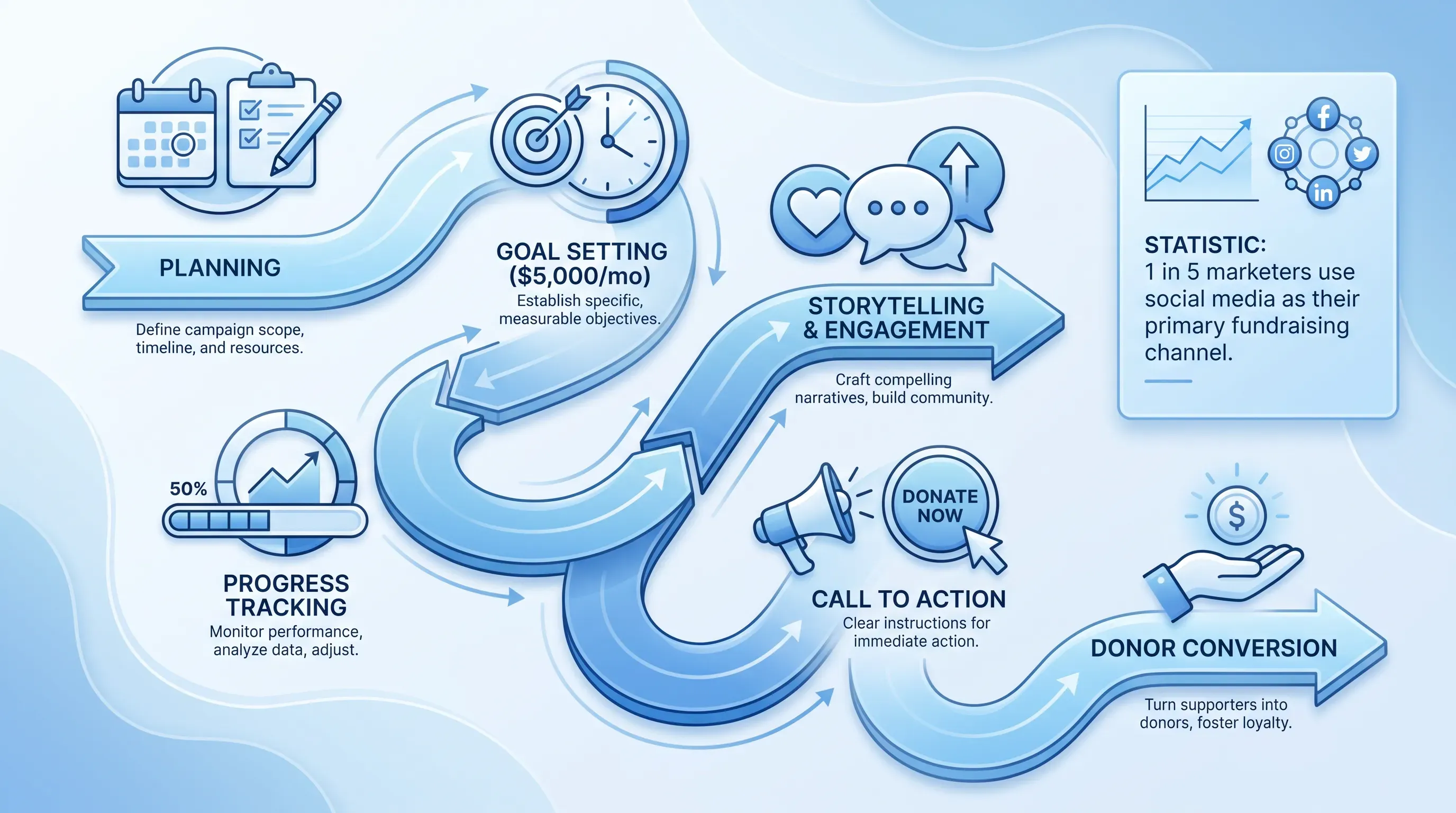
Infographic illustrating stages of a social media fundraising campaign with a blue gradient, icons, and a side-info panel.

Scattered posts don't add up to a campaign. A campaign has a shape. Its story pulls people toward a destination, and its content sustains momentum from start to finish. Get those three pieces in place before you publish a single social media marketing for fundraising post, and the posting itself becomes almost easy.

Think of what follows as the planning you do at your kitchen table. Each piece below is one building block. Tackle them in order, and by the end you'll have a campaign you can run in a week.

Need help with your AI visibility?

Book a free consultation with our experts we'll help you determine exactly which services your organization needs.

Set a goal and deadline

Pick a dollar figure you can believe in and a date it has to happen by. A goal without a deadline is a wish. The countdown is what creates urgency, and urgency is what turns "I'll give later" into "I'll give now." For a small nonprofit, something like "$5,000 by the end of the month to keep the after-school program running through spring" works because it sets a specific real outcome and a clock.

Make that goal impossible to miss inside your content. Post a running total. Show a progress bar. Say out loud how far you've come and how far is left. When van Teunenbroek's research on goal proximity is applied here, the closer you are to the finish line, the harder people push to get you across it. A visible thermometer is the mechanism.

Keep the math honest. If your following is small, a $50,000 goal that stalls at $3,000 reads as failure and kills momentum. Set a number you have a real shot at hitting. Then let a successful social media marketing for fundraising campaign fuel the next one.

Write the emotional hook

Every social media marketing for fundraising campaign needs one reason to care: a person's story. Go back to the identifiable victim effect from earlier. One story anchors the whole campaign, and every post ties back to it. Who is this person, and what changed in their life because of your work? Explain what happens next if the money comes in.

Pair that story with a call to action nobody can misread and a link that takes as few taps as possible. Remember the mobile conversion gap. Every extra field or redirect leaks donors.

Here's a launch-post template you can fill in:

  1. Open with one sentence that uses the person's name.

  2. Say what they're facing right now in plain words.

  3. State the goal and the deadline.

  4. Give the one action you want and the direct link.

Read it back on your phone before you post. If donating takes more than a couple of taps after they click, fix the link before you fix the caption.

Plan your content calendar

A one-person team can't post fresh social media marketing for fundraising content every day for a month without collapsing. You don't have to. Map a lightweight schedule across the campaign window and batch it in a single sitting. Free tools make this manageable. Meta Business Suite schedules Facebook and Instagram posts at no cost, and Buffer's free tier covers basic scheduling if you want one dashboard.

A campaign needs a few predictable beats. Cover these and you can leave the gaps quiet:

  • Launch: the story and the ask go live.

  • Midpoint push: a fresh angle on the same story to re-engage people who missed the launch.

  • Social proof update: the running total plus thanks to recent donors.

  • Final-hours reminder: the countdown, loud and clear.

Resist the urge to be everywhere. HubSpot's 2025 reporting notes that 1 in 5 marketers plan to shift budget away from Facebook toward video-first platforms, but the right answer for you is wherever your supporters already are. Pour your effort into that one platform and let the others sit. Good social media marketing for fundraising builds depth on one channel.

Peer-to-peer and fundraising social campaigns

If you do one thing beyond running your own social media marketing for fundraising campaign, do this. Peer-to-peer fundraising is the highest-leverage move a small team has, because it borrows trust you can't manufacture. When a supporter asks their own friends, the numbers jump. The Giving Block reports peer-to-peer efforts hit 71% success versus 22% for traditional appeals, with larger average gifts. A field experiment on peer-to-peer solicitation found a friend's ask raised average gift size by 52%.

The most copied format is charity: water's birthday model, where supporters give up their birthday and ask friends to donate instead of buying gifts. The organization reports the average birthday campaign raises over $770, and across roughly 17,000 campaigns that model has brought in nearly $9 million. The structure is simple enough that a one-year-old and a 79-year-old have both run one.

Facebook Challenges are the other format worth stealing. The Trevor Project, the leading suicide prevention organization for LGBTQ young people, ran a 50-mile walk/run Challenge that beat its goal in three days, then followed with a second Challenge that raised over $1.5 million and reached more than 32,000 group participants. Challenges are fundraising social campaigns that cost far less than in-person events, which is why they fit a tight budget.

Need help with your AI visibility?

Book a free consultation with our experts we'll help you determine exactly which services your organization needs.

How do you turn supporters into fundraising ambassadors?

What makes or breaks these fundraising social campaigns is how well you equip your ambassadors. Don't hand supporters a blank page and hope.

Give them a toolkit so they know exactly what to say:

  • Ready-to-share posts they can copy and personalize.

  • Images and a short video sized for the platform.

  • A one-line explanation of where the money goes.

The Trevor Project's public Pride fundraising toolkit does exactly this, down to fill-in-the-blank message templates. The point of fundraising social campaigns like these is reach. Your own followers are a fixed pool, but every ambassador opens a door into a personal network you'd never touch on your own. That's how a following of a few hundred turns into thousands of potential donors, and it's why these fundraising social campaigns outperform anything you post from the org account alone.

Drive donor engagement on social media with live and urgent content

Nothing beats real time for prompting action. Live video collapses the gap between "I should give" and "I gave." Matching windows and countdowns do the same because the moment is happening now and won't come back. This is where donor engagement on social media stops being passive scrolling and turns into something a viewer feels part of.

Livestreamed events prove the point on almost any budget. The Boys & Girls Club of DC ran a three-day livestreamed virtual gala with an auction and raised over $150,000 with 500-plus online attendees. On the smaller end, a Taylor Swift livestreamer named Tess Bohne rallied fans and raised over $35,000 for a domestic violence nonprofit against a $13,000 goal. A phone with a live donation link and a story are enough.

A few formats you can run without spending much:

  • A behind-the-scenes update filmed on your phone during the workday.

  • A matching-gift window where a board member covers every dollar for 24 hours.

  • A final-hours countdown posted every hour as the deadline closes.

Matching windows and countdowns work because they add a second deadline inside the campaign. The Nashville Predators used live donation tracking and an on-screen progress bar during a Hockey Fights Cancer game and raised over $36,000. The progress bar gamified the giving with visible momentum. When people watch a number climb in real time, they want to be the tap that moves it.

Tie all of this back to the psychology from earlier. Public thanks and visible progress are social proof in motion, and they deepen donor engagement on social media in a way a static post can't. GivePanel data shows Facebook fundraisers who are thanked during their campaign raise 35% more than those who aren't. So name your donors out loud, on camera, while the campaign is live. Recognition turns a first gift into repeat donor engagement on social media and brings people back for your next campaign.

Track what actually raised money

Likes feel good and prove nothing. If you want to repeat what works, measure the dollars that specific posts brought in. The good news is that two or three simple habits will do it.

Start with trackable links. A UTM tag, short for Urchin Tracking Module, is a bit of text added to the end of a donation URL that tells Google Analytics where a visitor came from. Use a distinct tag for each post and ambassador link. Without tags, that traffic gets dumped into "Direct" and you lose the trail. Google's free Campaign URL Builder makes the tags for you, so you can copy and paste the tags.

Then watch the metrics that map to money:

  • Conversion rate: what share of people who clicked actually gave.

  • Gifts per post: which specific posts drove donations.

  • Average gift size: whether your ask amounts land where you want them.

Compare results across campaigns instead of obsessing over a single post. If your midpoint push converted at 6% last time and 2% this time, the story changed or the link got harder to use. Read the number against the goal you set at the start. Did you hit $5,000? If not, where did people drop off, and which beat underperformed? That's the feedback that shapes your next calendar, so you spend your limited hours on the posts that pay and quietly retire the ones that don't.

Your next campaign starts now

A smart structure beats a big budget every time. You've seen it in the numbers: one story outpulls a wall of statistics, and a friend's ask raises 52% more than yours. A thanked fundraiser raises 35% more than a silent one. All of that in social media marketing for fundraising starts with a plan.

So this week, choose a platform where your people already are, then set a believable goal with a deadline. Center the campaign on one person's story. Launch a small test campaign and track it with a tagged link. You'll learn more from that one run than from another month of daily posting.

At Snoika Foundation, we help stretched-thin teams turn a following into funding with social media marketing for fundraising that fits a real budget. Reach out and we'll help you plan your next campaign.
Need help with your AI visibility?

Book a free consultation with our experts we'll help you determine exactly which services your organization needs.

Get written, informed permission before publishing a beneficiary’s name, image, health details, or quote. Explain where the story will appear, how long it may remain online, and that consent can be withdrawn where practical. For children, obtain permission from a parent or legal guardian.

Send a receipt from the organization or donation platform as soon as a gift is processed. The receipt should state the amount, date, legal organization name, and tax information required in your country. Don't promise tax deductibility unless the organization is eligible to offer it.

Yes, social media marketing for fundraising can include paid ads when you set a fixed test budget and use a separate tagged donation link. Target people who already know your organization, such as email subscribers or past website visitors, before paying to reach cold audiences. Compare donated revenue with ad cost.

Use the same verified account and donation domain in every campaign post. Pin a message that lists the official giving link, then report impersonation accounts to the platform. Tell supporters that staff won't request card numbers or passwords through direct messages.

Follow up within 48 hours with a receipt and a short update on the purpose their gift supports. Your organization can later share a campaign result after the deadline, with the total raised and a clear account of next steps. Ask donors for future contact consent separately.

Book a Demo

Book a time that works best for you

You Might Also Like

Discover more insights and articles

An airy infographic featuring a central 'Trust' card surrounded by translucent strategy steps, metrics, and icons on a blue gradient background.

Nonprofit Brand Strategy: A Step-by-Step Framework for Building Trust

This article lays out a reusable framework for defining what your organization stands for and proving your claims with evidence. It covers research through measurement.

Calm infographic showcasing 'Tailored AI Training for Nonprofit Staff' with role-specific cards and best practices in a clean layout.

AI Training for Nonprofits: A Practical Curriculum for Teams

This article lays out a curriculum for turning scattered AI experiments across your staff into shared, documented practice. It covers how to assess skills and risks and design role-specific learning.

Infographic illustrating the nonprofit donor journey with rounded cards for each stage, set against a light blue to white gradient background.

Donor Journey Mapping for Nonprofits: From First Contact to Long-Term Support

This article gives you a practical framework for donor journey mapping, from the moment someone discovers your cause through recurring support and advocacy. You will learn how to pick a priority persona and map each stage of the nonprofit donor journey. The finished map then becomes a guide for coordinated fixes across your website and email, with search and campaigns folded into the same effort.

A light blue infographic featuring a central translucent card labeled 'AI Policy for Nonprofits' with branching flowcharts and stakeholder silhouettes.

AI Policy for Nonprofits: A Practical Governance Template

This article walks you through building an AI policy for nonprofits based on what your staff already do. You'll get plain-language principles and use boundaries, with safeguards built into a copy-ready template and an implementation checklist you can adapt this week.