Social Media Strategy for Nonprofits: How to Build an Engaged Community Online

Content authorArtem LozinskyPublished onReading time14 min read
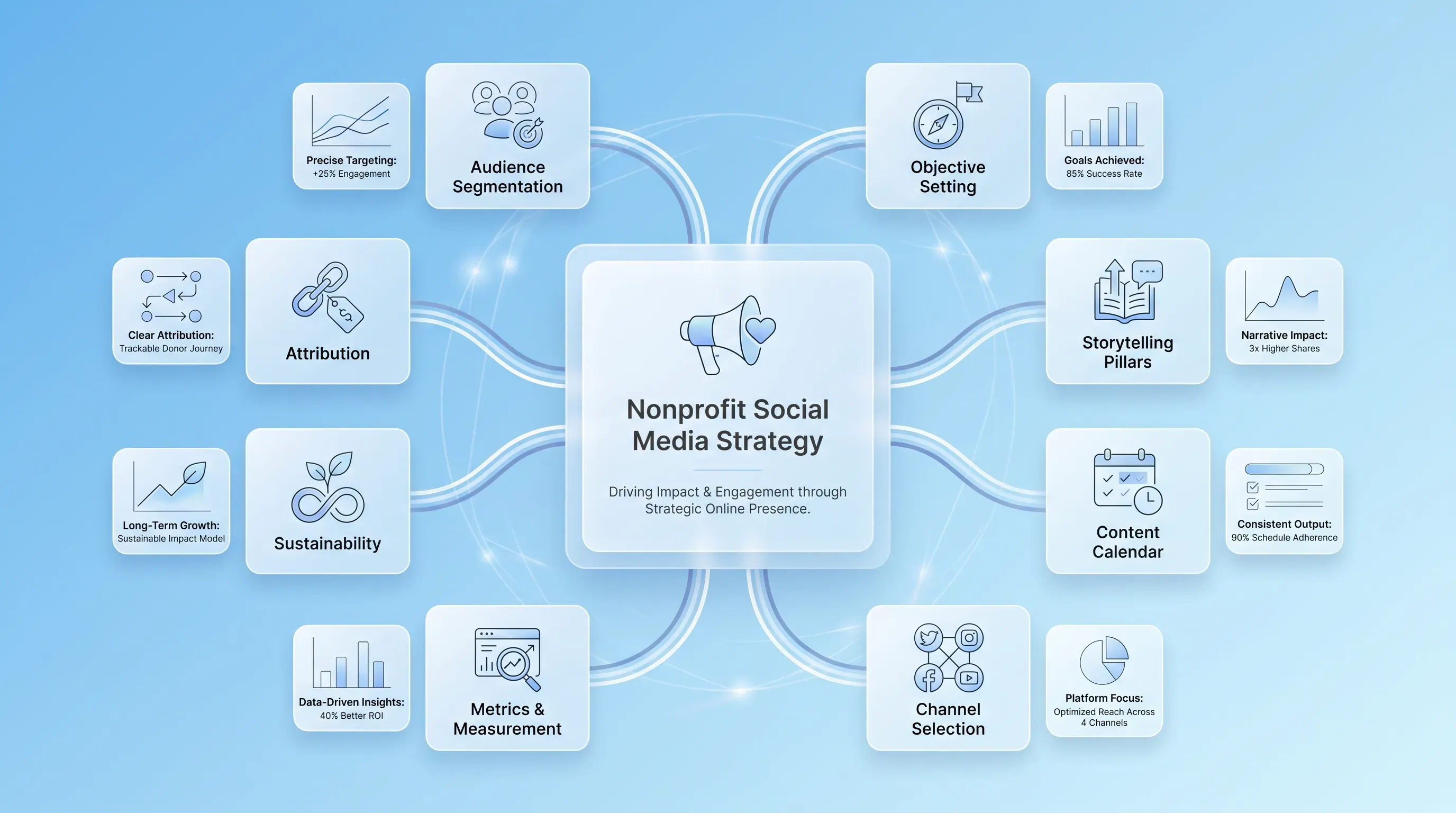
An abstract infographic illustrating a nonprofit social media strategy with layered translucent cards and soft blue gradient background.

This article gives you a connected framework for turning a busy-but-scattered presence into a social media strategy for nonprofits you can defend to a board and run without burning out. You will begin by defining audience segments and objectives. Storytelling pillars guide a realistic calendar, while channel choices and the handful of metrics signal whether a community is actually growing.

Why most nonprofit posting falls flat

A solid social media strategy for nonprofits starts with an honest admission: you are posting three or four times a week, the account looks alive, and yet you can't point to a single action it produced. You own social alongside a newsletter and a grant report, while whatever caught fire this morning also demands attention. The effort is real. The proof is missing.

That gap is the problem this piece solves. Activity without a nonprofit social planning framework produces noise, and noise is what happens when every post answers the question "what should we put up today" instead of "what is this post supposed to move." Commercial brands can spend their way past a weak plan. You can't, which is why a social media strategy for nonprofits matters more for you than for any company with a media budget.

Here is the reassuring part. Nonprofits already start ahead. Rival IQ's benchmark report found that photos earned the top engagement rates for nonprofits, a category that consistently outperforms retail and tech on connection. The raw material of a cause moves people. What is absent is a social media strategy for nonprofits that points all that goodwill in one direction. So treat the rest of this as one connected build. Each section feeds the next. And the goal throughout is a social media strategy for nonprofits that builds a community of people who comment back and show up on a giving day.

Start with who you serve

Everything downstream in nonprofit social planning depends on knowing exactly who is on the other side of the screen. "Our supporters" is a comforting blur that lets you write posts nobody in particular needs to read. The fix is segmentation, and a nonprofit has clearer natural segments than most businesses ever will.

Start by naming the distinct groups you actually have:

  • Recurring donors who already believe and want to see their money working

  • One-time or first-time givers who need a reason to come back

  • Volunteers and program beneficiaries, plus advocates who share and sign but rarely give

  • Corporate partners who care about visibility and co-branded credibility

Each of these wants something different. A monthly donor wants proof of impact. A first-time giver, according to Blackbaud Institute data, lands in a predictable range, with 53% of first-time GivingTuesday donors giving between $1 and $50, so your job with them is a small, easy, confidence-building ask. Corporate partners want to be seen alongside a cause that reflects well on them. Write one post for all four and you write for none.

Know who you're talking to

You don't need a research firm to build these segments. The data is sitting in your own systems. Pull your donor database and sort by frequency and gift size. Read the last two months of comments and note who keeps showing up. Add one question to your donation and sign-up forms: "Where did you hear about us?" Within a quarter you'll have real answers instead of guesses.

This is where nonprofit social planning quietly gets easier, because segments map to places. Corporate decision-makers spend professional time on LinkedIn, where 42% of US donors research nonprofits before supporting them. Younger advocates cluster on Instagram and TikTok. Once you know who a segment is, a social media strategy for nonprofits makes the question of where to reach them nearly answer itself, and the channel decisions later in this framework stop being a coin flip.

Set objectives leadership cares about

"More engagement" is a wish, and a board needs a fundable objective. The move that separates real nonprofit social planning from busywork is translating that wish into concrete campaign objectives that ladder up to what your executive director already answers for.

Most nonprofits balance four objective types, and each one demands different content and a different definition of success:

  1. Awareness, measured by reach and new followers from the right segments

  2. Fundraising, measured by donations and average gift size traced back to social

  3. Advocacy action, measured by petition signatures, calls, and shares that spread the message

  4. Volunteer and community building, measured by sign-ups and repeat participation

You have to defend the time your social media strategy for nonprofits requires against grant writing and direct mail, so objectives should point at organizational goals rather than platform trends. If leadership's priority this year is recurring revenue, an awareness campaign optimized for reach won't satisfy anyone, no matter how the numbers climb. The objective has to answer a question the board is already asking.

The discipline that keeps this from unraveling is simple. Assign one primary objective to each campaign. A year-end push is a fundraising campaign, so every post in it earns its place by serving that goal, even the ones that don't ask for money directly. When you try to make a single campaign in your social media strategy for nonprofits do everything at once, it does nothing well, and you lose the clarity that made the plan defensible in the first place.

Need help with your AI visibility?

Book a free consultation with our experts we'll help you determine exactly which services your organization needs.

Build your storytelling pillars

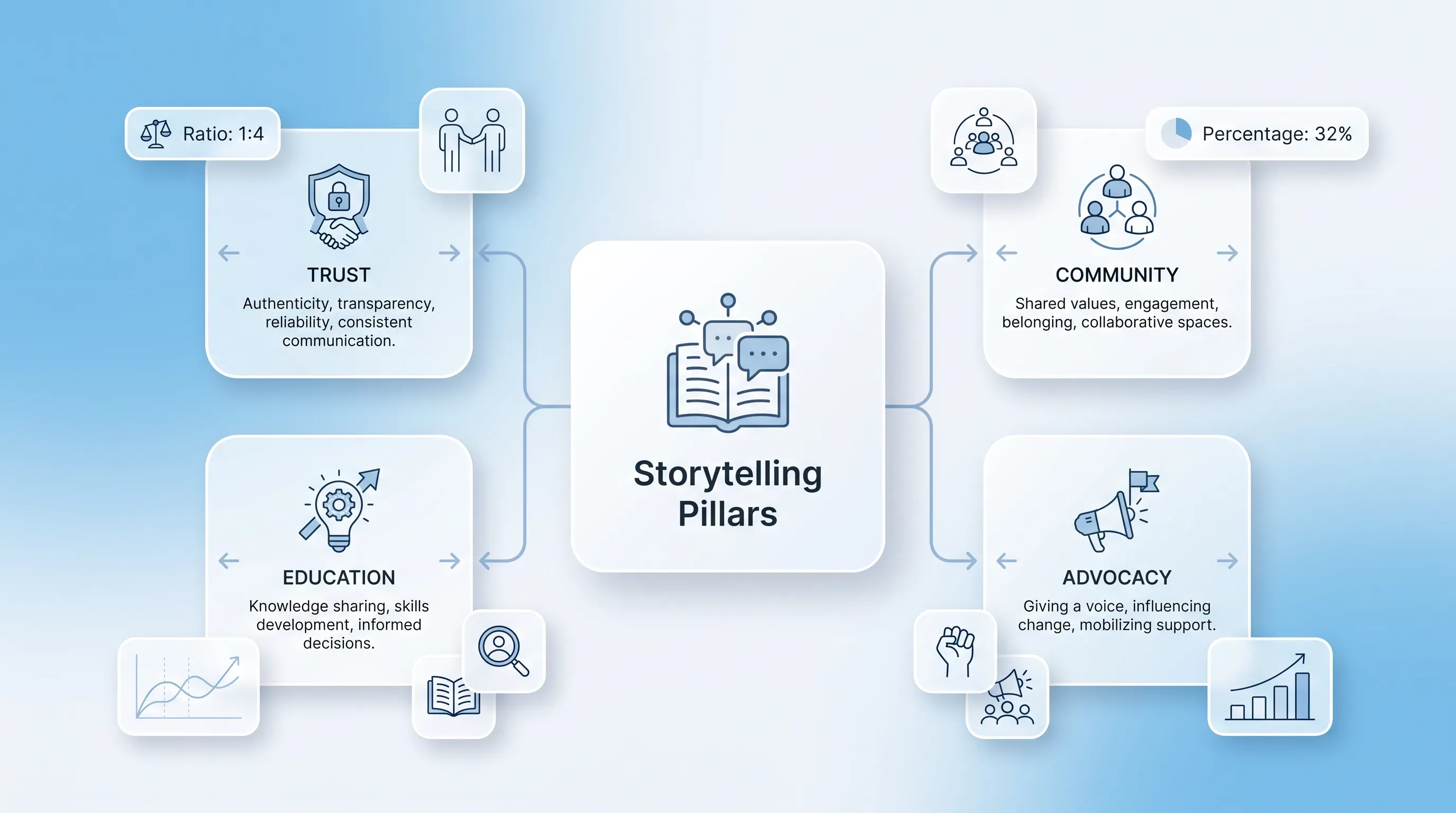
Calm infographic featuring a central card labeled 'Storytelling Pillars' with surrounding cards for Trust, Community, Education, and Advocacy.

Pillars are the bridge between the mission driven social strategy you've just set and the calendar you're about to build. A pillar is a recurring theme you return to, a small set of them that keeps content on-message and kills the weekly scramble of inventing something from scratch. They connect the emotional pull of the work to the concrete objectives from the last section, so a post is never just content. It's a theme serving a goal.

Three to five pillars is plenty for a stretched team. More than that and you're back to guessing. The four below cover what most organizations need, and each one is a self-contained theme you can plan and batch on its own.

Impact and proof stories

This pillar shows the mission working through a beneficiary's story or a program outcome. It can also offer an honest accounting of where the money went. It's the trust engine, and trust is what later converts to donations. The psychology here is well documented. In field research by Deborah Small and George Loewenstein, donations rose sharply when an appeal centered on an identifiable individual rather than statistics about a group, because people connect to a face.

Gather these stories ethically. Get real consent and never trade someone's dignity for a stronger appeal. Let people tell their own story in their words when they can. To keep this from becoming a second job, build a light pipeline with program staff. Ask them to drop a photo and two sentences into a shared folder whenever something good happens. You edit the material, and the pillar fills itself.

Behind the scenes and people

This pillar humanizes the organization through the staff and volunteers. It also shows the unglamorous Tuesday reality of the work. Authenticity beats polish here, which is a gift for a small team, because the content is cheap and fast to make. A phone video of a volunteer setting up chairs before an event does more than a produced spot.

What this pillar does is turn an audience into insiders. When supporters see the people behind the mission, they feel like part of the operation. That sense of belonging is what keeps a community warm between campaigns, and it costs you almost nothing but attention.

Education and awareness

This pillar teaches your audience about the cause and the problem it addresses. It shows why the issue matters, which positions your organization as a voice worth trusting on the issue. It's the natural home for advocacy objectives, and it pulls in new supporters who are searching to understand a problem before they decide to act on it. That discovery role is significant given that 32% of donors say social media is the channel that most inspires their giving.

Pitch the depth carefully. Inform without lecturing. A carousel that explains one cause of the problem you fight, in plain language, respects your segments and earns the credibility that advocacy asks depend on. Talk down to people and they leave.

Calls to give and act

This is the pillar that asks directly. Its asks range from donations to volunteer help, with sign-ups and petition signatures in between. It has to be the minority of what you post, because a feed that only asks trains people to scroll past. The trust built by the other three pillars is exactly what makes these asks land when you make them.

A workable ratio for a small team is roughly one direct ask for every four value posts. That 80/20 balance keeps the account generous most of the time and pointed when it counts. And when you do ask, be specific about the action and easy to follow, because the harder you make it, the fewer people finish.

Need help with your AI visibility?

Book a free consultation with our experts we'll help you determine exactly which services your organization needs.

Turn pillars into a content calendar

Here is where your social media strategy for nonprofits becomes something you can run on a Monday. A calendar gives your segments and objectives a repeatable rhythm through the pillars that a stretched team can actually maintain. This is the practical heart of nonprofit social planning, and the guiding principle is sustainability over volume.

Start with a cadence you can keep. Givebutter and other practitioner guides converge on 2 to 5 posts a week as the realistic sweet spot for most nonprofit teams. A steady three posts a week beats a heroic burst followed by two silent months, because consistency is what the algorithms and your community both reward. Pick the number your bandwidth can survive in a bad week. Batch the work. Set aside a few focused hours to write a week or two of posts at once. Rotate through your pillars so the mix stays balanced without daily decisions.

Then plan around the fixed moments you already know are coming:

Block those out first, then let your regular nonprofit social planning pillar rotation fill the space between them.

The last habit that saves a small team is reuse. One strong impact story can become an Instagram Reel or a LinkedIn write-up for corporate partners. It can also supply a Facebook update and a line in the year-end appeal. A mission driven social strategy treats every good piece of content as raw material to adapt across formats, so you produce once and publish many times. That's how a team of one keeps a calendar full without inventing something new every day.

A mission driven social strategy across channels

The mistake that burns out small teams is treating each platform as a separate job with its own content. It isn't. A mission driven social strategy runs one coherent story and adapts it to each channel.

Match channels back to the segments and objectives you already defined. Here's what each major platform does well in a nonprofit context:

  • Facebook: community and fundraising, still the strongest for donor inspiration, with 56% of social-inspired donors most impacted by Facebook posts. Facebook Groups build belonging between campaigns.

  • Instagram: visual impact stories and behind-the-scenes reach for younger supporters, where 62% of users are aged 18 to 34.

  • LinkedIn: corporate partners and credibility, where 26% of US donors discover donation opportunities.

  • TikTok: authentic, unpolished awareness content for the youngest segment.

The same story flexes to fit. An impact story becomes an emotional Reel on Instagram. On LinkedIn, it becomes a data-backed outcome post for the partner who funded it. On Facebook, it becomes a warm community update. One story takes different shapes while carrying one message. That adaptation is what a mission driven social strategy means in practice, and it's the opposite of maintaining separate personalities on separate apps.

So choose a focused mix. Two or three channels you can run well beats five you run badly, and being everywhere is a fantasy for a team your size. Pick the platforms where your priority segments actually spend time, and commit to them. A mission driven social strategy is defined as much by what you decline to do as by what you post.

Measure engagement that signals community

Measurement is where good intentions turn into a reporting burden, so keep the metric set small and meaningful. The goal is to distinguish numbers that flatter you from numbers that signal a community is actually forming.

Follower count is the classic vanity metric. It looks good on a board slide and tells you almost nothing, because a large following that never interacts is invisible to the platform anyway, with organic reach dropping to as little as 2 to 6% when content doesn't spark interaction.

The signals that matter are the ones platforms now call meaningful interactions:

  • Saves and shares, which show someone valued a post enough to keep or spread it

  • Comments and replies, which show a real exchange

  • Conversions like donations, volunteer sign-ups, and petition signatures

Tie each metric back to the objective it serves. A fundraising campaign is judged on donations. An advocacy campaign is judged on shares and signatures. An awareness push is judged on reach among the right segment.

Track what gives results

To prove social's contribution, you need to know where a donation or sign-up originated, and the practical tool is UTM parameters. As the team at Raisely explains, adding a UTM code to a link lets you automatically capture attribution on donations and sign-ups. Build one tagged link per campaign, put it in your bios and posts, and your donation platform or Google Analytics will tell you what social actually drove. That single habit turns "social is working, trust me" into a number you can defend.

Review on a monthly or quarterly rhythm. Sit down once a period to ask what moved and why. Feed the answer into your next calendar. Measurement in a social media strategy for nonprofits is only worth the effort if it changes what you do next, so keep it light enough that it informs the plan instead of becoming another job you dread.

Put your one page strategy to work

You now have your social media strategy for nonprofits system on one page. Your segments tell you who you're talking to. Your objectives tell you what each campaign must move. Pillars keep content on-message, and the calendar makes it sustainable. Your channel mix keeps one story coherent. A handful of metrics prove it's building community. Written down, that page is the plan you defend to a board and run without burning out.

Don't wait for it to be perfect. A modest social media strategy for nonprofits that you start Monday beats a flawless one you never launch. So here's the first step: this week, write your four segments and one primary objective for your next campaign on a single page, then map three posts to your pillars.

Snoika Foundation helps nonprofits build practical digital marketing strategies that strengthen engagement, support fundraising, and grow lasting communities. Book a call with our team to discuss your goals and create a social media strategy tailored to your organization.
Need help with your AI visibility?

Book a free consultation with our experts we'll help you determine exactly which services your organization needs.

Track repeat participation, not follower totals, to judge whether a social media strategy for nonprofits is building community. Compare the number of people who comment or share in consecutive months, then review whether those people later sign up, donate, or attend an event. A rising repeat-participation rate shows that supporters return instead of only noticing a single post.

Respond with a calm, documented process when criticism is legitimate. Acknowledge the concern, state what information you can share, and move account-specific details to a private channel. Remove comments only when they violate a published rule, such as threats or harassment. Keep screenshots and a response log for issues that need staff review.

Get written, informed permission before publishing a person's name, image, or story. Explain the post's purpose, platforms, and how long material may remain online. For children or people with limited ability to consent, obtain permission from the appropriate guardian and avoid details that expose private circumstances.

Use paid social when a defined campaign needs reach beyond your current followers and you can track the resulting action. Start with a small test budget, one audience, and one tagged donation or sign-up link. Continue only if the cost per donation or registration fits the campaign's financial goal.

There is no single best platform for every nonprofit. Choose channels based on where your priority audiences spend their time. Facebook often performs well for fundraising and community building, LinkedIn helps reach corporate partners and sponsors, while Instagram and TikTok are effective for visual storytelling and engaging younger supporters.

Book a Demo

Book a time that works best for you

You Might Also Like

Discover more insights and articles

An airy infographic featuring a central 'Trust' card surrounded by translucent strategy steps, metrics, and icons on a blue gradient background.

Nonprofit Brand Strategy: A Step-by-Step Framework for Building Trust

This article lays out a reusable framework for defining what your organization stands for and proving your claims with evidence. It covers research through measurement.

Calm infographic showcasing 'Tailored AI Training for Nonprofit Staff' with role-specific cards and best practices in a clean layout.

AI Training for Nonprofits: A Practical Curriculum for Teams

This article lays out a curriculum for turning scattered AI experiments across your staff into shared, documented practice. It covers how to assess skills and risks and design role-specific learning.

Infographic illustrating the nonprofit donor journey with rounded cards for each stage, set against a light blue to white gradient background.

Donor Journey Mapping for Nonprofits: From First Contact to Long-Term Support

This article gives you a practical framework for donor journey mapping, from the moment someone discovers your cause through recurring support and advocacy. You will learn how to pick a priority persona and map each stage of the nonprofit donor journey. The finished map then becomes a guide for coordinated fixes across your website and email, with search and campaigns folded into the same effort.

A light blue infographic featuring a central translucent card labeled 'AI Policy for Nonprofits' with branching flowcharts and stakeholder silhouettes.

AI Policy for Nonprofits: A Practical Governance Template

This article walks you through building an AI policy for nonprofits based on what your staff already do. You'll get plain-language principles and use boundaries, with safeguards built into a copy-ready template and an implementation checklist you can adapt this week.